Exact2Pass

Last Update 13 hours ago Total Questions : 379
The Designing Cisco Enterprise Networks content is now fully updated, with all current exam questions added 13 hours ago. Deciding to include 300-420 practice exam questions in your study plan goes far beyond basic test preparation.
You'll find that our 300-420 exam questions frequently feature detailed scenarios and practical problem-solving exercises that directly mirror industry challenges. Engaging with these 300-420 sample sets allows you to effectively manage your time and pace yourself, giving you the ability to finish any Designing Cisco Enterprise Networks practice test comfortably within the allotted time.
An engineer is designing a PIM Anycast RP solution between two data centers. The design must ensure that RP1 in DC1 and RP2 in DC2 inform each other about specific sources that have joined locally. Which solution must the engineer choose?
A customer requires QoS to support multimedia conferencing over MPLS. The network architect chooses to use per-hop behavior. Which solution must the architect use to classify and mark traffic traveling between branch sites?
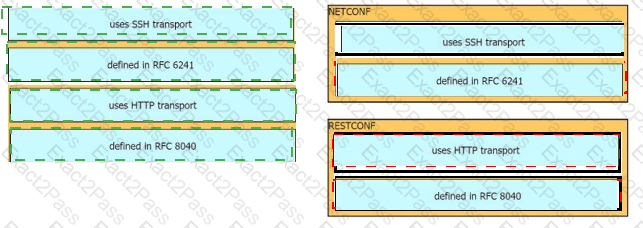
Drag and drop the characteristics from the left onto the configuration protocols they describe on the right.
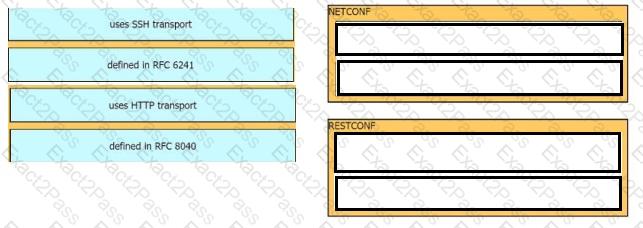
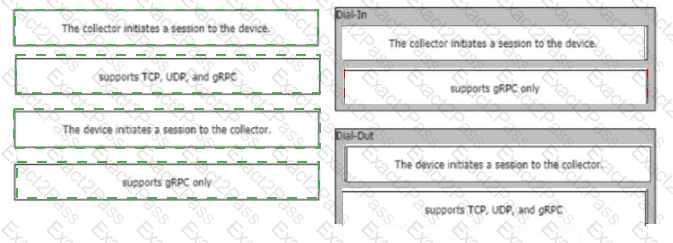
Drag and drop the characteristics from the left onto the telemetry mode they apply to on the right.

When differentiating between IETF. OpenConfig. and Cisco native YANG models, how does the use of containers differ?
In Cisco SD-Access. virtual networks create segmentation that allows for separation of users and resources. How is this type of segmentation described?
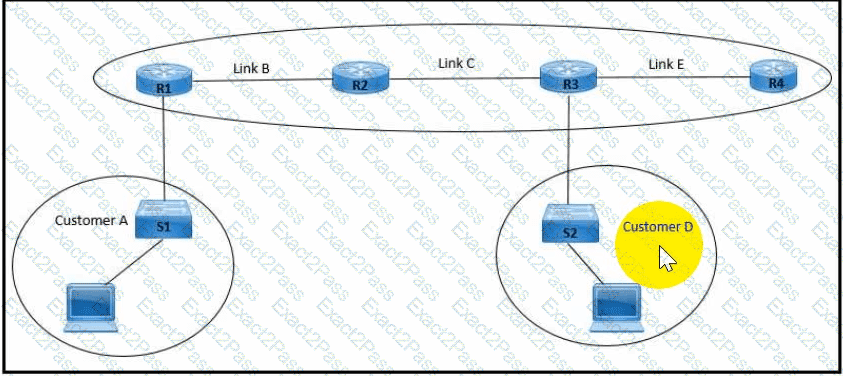
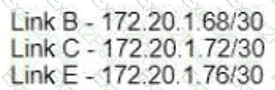
Refer to the exhibit An architect is designing an IPv4 plan using the 172 20 0.0/16 network The design must maximize the number of subnets and minimize the number of wasted IP addresses In addition, the plan must allocate a subnet to these customers and links
Customer A, which supports 125 hosts
Customer D, which supports 62 hosts
Links B C. and E
Which two configuration sets meet these requirements ' ? (Choose two)
A)

B)

C)

D)
E)

Which two functions are provided by the Cisco SD-WAN orchestration plane? (Choose two.)
An engineer is upgrading a company’s main site to include a connection to a second ISP. The company will receive full Internet routing tables from both ISPs via BGP. The engineer must ensure that the company does not become a transit autonomous system. Which solution should be included in this design?
Refer to the exhibit. ISP_C is enabling IPTV services to ISP_A and ISP_B. IPTV services are launched with GLOP IP address range 233.3.1.0/24. PIM-SM already has been enabled globally in each ISP network. RP functions have been configured on edge routers in each autonomous system. ISP_C must implement a connection based on RFC 3618. Which solution achieves this goal?