Exact2Pass

Last Update 13 hours ago Total Questions : 379
The Designing Cisco Enterprise Networks content is now fully updated, with all current exam questions added 13 hours ago. Deciding to include 300-420 practice exam questions in your study plan goes far beyond basic test preparation.
You'll find that our 300-420 exam questions frequently feature detailed scenarios and practical problem-solving exercises that directly mirror industry challenges. Engaging with these 300-420 sample sets allows you to effectively manage your time and pace yourself, giving you the ability to finish any Designing Cisco Enterprise Networks practice test comfortably within the allotted time.
Which consideration must be made when designing a Cisco SD-Access fabric underlay?
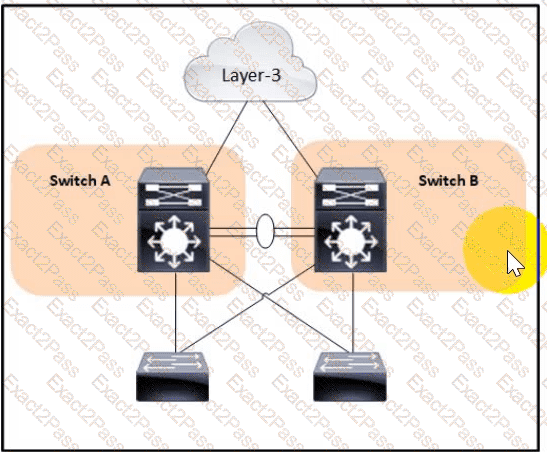
Refer to the exhibit A customer requires a Layer 2 network designed to support:
500 active logical ports
trunking of 30 VLANs
convergence of less than 1 second
Which Spanning Tree Protocol must be selected?
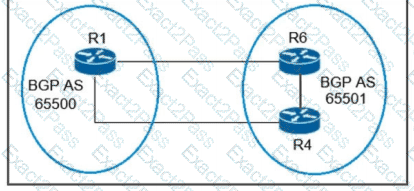
Refer to the exhibit. An architect must design a solution to connect the two ASs. To optimize bandwidth, the design will implement load sharing between router R6 and router R4. Which solution should the design include?
Which consideration must be taken into account when using the DHCP relay feature in a Cisco SD-Access Architecture?
An engineer must design a multicast network for a financial application. Most of the multicast sources also receive multicast traffic (many-to-many deployment model). To better scale routing tables, the design must not use source trees. Which multicast protocol satisfies these requirements?
An engineer is designing a BGP solution supporting a VXLAN environment over a Layer 3 IPv4 network fabric with these requirements
provide Layer 2 adjacency
allow VM migration of workloads between sites
IGP is OSPF
Which BGP address family must the engineer choose?
Which QoS feature responds to network congestion by dropping lower priority packets?
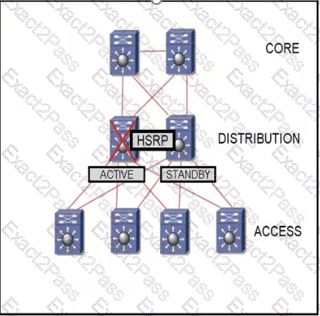
Refer to the exhibit. The distribution switches serve as the layer 3 boundary. HSRP preemption is enabled. When the primary switch comes back after a failure, traffic is initially dropped. Which solution must be implemented to improve the design?
Refer to the exhibit. An architect is designing a Layer 3 routed network using point-to-point fiber links between the topology layers. BFD is supported on the software that runs within the infrastructure. Is BFD required within the design to provide sub-second convergence in the event of a fiber breakage?
A company requested that an architect propose a new IPv4 and IPv6 deployment strategy. The company wants a solution that is straightforward, with no information hiding or forwarding overhead. Which solution meets these requirements?

