Spring Sale Special Limited Time 70% Discount Offer - Ends in 0d 00h 00m 00s - Coupon code: buysanta

Exact2Pass Menu

Implementing and Operating Cisco Service Provider Network Core Technologies (350-501 SPCOR)

Last Update 9 hours ago Total Questions : 547

The Implementing and Operating Cisco Service Provider Network Core Technologies (350-501 SPCOR) content is now fully updated, with all current exam questions added 9 hours ago. Deciding to include 350-501 practice exam questions in your study plan goes far beyond basic test preparation.

You'll find that our 350-501 exam questions frequently feature detailed scenarios and practical problem-solving exercises that directly mirror industry challenges. Engaging with these 350-501 sample sets allows you to effectively manage your time and pace yourself, giving you the ability to finish any Implementing and Operating Cisco Service Provider Network Core Technologies (350-501 SPCOR) practice test comfortably within the allotted time.

Question # 151

Which additional configuration is required for NetFlow to provide traceback information?
A.

Cisco Express Forwarding must be configured for traffic that is egressing from the router to be properly reported.

B.

A classification ACL must be configured to identify which type of traffic will be analyzed.

C.

The BGP routing process must be started for any ingress or egress data to be reported when using NetFlow. Version 5.

D.

LLDP must be configured or the device will be unable to locate a NetFlow analyzer.

Question # 152

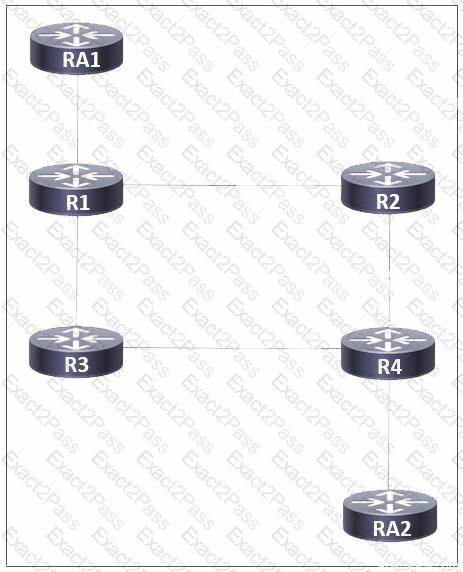
Refer to the exhibit. A network administrator implemented MPLS routing between routers R1, R2, R3, and R4. AToM is configured between R1 and R4 to allow Layer 2 traffic from hosts on RA1 and RA2. A targeted MPLS session is established between R1 and R4. Which additional action must the administrator take on all routers so that LDP synchronization occurs between connected LDP sessions?
A.

Disable the MPLS LDP IGP sync holddown.

B.

Configure OSPF or IS-IS as the routing protocol.

C.

Configure EIGRP as the routing protocol using stub areas only.

D.

Enable MPLS LDP sync delay timers.

Question # 153

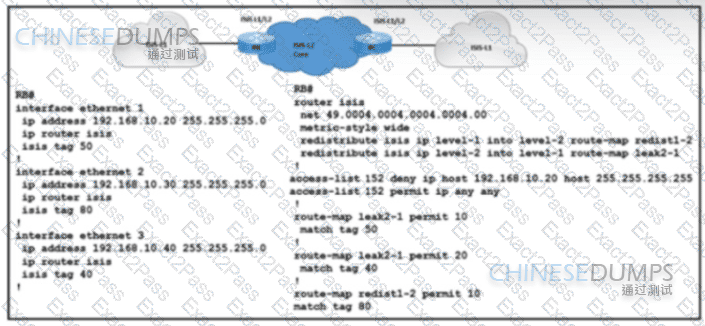
Refer to the exhibit. A network engineer with an employee ID 4379:43:595 is setting up an IS-IS network with these requirements:

    Routes with a tag of 80 and IP prefixes other than 192.168.10.20/24 must be redistributed from Level 1 into Level 2.

    Route leaking must be configured from Level 2 into the Level 1 domain for routes that are tagged with only 50 or 40.

Which configuration must be implemented on RB to meet the requirements?

A.

Add match tag 80 in route-map Ieak2-1

B.

DUMPS Add match ip address 152 in route-map redist1-2

C.

Remove match tag 40 from route-map Ieak2-1

D.

Change match tag 80 to match tag 50 in route-map redist1-2.

Question # 154

An engineer is implementing IGMP with SSM on a multicampus network that supports video streaming. Which task must the engineer perform as part of the process?

A.

Configure the network to use IGMPv3.

B.

Configure the network to use bidirectional PIM.

C.

Configure an RP that uses static assignments only.

D.

Configure the network to use the PIM bsr-candidate

Question # 155

A regional MPLS VPN provider operates m two regions and wants to provide MPLS L 3VPN service for a customer with two sites in these separate locations. The VPN provider approaches another organization to provide backbone carrier services so that the provider can connect to these two locations.

Which statement about this scenario is true?

A.

When edge routers at different regional sites are connected over the global carrier backbone, MP-eBGP must run between the routers to exchange the customer VPNv4 routes

B.

When eBGP is used for label exchange using the send label option, MPLS-BGP forwarding is configured under the global ABC CSC PE-to CE interface

C.

When IGP is used for route exchange and LDP for label exchange, MPLS is enabled only on the VRF interface on the backbone-earner PE side.

D.

When BGP is used for both route and label exchange, the neighbor a.b.c.d send-lable command is used under the address family VPNv4 command mode.

Question # 156

FRR is configured on a network. What occurs when the headend router on the path is alerted to a link failure over IGP?
A.

LSP attempts fast switching on the backup path until the primary path returns to the active state.

B.

The headend router uses a presignaled LSP to bypass the failure point.

C.

A new backup tunnel is established past the PLR to pass through the protected nodes

D.

Backup tunnel is established and intersects with the primary tunnel at the headend.

Question # 157

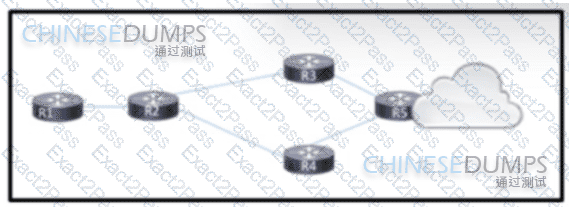
Refer to the exhibit. An engineer is scripting ACLs to handle traffic on the given network. The engineer must block users on the network between R1 and R2 from leaving the network through R5. but these users must still be able to access all resources within the administrative domain. How must the engineer implement the ACL configuration?

A.

Configure an ACL that permits traffic to any internal address, and apply it to the R5 interfaces to R3 and R4 in the egress direction

B.

Configure a permit any ACL on the R1 interface to R2 in the egress direction, and a deny any ACL on the interface in the ingress direction

C.

Configure an ACL that permits traffic to all internal networks and denies traffic to any external address, and apply it to the R2 interface to R1 in the ingress direction.

D.

Configure an ACL that denies traffic to any internal address and denies traffic to any external address, and apply it to the R5 interfaces to R3 and R4 in the ingress direction

Question # 158

A customer of an ISP requests support to setup a BGP routing policy. Which BGP attribute should be configured to choose specific BGP speakers as preferred exit

points for the customer AS?

A.

highest local preference outbound

B.

lowest local preference inbound

C.

highest local preference inbound

D.

lowest multi-exit discriminator

Question # 159

How does model-driven telemetry use YANG?

A.

to reset network devices that malfunction

B.

to set informs and traps on clients to report back to a centralized server

C.

to subscribe to data that is streamed from a device

D.

to poll network devices on a 30-minute interval

Question # 160

Refer to the exhibit.

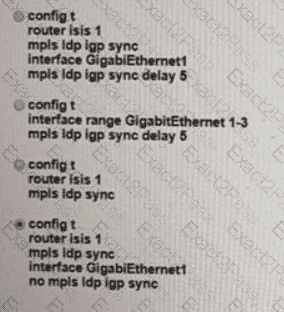
An engineer must configure router R2 as the new P router in the network. Which configuration must be applied to R2 to enable LDP-IGP Sync on its L2 IS-IS adjacencies?
A.

Option A

B.

Option B

C.

Option C

D.

Option D

Question # 161

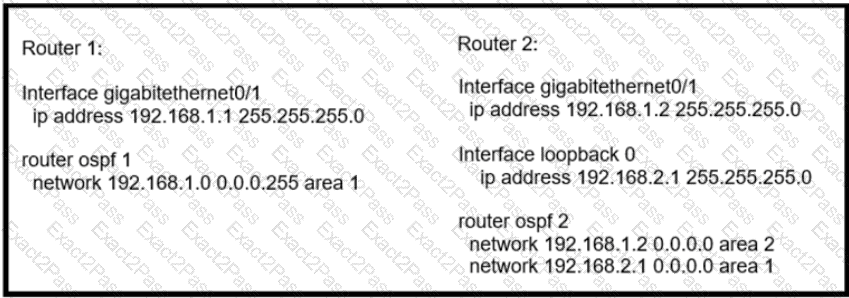
Refer to the exhibit.

Router 1 is missing the route for the router 2 loopback 0. What should the engineer change to fix the problem?

A.

the area numbers on Router 1 and Router 2 to be similar

B.

the wildcard mask network statement in OSPF of Router 2

C.

Router 1 to be an ABR

D.

the hello timers on Router 1 and Router 2 to be different

Question # 162

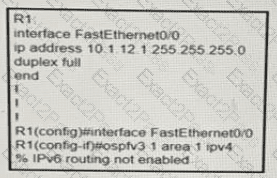
Refer to the exhibit:

A network engineer is implementing an OSPF configuration Based on the output, which statement is true?

A.

In the ospfv3 1 area 1 ipv4 command, area 0 must be configured instead of area 1.

B.

OSPFv3 does not run for IPv4 on FastEthemet0/0 until IPv6 routing is enabled on the router and IPv6 is enabled on interface Fastfc.thernet0/0

C.

OSPFv3 cannot be configured for IPv4; OSPFv3 works only for IPv6.

D.

IPv6 routing not enabled " is just an informational message and OSPFv3 runs for IPv4 on interface FastEthernet0/0 anyway

Question # 163

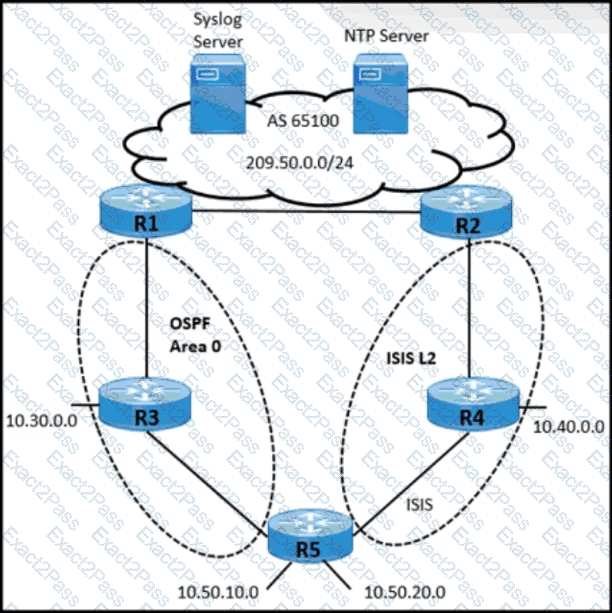
Refer to the exhibit.

A network operator working for a telecommunication company with an employee ID: 4350:47:853 must implement an IGP solution based on these requirements:

• Subnet 10.50.10.0 traffic must exit through the R1 router to connect with the Syslog server.

• Subnet 10.50.20.0 traffic must exit through the R2 router to connect with the NTP server.

• In case of link failure between R2 and R4, traffic must be routed via R1 and R3.

Which two configurations must be implemented on R5 to meet these requirements? (Choose two.)

A.

Apply a route policy to redistribute 10.50.0.0 prefixes in OSPF to ISIS and ISIS to OSPF.

B.

Apply a route policy to redistribute 10.50.20.0 from ISIS-L2 to OSPF Area 0 at a higher cost.

C.

Enable a route policy to advertise 10.50.20.0 in ISIS-L2 at a higher cost.

D.

Apply a route policy to redistribute 10.50.10.0 from OSPF Area 0 to ISIS-L2 at a lower cost.

E.

Enable a route policy to advertise 10.50.10.0 In OSPF Area 0 at a low cost.

Question # 164

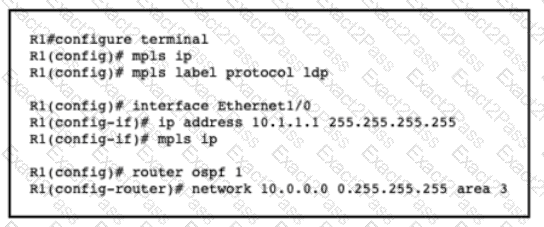
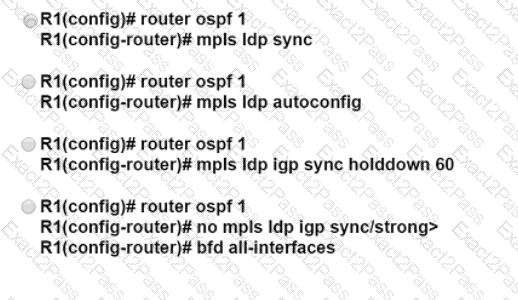
Refer to the exhibit.

A network engineer is configuring MPLS LDP synchronization on router R1. Which additional configuration must an engineer apply to R1 so that it will synchronize to OSPF process 1?

A.

Option A

B.

Option B

C.

Option C

D.

Option D

Go to page: