Spring Sale Special Limited Time 70% Discount Offer - Ends in 0d 00h 00m 00s - Coupon code: buysanta

Exact2Pass Menu

Implementing and Operating Cisco Service Provider Network Core Technologies (350-501 SPCOR)

Last Update 8 hours ago Total Questions : 547

The Implementing and Operating Cisco Service Provider Network Core Technologies (350-501 SPCOR) content is now fully updated, with all current exam questions added 8 hours ago. Deciding to include 350-501 practice exam questions in your study plan goes far beyond basic test preparation.

You'll find that our 350-501 exam questions frequently feature detailed scenarios and practical problem-solving exercises that directly mirror industry challenges. Engaging with these 350-501 sample sets allows you to effectively manage your time and pace yourself, giving you the ability to finish any Implementing and Operating Cisco Service Provider Network Core Technologies (350-501 SPCOR) practice test comfortably within the allotted time.

Question # 31

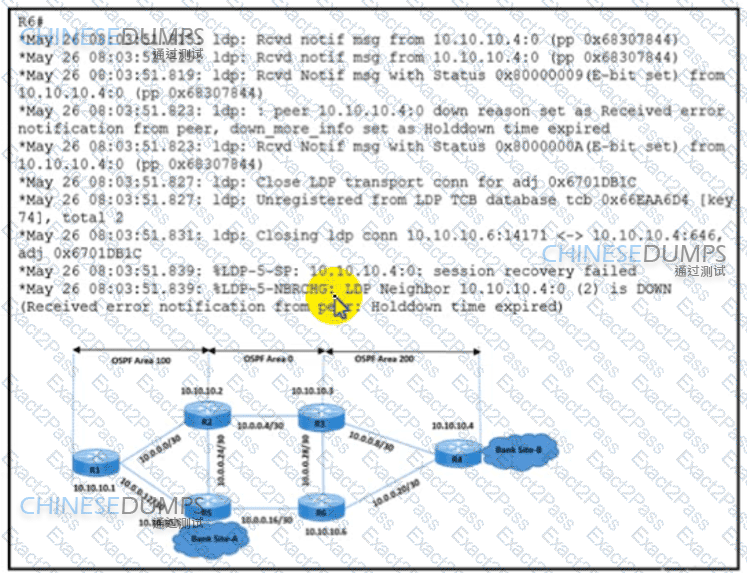
Refer to the exhibit.

A network engineer is implementing an LDP-based MPLS solution to enable packet flow between the two bank sites The engineer was given two requirements

· LDP peering must stay up when there is a link failure between R3 and R6

· LDP peering must not flap when there is a link failure between R5 and R6

Which action meets these requirements?

A.

Enable Link LDP on R4 and R6

B.

Reset the LDP session between R4 and R6

C.

Configure LDP Session Protection on R4

D.

Implement an LDP targeted session with R4 on R6

Question # 32

Which two tasks must you perform when you implement LDP NSF on your network? (Choose two.)

A.

Enable NSF for EIGRP

B.

Enable NSF for the link-state routing protocol that is in use on the network.

C.

Disable Cisco Express Forwarding

D.

Implement direct connections for LDP peers

E.

Enable NSF for BGP

Question # 33

Which function does orchestrated fulfillment perform under the Cisco Network Services Orchestrator model?

A.

It maintains the service topology in an inventory system to enable accurate assessment of service impact and support root-cause analysis.

B.

It translates the networking service high-level intent into device configurations, and pushes the configurations to physical and virtual devices.

C.

It leverages open-source NFV components such as OpenStack virtual infrastructure manager and Open vSwitch to create necessary service chains among VNFs.

D.

It instantiates virtual test probes to perform activation testing and provide ongoing measurement of service KPIs against defined SLAs.

Question # 34

Refer to the exhibit:

Which statement describes the effect of this configuration?

A.

It applies a service policy to all interfaces remarking HTTP traffic

B.

It creates an ACL named WEB that filters HTTP traffic.

C.

It matches HTTP traffic for use in a policy map

D.

It modifies the default policy map to allow all HTTP traffic through the router

Question # 35

A network engineer is configuring a router to send multicast traffic for the 239.10.10.10 group. Which configuration must an .... forward the traffic?

A.

Cisco(config)# interface ethernet 1/0 Cisco(config-if)# ip igmp max-groups action replace

B.

Cisco(config)# interface ethernet 1/0 Cisco(config-if)# ip igmp filter

C.

Cisco(config)# interface ethernet 1/0 Cisco(config-if)# ip igmp access-group 239.10.10.10

D.

Cisco(config)# interface ethernet 1/0 Cisco(config-if)# ip igmp join-group 239.10.10.10

Question # 36

What are the two uses of the YANG data modeling language? (Choose two.)

A.

It is used to access a device by HTTP.

B.

It Is used to model the configuration used by NETCONF operations.

C.

It is used to shape state data of network elements.

D.

It Is used to replace RESTCONF as a mechanism to install and manipulate configuration.

E.

It is used to replace the OSI model for troubleshooting.

Question # 37

After implement MPLS protocol for multiple VRFs on a single Cisco device, the engineer notices all VRFs on the router still do to not LDP session protection feature enabled. Which configuration must the engineer apply to enable the LDP session protection feature FOR LDP neighbors within each VRF?
A.

Configure LDP session protection globally on the device only.

B.

Configure LDP session protection globally on the device and on each neighbor that requires session protection.

C.

Configure LDP session authentication on the device to enable LDP session protection on each VRF automatically.

D.

Configure LDP session protection within the individual VRFs.

Question # 38

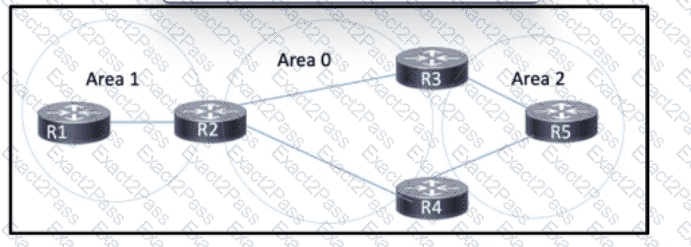
Refer to the exhibit. OSPF is running in the network, which is segmented into three areas. MPLS is enabled on all routers to support Layer 3 VPN. The network architect is concerned about potential packet loss when new OSPF adjacencies form. Which two tasks should the architect perform to implement MPLS LDP synchronization? (Choose two.)
A.

Enable MPLS functionality on all interfaces that are involved in MPLS.

B.

Configure OSPF to use the same router ID for each router that is involved in MPLS.

C.

Enable LDP sync under the OSPF process.

D.

Establish MPLS targeted sessions for connected LDP neighbors only.

E.

Establish a virtual link between the areas to support LDP sync between segments.

Question # 39

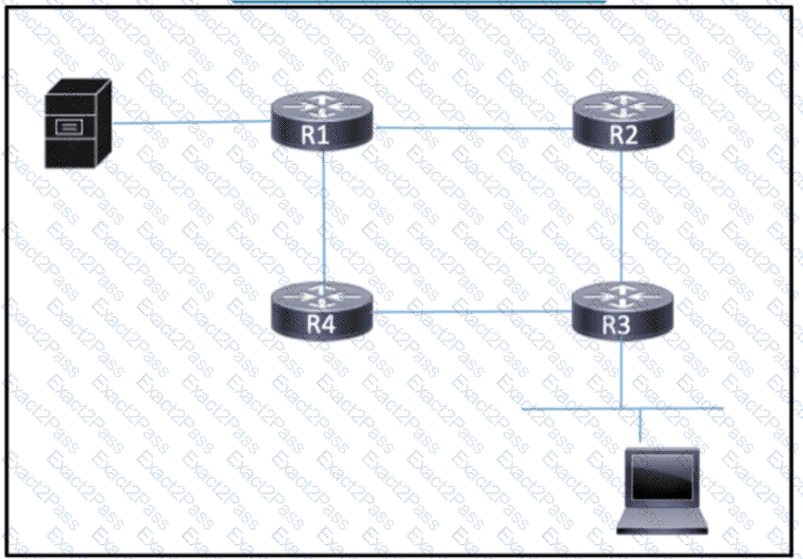
Refer to the exhibit. A host connected to R3 must connect with a server on R1 that provides critical, time-sensitive data. Traffic between the host and server must always be given bandwidth to traverse the links when they are congested, with other traffic being dropped. How must the network engineer implement a QoS strategy with classification to ensure that the traffic is given the appropriate bandwidth?

A.

Implement FIFO to guarantee that the server traffic is sent first while other traffic is queued.

B.

Implement policing to rate-limit noncritical traffic that exceeds designated thresholds.

C.

Implement traffic shaping to delay noncritical traffic when the link is congested.

D.

Implement strict priority to guarantee bandwidth for the server traffic.

Question # 40

Which two features will be used when defining SR-TE explicit path hops if the devices are using IP unnumbered interfaces? (Choose two.)

A.

router ID

B.

labels

C.

node address

D.

next hop address

E.

output interface

Question # 41

A network engineer must implement an ACL-based solution to mitigate availability issues on a web service that is hosted on a server at IP address 172.16.15.18/23. Access to the web server should be allowed over HTTP from RFC 1918 addresses only. The network architect has already enabled PMTUD in the network. Which ACL configuration must the engineer implement to complete the task?

A.

access-list 198 deny ip any host 172.16.15.18 fragments

access-list 198 permit 6 10.0.0.0 0.255.255.255 172.16.15.18 0.0.1.255 eq 80

access-list 198 permit 6 172.16.0.0 0.0.255.255 172.16.15.18 0.0.1.255 eq 80

access-list 198 permit 6 192.168.0.0 0.0.0.255 172.16.15.18 0.0.1.255 eq 80

access-list 198 deny ip any any

B.

access-list 198 deny ip any host 172.16.15.18 ip-fragments

access-list 198 permit 18 10.10.0.0 0.0.255.0 172.16.15.18 255.255.254.0

access-list 198 permit 18 172.16.0.0 255.255.0 172.16.15.18 255.255.254.0

access-list 198 permit 18 192.168.0.0 255.255.0 172.16.15.18 255.255.254.0

access-list 198 deny tcp any any

C.

access-list 199 deny ip any host 172.16.15.18 tcp-fragments

access-list 199 permit tcp 10.0.0.0 0.0.255.255 172.16.15.18 0.0.254.255 eq 80

access-list 199 permit tcp 172.16.0.0 0.0.0.255 172.16.15.18 0.0.254.255 eq 80

access-list 199 permit tcp 192.168.0.0 0.0.0.255 172.16.15.18 0.0.254.255 eq 80

access-list 199 deny ip any any

D.

access-list 199 deny tcp any host 172.16.15.18 http-fragments

access-list 199 permit 16 10.10.0.0 0.255.255.255 172.16.15.18 0.0.2.253 eq 80

access-list 199 permit 16 172.16.0.0 0.0.255.255 172.16.15.18 0.0.2.253 eq 80

access-list 199 permit 16 192.168.0.0 0.0.255 172.16.15.18 0.0.2.253 eq 80

access-list 199 deny tcp any any

Question # 42

What is the function of the FEC field within the OTN signal structure?

A.

It allows the sending devices to apply QoS within the OTN forwarding structure.

B.

It allows source nodes to discard payload errors before transmitting data on the network.

C.

It allows receivers to correct errors upon data arrival.

D.

It allows deep inspection of data payload fields.

Question # 43

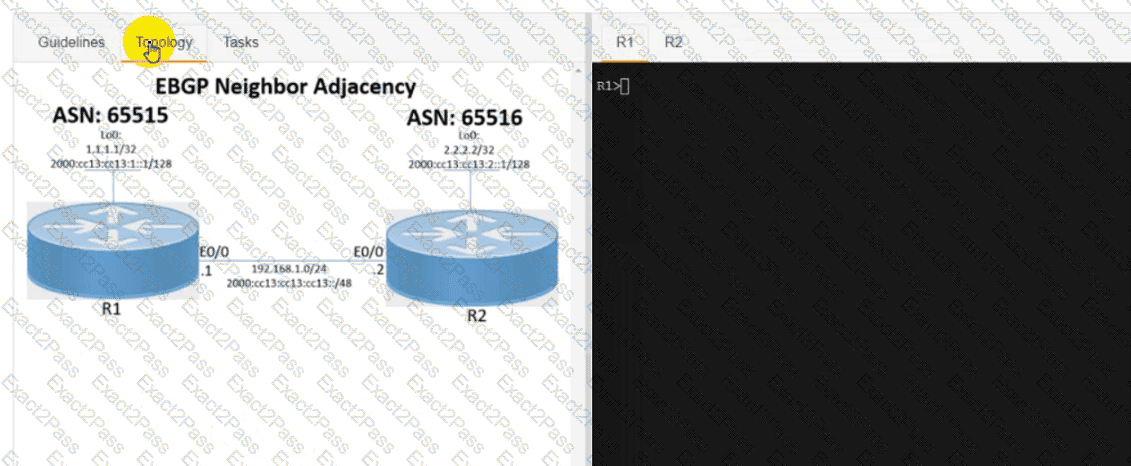
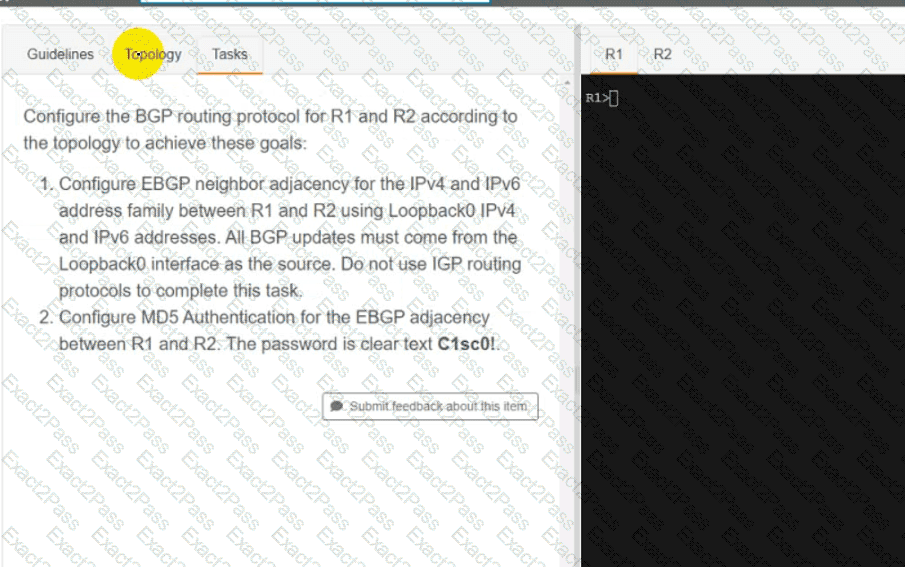
SIMULATION 4

Question # 44

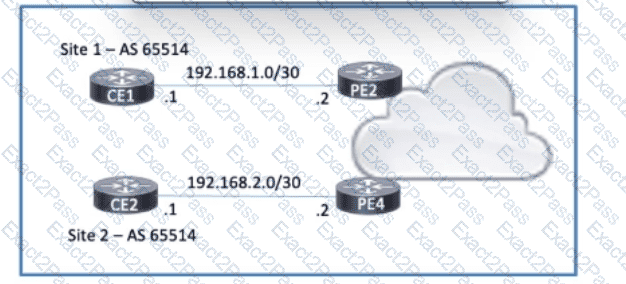
Refer to the exhibit. Company A has two offices that communicate via a service provider in AS 65516. CE1 and CE2 provide connections to the service provider from site 1 and site 2 respectively. Both customer sites use BGP as the PE-CE routing protocol. Which configuration must the engineer apply to ensure that traffic passes between the two sites?

A.

CE2(config)#router bgp 65514

CE2(config-router)#neighbor 192.168.1.1 as-override

B.

CE1(config)#router bgp 65514

CE1(config-router)#neighbor 192.168.1.2 allowas-in

C.

PE2(config)#router bgp 65516

PE2(config-router)#neighbor 192.168.1.1 next-hop-self

PE4(config)#router bgp 65516

PE4(config-router)#neighbor 192.168.2.1 next-hop-self

D.

CE1(config)#router bgp 65514

CE1(config-router)#neighbor 192.168.1.2 next-hop-self

CE2(config)#router bgp 65514

CE2(config-router)#neighbor 192.168.2.2 next-hop-self

Question # 45

An engineer must apply an 802.1ad-compliant configuration to a new switchport with these requirements:

The switchport must tag all traffic when it enters the port.

The switchport is expected to provide the same level of service to traffic from any customer VLAN.

Which configuration must the engineer use?

A.

interface GigabitEthernet1/0/1

switchport mode trunk

switchport trunk encapsulation dot1q

encapsulation ISL

bridge-domain 12

B.

interface GigabitEthernet1/0/1

ethernet dot1ad uni c-port

service instance 12

encapsulation dot1q

rewrite ingress tag push dot1ad 21 symmetric

bridge-domain 12

C.

interface GigabitEthernet1/0/1

ethernet dot1ad uni s-port

service instance 12

encapsulation default

rewrite ingress tag push dot1ad 21 symmetric

bridge-domain 12

D.

interface GigabitEthernet1/0/1

ethernet dot1ad nni

service instance 12

encapsulation dot1ad

bridge-domain 12

Go to page: