Spring Sale Special Limited Time 70% Discount Offer - Ends in 0d 00h 00m 00s - Coupon code: buysanta

Exact2Pass Menu

Implementing and Operating Cisco Service Provider Network Core Technologies (350-501 SPCOR)

Last Update 8 hours ago Total Questions : 547

The Implementing and Operating Cisco Service Provider Network Core Technologies (350-501 SPCOR) content is now fully updated, with all current exam questions added 8 hours ago. Deciding to include 350-501 practice exam questions in your study plan goes far beyond basic test preparation.

You'll find that our 350-501 exam questions frequently feature detailed scenarios and practical problem-solving exercises that directly mirror industry challenges. Engaging with these 350-501 sample sets allows you to effectively manage your time and pace yourself, giving you the ability to finish any Implementing and Operating Cisco Service Provider Network Core Technologies (350-501 SPCOR) practice test comfortably within the allotted time.

Question # 106

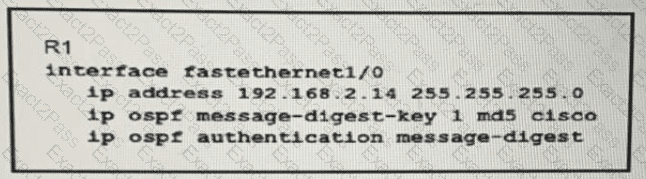
Refer to the exhibit:

Which condition must be met by the OSPF peer of router R1 before the two devices can establish communication?

A.

The interface on the OSPF peer must use the same key ID and key value as the configured interface

B.

The interface on the OSPF peer may have a different key ID, but it must use the same key value as the configured interface

C.

The OSPF peer must be configured as an OSPF stub router

D.

The OSPF peer must use clear-text authentication

Question # 107

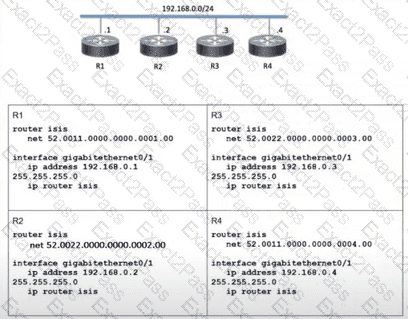
Refer to the exhibit.

Which two topology changes happen to the IS-IS routers? (Choose two.)

A.

All four routers are operating as Level 1 routers only.

B.

All four routers are operating as Level 2 routers only.

C.

R1 and R4 are Level 2 neighbours.

D.

R1 and R2 are Level 2 neighbours.

E.

All four routers are operating as Level 1-2 routers.

Question # 108

What is a primary benefit of IPoATM or MPLS over ATM backbone service provider networks?

A.

dedicated circuits

B.

variable-length packets

C.

isochronous system

D.

fixed-length cells

Question # 109

A network architect at ISP must implement a loop-avoidance mechanism in the organization ' s ring network topology. The architect decided to implement ITU-T G.8032. Intermittent link flaps within two seconds should be ignored. Which two configurations must the architect apply? (Choose two.)

A.

ring-protection g8032 profile vlan port-channel none

B.

link-protection group management vlan 1

C.

timer hold-off 2

D.

continuity-check direction down 2

E.

ethernet ring g8032 profile ethernet

Question # 110

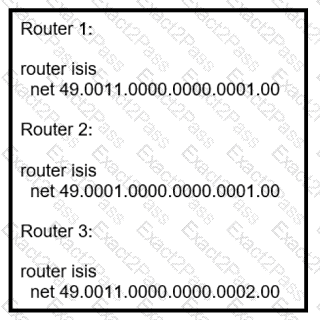
Refer to the exhibit.

Router 4 is added to the network and must be in the same area as router 1. Which NET should the engineer assign?

A.

49.0001.0000.0000.0004.00

B.

49.0111.0000.0000.0001.00

C.

49.0011.0000.0000.0003.00

D.

49.0011.0000.0000.0002.00

Question # 111

What is the purpose of microsegments in the SRv6 architecture?

A.

They ensure that routers in the path sufficiently examine the indexed mapping tables.

B.

They support a scalable control plane.

C.

They reduce fragmentation as packets traverse the network.

D.

They allow for configuration changes in the SRv6 data plane without requiring the device to reboot.

Question # 112

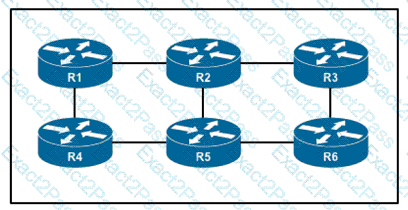
What Is one of the differences between Ansible and Chef?
A.

Ansible uses YAML and Chef uses Ruby.

B.

Chef requires the use of Windows in the environment and Ansible requires Linux.

C.

Chef is highly scalable and Ansible is highly secure.

D.

Ansible uses Ruby and Chef uses Python.

Question # 113

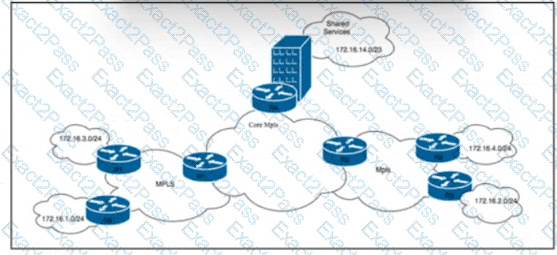
Refer to the exhibit. The ISP is implementing a new hosting-as-a-service solution for its business customers. Service accessibility must be unique and separate for each customer. The network architect must ensure that multiple paths toward the hosting-as-a-service solution are always available. Basic protection against traffic black-holing on the MPLS network is required in case of link failure. Which two actions must the engineering team perform to meet the requirements? (Choose two.)

A.

Create the hosting-as-a-service VRF on router R4 and configure It with the route target both 65123:88 command.

B.

Configure the fast-reroute per-prefix command for the IS-IS protocol in the MPLS network and enable the BGP route-reflector feature on R2.

C.

Enable the VRF-Lite feature on router R4 and enable BGP address-family VPNv4.

D.

Configure the mpls Idp sync command in the MPLS network with the BGP additional-paths receive and additional-paths send options.

E.

Configure the fast-hello command under the IS-IS routing protocol with the BGP multipath 2 option enabled.

Question # 114

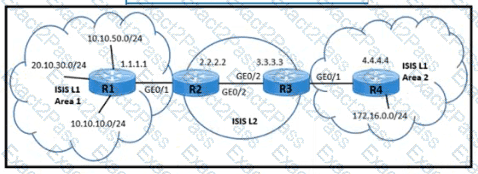
Refer to the exhibit.

A network engineer must meet these requirements to provide a connects, solution:

    The customer connected to Area 2 needs to access the application in Area 1 on the 10.10.10.0/24 subnet

    The Customer must not have access to the 20.10 30.0/24 subnet.

    The service provider must make sure that the Area 2 routing database limits the number of IP addresses in the routing table

Which two configurations must be implemented to meet the requirements? (Choose two)

A.

Set a tag value of 200 to match the summary address 10.0.0/16 on R2.

B.

Set a tag value of 200 to match the summary address 10.0.0.0/16 on R3.

C.

Apply the route map for tag 200 and leak Level 2 routes into Level 1 Area 2 on R3

D.

Apply the route map for tag 200 and teak Level 2 routes into Level 1 Area 2 on R4.

E.

Set a tag value of 200 to match the summary address 10.0.0./16 on R1.

Question # 115

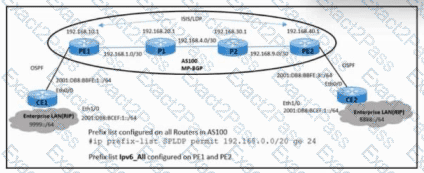
Which set of facts must the network architect consider when deciding whether to implement SaltStack or Chef?
A.

Chef is an agent-based on Ruby, and SaltStack is a module tool based on Python.

B.

Chef refers to its automation instructions as manifests, and SaltStack refers to its instructions as a playbook.

C.

Chef is written in Python, and SaltStack is written in Ruby.

D.

Chef uses a message-based system, and SaltStack uses an agent to deliver messages

Question # 116

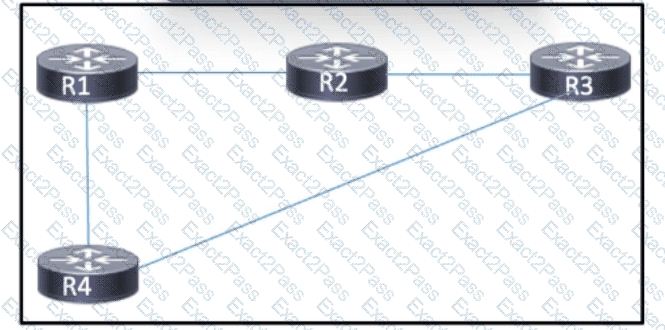
Refer to the exhibit. An engineer must update the configuration of the network with these requirements:

    PE routers must define labels for IS-IS learned routes in AS100.

    P routers must not receive LDP bindings for the external network in the IPv6 address family.

Which configuration must the engineer implement to meet these requirements?
A.

PE2(config)# mpls Idp label

 PE2(config-Idp-Ibl)# allocate global host-routes

B.

CE1(config)# mpls Idp label

 CE1(config-Idp-Ibl)# allocate global host-routes

C.

PE2(config)# mpls Idp label

 PE2(config-Idp-Ibl)# allocate global prefix-list SPLDP

D.

PE1(config)# mpls Idp label

 PE1(config-Idp-Ibl)# no allocate global prefix-list Ipv6_All

Question # 117

Refer to the exhibit. MPLS is configured within the network. The routers use OSPF to exchange routing information. Hosts that are connected to routers R1 and R3 use routers R2 and R4 to access servers that run a variety of intranet applications. A network engineer must ensure that R1 and R3 maintain an LDP session between them to support the flow of traffic between hosts and servers in case of failure on the path between R1 and R3. Which task should the engineer perform to provide LDP bindings in case of failure on the path between R1 and R3?

A.

Implement session protection to send targeted hellos between R1 and R3.

B.

Implement multicast in the network to share data between hosts and servers without targeted routing.

C.

Implement LDP sync on the four devices to give MPLS and OSPF the ability to maintain continuous uptime.

D.

Implement BFD to monitor and detect link failures between R1 and R3.

Question # 118

Refer to the exhibit.

An engineer is configuring an administrative domain in the given multi-vendor environment with PIM-SM. Which feature must the engineer implement so that devices will dynamically learn the RP?

A.

Auto-RP

B.

BIDIR-PIM

C.

SSM

D.

BSR

Question # 119

After recent network outages and customer complaints, a large Tier 1 service provider has asked a network engineer to implement MPLS OAM policy on all Provider Edge devices in the MPLS network. To improve network performance and reliability, the policy must be able to detect 2% packet drops and a delay of 0.05 seconds. The solution must be based on RFC 6374 and RFC 4379 standards for MPLS OAM. The CCM to detect connectivity issues has already been configured with interval 1000. Which two actions must the engineer take to achieve the goal? (Choose two.)

A.

Set loopback delay-frequency 50 and drop-threshold 0.2 on the PE routers.

B.

Implement mpls ldp tracing on the PE and P routers.

C.

Implement mpls oam policy oam on the PE routers.

D.

Implement mpls ip oam map-policy on the PE routers.

E.

Set loss-threshold 2 and delay-threshold 50 on the P routers.

Question # 120

What are two purposes of a data-modeling language such as YANG? (Choose two.)

A.

defining a hierarchical data scheme

B.

modeling notifications, data configuration, and data status

C.

defining a relational-model data scheme

D.

defining a semi-structured data scheme

E.

defining API calls, JSON format, and XML structure

Go to page: