Spring Sale Special Limited Time 70% Discount Offer - Ends in 0d 00h 00m 00s - Coupon code: buysanta

Exact2Pass Menu

Implementing and Operating Cisco Service Provider Network Core Technologies (350-501 SPCOR)

Last Update 8 hours ago Total Questions : 547

The Implementing and Operating Cisco Service Provider Network Core Technologies (350-501 SPCOR) content is now fully updated, with all current exam questions added 8 hours ago. Deciding to include 350-501 practice exam questions in your study plan goes far beyond basic test preparation.

You'll find that our 350-501 exam questions frequently feature detailed scenarios and practical problem-solving exercises that directly mirror industry challenges. Engaging with these 350-501 sample sets allows you to effectively manage your time and pace yourself, giving you the ability to finish any Implementing and Operating Cisco Service Provider Network Core Technologies (350-501 SPCOR) practice test comfortably within the allotted time.

Question # 16

How does TI-LFA reduce packet loss in Segment routing?

A.

It determines which link to use when load balancing to prevent packet fragmentation loss.

B.

It establishes multiple labels per path using more than one IGP.

C.

It calculates loop-free backup paths that are rapidly implemented in case of a link failure.

D.

It enables path selection in SR-TE to support MPLS label allocation.

Question # 17

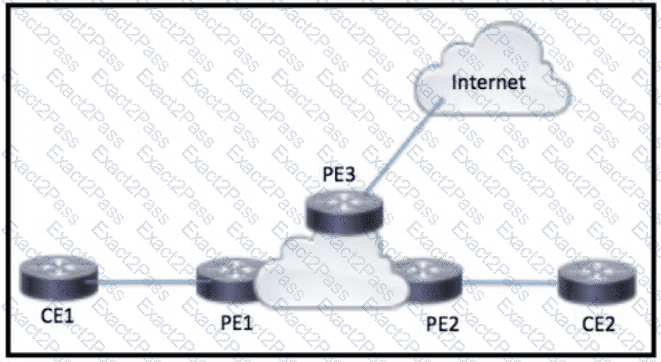
Refer to the exhibit.

CE1 and CE2 require connectivity to the internet through the ISP connected to PE3 What should an engineer configure to complete this task?

A.

PE2 must be configured to serve as a route reflector for PE3 routes learned from the internet. PE2 then shares the routes with CE1 and CE2.

B.

CE1 and CE2 must be configured with a route distinguisher in the PE1 VRF that dynamically imports the route from the internet.

C.

CE1 and CE2 must be configured to use a static default route with a next-hop of PE3 to reach internet routes.

D.

PE1 must be configured with an import route target in the CE1 VRF that matches the export route target for the internet VRF on PE3.

Question # 18

What occurs when a high bandwidth multicast stream is sent over an MVPN using Cisco hardware?

A.

The traffic uses the default MDT transmit the data Only if it is a (S, G) multicast route entry.

B.

A data MDT is created if is a Multicast route entries

C.

A data and default MDT are created to flood the multicast stream of all PIM-SM neighbors.

D.

A data MDT is created to allow for the best transmit through the core for multicast route entries.

Question # 19

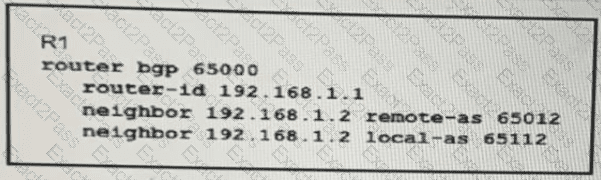
Refer to the exhibit:

A network engineer is implementing a BGP protocol. Which effect of the local-as keyword in this configuration is true?

A.

It enables peer 192.168.1.2 to establish a BGP relationship with R1 using AS 65012 and the VPNv4 address family

B.

It enables peer 192.168.1.2 to establish a BGP relationship with R1 using AS 65012 without additional configuration

C.

It enables peer 192.168.1.2 to establish a BGP relationship with R1 using AS 65112 and the VPNv4 address family

D.

It enables peer 192.168.1.2 to establish a BGP relationship with R1 using AS 65112 without additional configuration.

Question # 20

A network engineer is configuring a newly installed PE router at the regional gateway location. The new PE router must use MPLS core routing protocols with the existing P router, and LDP sessions between the two routers must be protected to provide faster MPLS convergence. Which configuration must the engineer perform on the network so that LDP sessions are established?

A.

Enable communication over TCP port 646 for T-LDP hello messages.

B.

Enable RSVP-TE FRR on the LDP interface to protect the LDP session between routers.

C.

Enable LDP session protection on either one of the routers, which allows them to autonegotiate.

D.

Set the LDP session protection timer on each router to the same value.

Question # 21

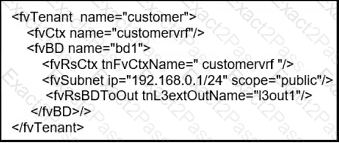
Refer to the exhibit.

What does this REST API script configure?

A.

application profile

B.

VRF

C.

public community string for SNMP

D.

interface with IP address 192.168.0.1

Question # 22

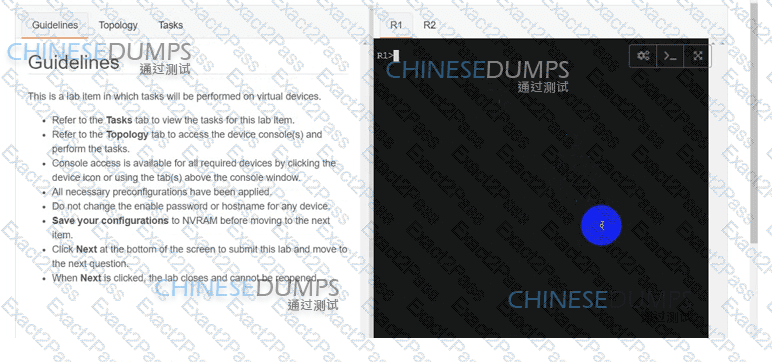
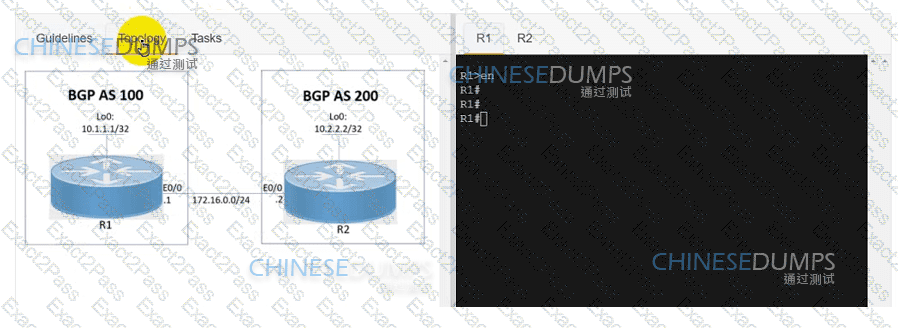
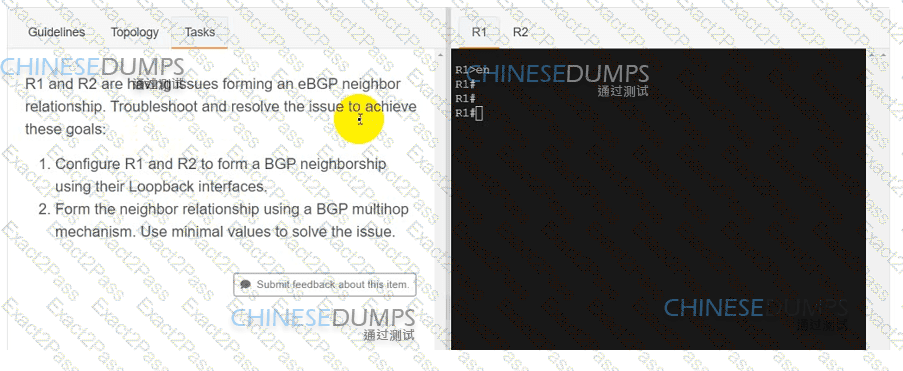
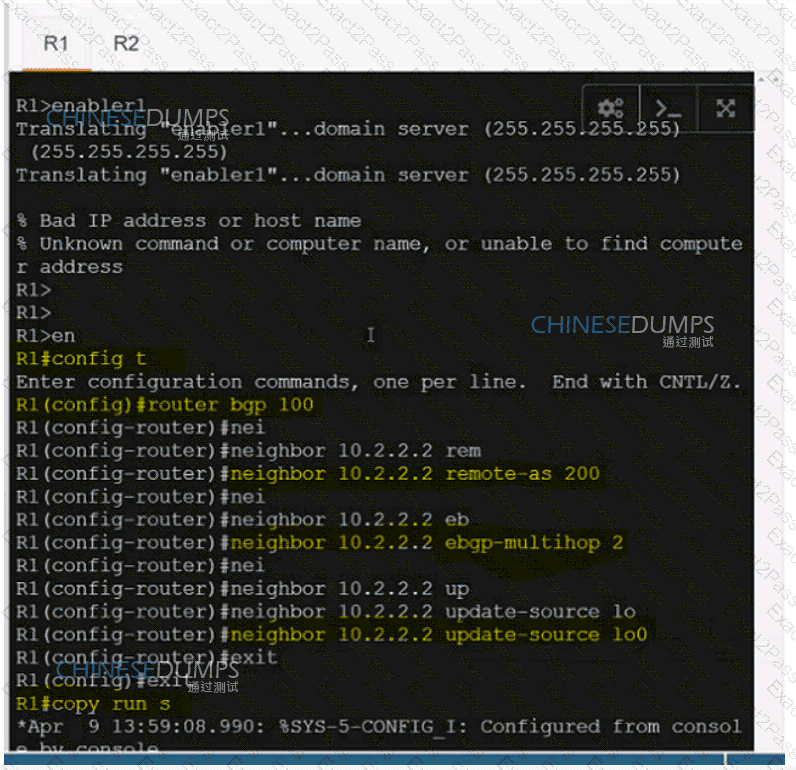
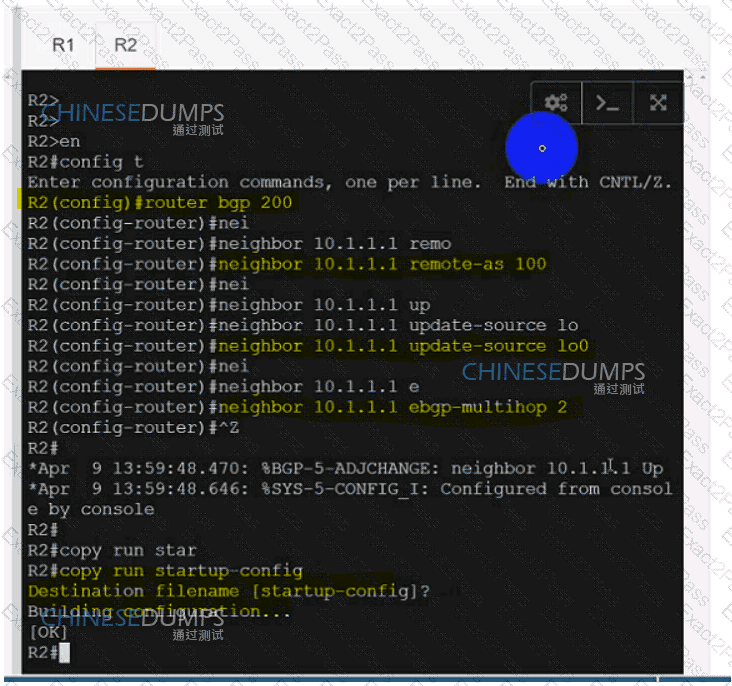
Simulation2

TOPOLOGY

Question # 23

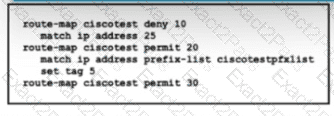
Refer to the exhibit. A client wants to filter routes to a BGP peer to limit access to restricted areas within the network. The engineer configures the route map ciscotest to filter routes from the BGP neighbor. The engineer also sets a tag that will be used for QoS in the future. Which task must be performed to complete the Implementation?

A.

Attach the new route map to the BGP neighbor statement in the inbound direction.

B.

Create a policy map named ciscotest and apply It to inbound traffic on the link that is directly connected to the BGP neighbor.

C.

Create a route map, configure BGP with an IPv4 address family, and activate the neighbor.

D.

Add a route map statement with sequence 40 that links a BGP community to the routing protocol

Question # 24

How do CSC VPN services use BGP to support connectivity between customer sites?

A.

BGP uses address families for IPv6 support in networks that use IPv4 and IPv6 between customers in different geographies.

B.

The BGP AS-Override feature allows the CSC network to use the same autonomous system number.

C.

BGP eliminates the need for an IGP to run within the backbone carrier core and provides more efficient label distribution.

D.

BGP sends labels to the CSC-PE router so that traffic can traverse the backbone carrier.

Question # 25

Which protocol does a Cisco MPLS TE tunnel use to maintain paths within the core?
A.

RSVP

B.

VTP

C.

STP

D.

RPF

Question # 26

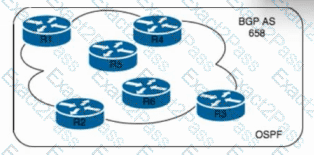
Refer to the exhibit. An ISP is providing online registration services for a new social program. OSPF is being used as an interior routing protocol with TE capabilities. A network engineer with an employee ID: 5209:82:636 must provide faster MPLS-enabled convergence in case of failure. The ip cef distributed command has already been configured on all MPLS-enabled routers, and connectivity between the core routers has been verified following IETF RFC 4379. Which additional task must the engineer perform to complete the implementation?

A.

Implement LDP session protection on all PE routers.

B.

Implement MPLS TE fast reroute node protection on all MPLS-enabled routers.

C.

Implement MPLS TE fast reroute link protection on routers R2 and R3.

D.

Implement OSPF loop-free alternate fast reroute on core routers only.

Question # 27

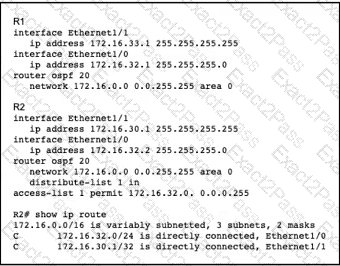
Refer to the exhibit.

A network engineer notices that router R2 is failing to install network 172.16.33.1/32 in the routing table. Which configuration must the engineer apply to R2 to fix the problem?

A.

R2(config)# access-Iist 1 permit 172.16.33.0 255.0.0.0

B.

R2(config)# access-list 1 permit 172,16,33.0 255,255,255,0

C.

R2(config)# access-list 1 permit 172.16.33.0 0.0.0.255

D.

R2(config)# access-list 1 permit 172,16,33.0 255.255,0,0

Question # 28

Which two features describe TI-LFA? (Choose two.)
A.

TI-LFA uses PQ or P and Q nodes on the post-convergence path to compute the backup path.

B.

Post-convergence, TI-LFA considers the next-hop neighbor to calculate the backup repair path.

C.

TI-LFA works with point of local repair when the PQ node supports only LDP capability.

D.

Unlike RLFA, TI-LFA works without the PQ node and provides double segment failure protection.

E.

TI-LFA leverages the post-convergence path that carries data traffic after a failure.

Question # 29

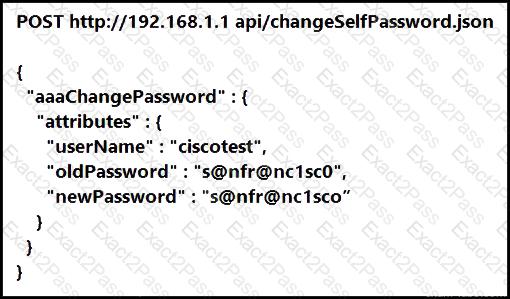
Refer to the exhibit. What is the purpose of this JSON script?

A.

It changes the existing password.

B.

It updates a user authentication record.

C.

It deletes a user’s authentication record.

D.

It confirms a user’s login credentials.

Question # 30

Which action occurs during the traceback phase of the six-phase approach to service provider security?


A.

Trace action occur flows from the stacked sections of the network toward the network edges

B.

Detect unusual activity or behavior and activate appropriate measures after an alert is raised.

C.

Review the whole attack-handling process

D.

Mitigate the attack that flows using various mechanisms.

Go to page: