Spring Sale Special Limited Time 70% Discount Offer - Ends in 0d 00h 00m 00s - Coupon code: buysanta

Exact2Pass Menu

Implementing and Operating Cisco Service Provider Network Core Technologies (350-501 SPCOR)

Last Update 8 hours ago Total Questions : 547

The Implementing and Operating Cisco Service Provider Network Core Technologies (350-501 SPCOR) content is now fully updated, with all current exam questions added 8 hours ago. Deciding to include 350-501 practice exam questions in your study plan goes far beyond basic test preparation.

You'll find that our 350-501 exam questions frequently feature detailed scenarios and practical problem-solving exercises that directly mirror industry challenges. Engaging with these 350-501 sample sets allows you to effectively manage your time and pace yourself, giving you the ability to finish any Implementing and Operating Cisco Service Provider Network Core Technologies (350-501 SPCOR) practice test comfortably within the allotted time.

Question # 46

What is an enhancement that Cisco IOS XE Software has over Cisco IOS Software?

A.

It support symmetric multiprocessing

B.

It allows all processes to use the same pool of memory.

C.

It runs on a 32-bit operating system.

D.

It is built on a GNX Neutrino Microkernel.

Question # 47

Which action does the ingress VTEP perform on traffic between EVPN VXLAN overlays?
A.

routing and tunneling when doing symmetric IRB

B.

routing when doing asymmetric IRB

C.

routing and bridging when doing asymmetric IRB

D.

bridging when doing symmetric IRB

Question # 48

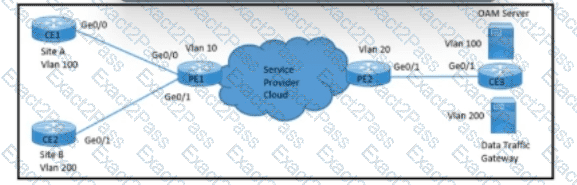
Refer to the exhibit. A network engineer with an employee ID: 5086:72:817 is configuring a connection to manage CE1 from the OAM server on VLAN 100. PE1 must push S-VLAN tag 10 toward PE2 while forwarding traffic from CE1 to the OAM server. PE1 must push S-VLAN tag 20 toward PE2 while forwarding traffic from CE2 to the data traffic gateway. Which configuration must the engineer implement on PE2?

A.

interface GigE0/1

encapsulation dot1q 100

rewrite ingress tag pop 10

rewrite ingress tag push 20

B.

interface Ge0/0

encapsulation dot1q 100

rewrite ingress tag push dot1q 10 symmetric

interface Ge0/1

encapsulation dot1q 200

rewrite ingress tag push dot1q 20 symmetric

C.

interface GigE0/1

encapsulation dot1q 10

rewrite ingress tag push dot1q 10 symmetric

Interface Ge0/0

encapsulation dot1q 20

rewrite ingress tag push dot1q 20 symmetric

D.

Interface Ge0/1

encapsulation dot1q 100

Question # 49

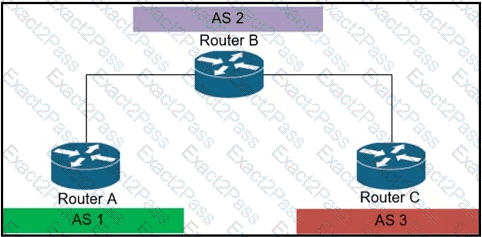
Refer to the exhibit.

An engineer working for private Service Provider with employee id: 3948:11:613 is configuring the BGPsec framework. Which two conditions must the engineer take into account? (Choose two.)

A.

BGPsec uses IPsec tunnel for security.

B.

The BGPsec framework secures the AS path.

C.

In BGPsec. all route advertisements are given an expiry time by the originator of the route.

D.

Private keys are part of the router key pair used to sign route updates.

E.

In BGPsec. route advertisements are not given an expiration time by the originator of the route.

Question # 50

How does SR policy operate in Segment Routing Traffic Engineering?

A.

An SR policy for color and endpoint is deactivated at the headend as soon as the headend learns a valid candidate path for the policy.

B.

When " invalidation drop " behavior occurs, the SR policy forwarding entry is removed and the router drops all traffic that is steered into the SR policy.

C.

When a set of SID lists is associated with the SR policy designated path, traffic steering is ECMP-based according to the qualified cost of each SID-list.

D.

An active SR policy installs a BSID-keyed entry in the forwarding table to steer the packets that match the entry to the SR policy SID-list.

Question # 51

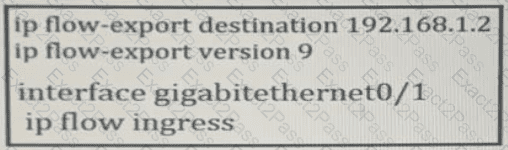
Refer to the exhibit:

Which information is provided for traceback analysis when this configuration is applied?

A.

BGP version

B.

packet size distribution

C.

source interface

D.

IP sub flow cache

Question # 52

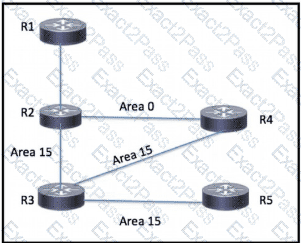
Refer to the exhibit.

An engineer has started to configure a router for OSPF, as shown Which configuration must an engineer apply on the network so that area 15 traffic from R5 to R1 will prefer the route through R4?
A.

Place the link between R3 and R5 in a stub area to force traffic to use the route through R4.

B.

Increase the cost on the link between R2 and R4, to influence the path over R3 and R4.

C.

Implement a multiarea adjacency on the link between R2 and R4, with the cost manipulated to make the path through R4 preferred.

D.

Implement a sham link on the between R3 and R2 to extend area 0 area 15.

Question # 53

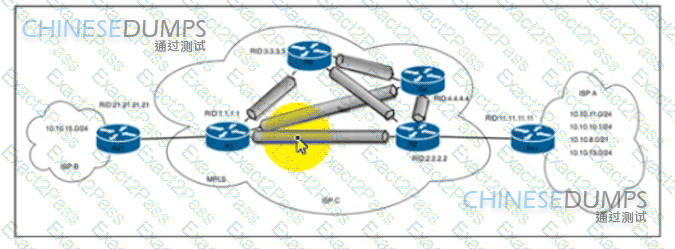
Refer to the exhibit An engineer at ISP C is configuring a new interconnection with ISPs A and B using the BGP protocol After the initial configuration the engineer noticed high memory usage and an abnormally large LIB table on router R2 Which two actions must the engineer take on R2 to minimize memory usage? (Choose two.)

A.

Configure Extended ACL 101 with accepted prefixes.

B.

Confiure the mpls idp neighbor 11.11.11.11 labels accept1 command.

C.

Configure Standard ACL 1 with accepted prefixes.

D.

Configure the mpls idp neighbor 1.1.1.1 labels accept 101 command.

E.

Configure the mpls idp neighbor 21.21.21.21 labels accept 101 command.

Question # 54

A network operator needs to implement PIM-SSM multicast configuration on customer ' s network so that users in different domains are able to access and stream live traffic. Which two actions must the engineer perform on the network

to make the streaming work? (Choose two.)

A.

Configure at least one MSDP peer on the network

B.

Enable IGMP version 2 at the interface lever.

C.

Enable PIM sparse mode on the device.

D.

Enable IGMP version 3 at the interface level.

E.

Enable PM dense mode on the device.

Question # 55

Refer to the exhibit:

You are configuring an administrative domain implement so that devices can dynamically learn the RP?

A.

SSM

B.

BID1R-PIM

C.

BSR

D.

Auto-RP

Question # 56

An ISP that provides private network services across the country has recently migrated their infrastructure to support MPLS technology. A network engineer configured mpls ip on all routers and implemented the OSPF routing protocol with TE extensions in the backbone area. The ISP wants to ensure that label exchange is performed only on MPLS-enabled interfaces that are associated with the IGP instance.

Which action must the engineer take to accomplish the goal?

A.

Enable Cisco Express Forwarding on all routers in the backbone area.

B.

Implement mpls Idp sync on all routers in the segment.

C.

Update the routers in the segment to use RSVP-TE for label distribution.

D.

Implement mpls Idp autoconfig on all routers in the segment.

Question # 57

Network devices in the core layer use different IGPs, and the network is split into several areas. The engineer must use a NETCONF operation to load a full interface configuration on multiple Cisco devices to ensure that they meet company standards. The devices must work over SSH from the Linux jump server. Which action meets the configuration requirements?

A.

Use the NETCONF operation < get-config > to load the configuration and verify that TCP port 830 is open from the Linux server to the routers.

B.

Use the NETCONF operation < get-update > to load the configuration and verify that TCP port 630 is open from the Linux server to the routers.

C.

Use the NETCONF operation < get-config > to load the configuration and verify that TCP port 22 is open from the Linux server to the routers.

D.

Use the NETCONF operation < get-update > to load the configuration and verify that TCP port 22 is open from the Linux server to the routers.

Question # 58

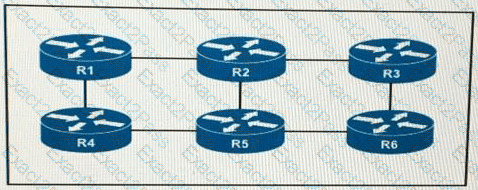
Refer to the exhibit.

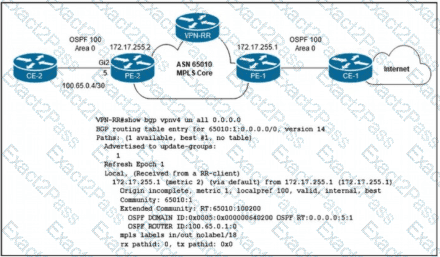
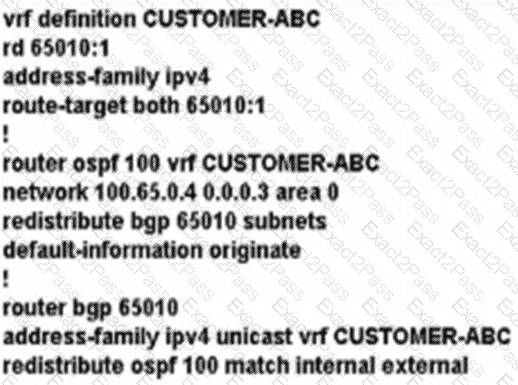
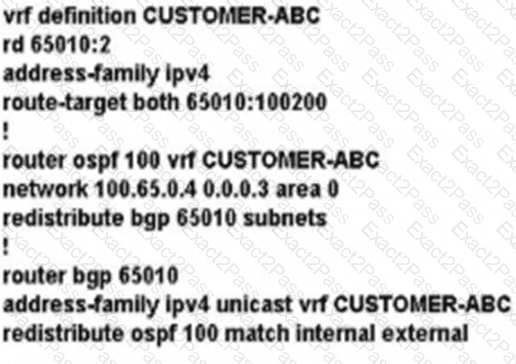
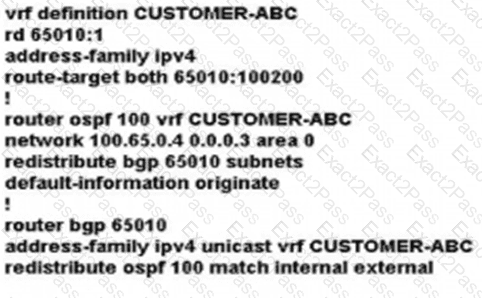
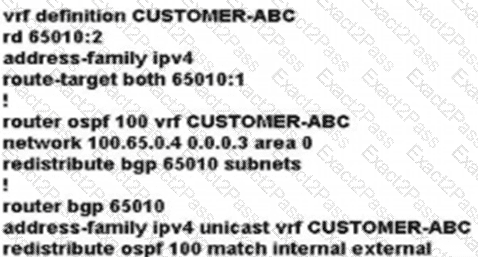
The network engineer who manages ASN 65010 is provisioning a customer VRF named CUSTOMER-ABC on PE-2. The PE-CE routing protocol is OSPF Internet reachability is available via the OSPF 0 0 0.0/0 route advertised by CE-1 to PE-1 In the customer VRF Which configuration must the network engineer Implement on PE-2 so that CE-2 has connectivity to the Internet?

A)
B)
C)
D)
A.

Option A

B.

Option B

C.

Option C

D.

Option D

Question # 59

What are two features of stateful NAT64?

A.

It provides 1: N translations, so it supports an unlimited number of endpoints

B.

It provides 1:1 translation so it supports a limited number of end points

C.

It requires the ipv6 hosts to use either DHCPv6 based address assignments or manual address assignments

D.

It uses address overloading

E.

It requires IPv4 translatable IPv6 address assignments

Question # 60

A network architect décides to expand the scope of the multicast deployment within the company network the network is already using PlM-SM with a static RP that supports a high-bandwidth. video-based training application that s heavily used by the employees, but excessive bandwidth usage is a concern How must the engineer update the network to provide a more efficient multicast implementation ' ?


A.

Configure IGMP to manage the multicast hosts on each LAN

B.

implement BSR to support dynamic RP notification.

C.

Deploy ICMP to Improve multicast reachability across the network using static RP.

D.

Implement STP to improve switching performance for multicast data.

Go to page: