Spring Sale Special Limited Time 70% Discount Offer - Ends in 0d 00h 00m 00s - Coupon code: buysanta

Exact2Pass Menu

Implementing and Operating Cisco Service Provider Network Core Technologies (350-501 SPCOR)

Last Update 8 hours ago Total Questions : 547

The Implementing and Operating Cisco Service Provider Network Core Technologies (350-501 SPCOR) content is now fully updated, with all current exam questions added 8 hours ago. Deciding to include 350-501 practice exam questions in your study plan goes far beyond basic test preparation.

You'll find that our 350-501 exam questions frequently feature detailed scenarios and practical problem-solving exercises that directly mirror industry challenges. Engaging with these 350-501 sample sets allows you to effectively manage your time and pace yourself, giving you the ability to finish any Implementing and Operating Cisco Service Provider Network Core Technologies (350-501 SPCOR) practice test comfortably within the allotted time.

Question # 76

What Is the primary role of Ansible In a network?

A.

It is used as a debugging tool for connectivity issues between the DMZ and an enterprise intranet.

B.

It Is used to diagnose Layer 11ssues In data centers that span more than one city block.

C.

It is used to deploy IPv6 configuration is networks That are dual slack.

D.

It is used as a network automation provisioning and configuration tool.

Question # 77

Which benefit is provided by FRR?

A.

It provides fast forwarding path failure detection times for all media.

B.

It provides rapid failure detection between forwarding engines.

C.

It provides performance data for the service provider network.

D.

It protects Cisco MPLS TE LSPs from link and node failures.

Question # 78

Which two routing protocols support Cisco MPLS TE tunnels? (Choose two.)

A.

IS-IS

B.

RIP

C.

BGP

D.

OSPF

E.

EIGRP

Question # 79

A network engineer is deploying VRF on ASBR router R1. The interface must have connectivity over an MPLS VPN inter-AS Option AB network. Which configuration must the engineer apply on the router to accomplish this task?

A)

B)
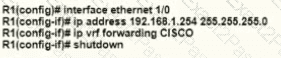
C)
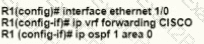
D)
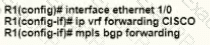
A.

Option A

B.

Option B

C.

Option C

D.

Option D

Question # 80

An engineer is moving all of an organization’s Cisco IOS XE BGP routers to the address-family identifier format. Which command should be used to perform this upgrade quickly with the minimum service disruption?
A.

vrf upgrade-cli

B.

bgp upgrade-cli

C.

address-family ipv4

D.

ip bgp-community new-format

Question # 81

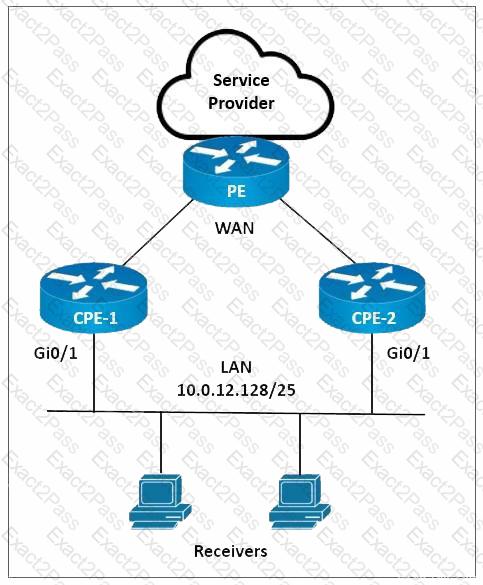
Refer to the exhibit. A network engineer is implementing multicast services on CPE-1 and CPE-2. CPE-1 must be configured as the preferred IGMP querier for the LAN segment. PIM-SM must be implemented on the LAN interfaces with an IGMP version that supports (*, G) joins only. Which configurations must the engineer implement on CPE-1 and CPE-2?

A.

On CPE-1:

interface GigabitEthernet0/1

ip address 10.0.12.129 255.255.255.128

ip pim sparse-mode

ip igmp version 2

On CPE-2:

interface GigabitEthernet0/1

ip address 10.0.12.130 255.255.255.128

ip pim sparse-mode

ip igmp version 2

B.

On CPE-1:

interface GigabitEthernet0/1

ip address 10.0.12.130 255.255.255.128

ip pim sparse-mode

ip igmp version 3

On CPE-2:

interface GigabitEthernet0/1

ip address 10.0.12.129 255.255.255. 128

ip pim sparse-mode

ip igmp version 3

C.

On CPE-1:

interface GigabitEthernet0/1

ip address 10.0.12.130 255.255.255.128

ip pim sparse-mode

ip igmp version 2

On CPE-2:

interface GigabitEthernet0/1

ip address 10.0.12.129 255.255.255.128

ip pim sparse-mode

ip igmp version 2

D.

On CPE-1:

interface GigabitEthernet0/1

ip address 10.0.12.129 255.255.255.128

ip pim sparse-mode

ip igmp version 3

On CPE-2:

interface GigabitEthernet0/1

ip address 10.0.12.130 255.255.255.128

ip pim sparse-mode

ip igmp version 3

Question # 82

You are configuring MPLS traffic-engineering tunnels in the core.

Which two ways exist for the tunnel path across the core? (Choose two )
A.

Tunnel links inherit IGP metrics by default unless overridden

B.

Tunnels can be configured with dynamic path or explicitly defined path

C.

A zero bandwidth tunnel is not a valid option

D.

The bandwidth statement creates a " hard " reservation on the link-The dynamic path option is supported only with IS-IS

Question # 83

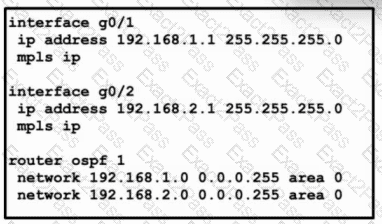
Refer to the exhibit. This enterprise configured MPLS within its network to connect offices that span different geographic areas, with LDP running between connected neighbors. At each office, including headquarters, the networks are running OSPF with a similar configuration.

Which additional action must the engineering team take to support a more reliable connection between MPLS and OSPF?
A.

Implement targeted LDP sessions between the peers connected to interface g0/1 and g0/2.

B.

Implement MD5 authentication between LDP and OSPF neighbors to secure the connection.

C.

Implement LDP session protection to maintain uptime during outages.

D.

Implement MPLS LDP sync to synchronize OSPF and LDP.

Question # 84

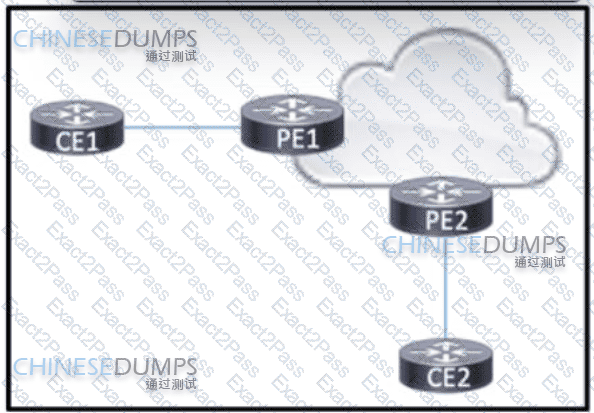
Refer to the exhibit BGP is running in the core of the service provider to exchange routes for its customers, and OSPF serves as the PE-CE routing protocol. The service provider s existing customer at CE1 is opening a new office in a different geographical location connected via CE2. A network engineer must update the BGP implementation so that PE1 and PE2 will share routes and provide communication between CE1 and CE2 Which action must the engineer take?

A.

Configured CE2 to establish a BGP relationship with PE1 and PE2

B.

Configure CE1 and CE2 with a pseudowire that will run over the service provider core.

C.

Configure PE1 and PE2 to mutually redistribute BGP and OSPF in the VRF for the customer.

D.

Configure PE1 and PE2 to redistribute OSPF from the VRF for the customer into BGPPUM

Question # 85

The NOC team must update the BGP forwarding configuration on the network with these requirements:

BGP peers must establish a neighborship with NSF capability and restart the session for the capability to be exchanged after 120 seconds.

BGP peers must delete routes after 360 seconds of inactivity.

Which action meets these requirements?
A.

Set the BGP restart-time to 120 seconds and the BGP ha-mode sso to 360 seconds.

B.

Set the stalepath-time to 120 seconds and the BGP restart-time to 360 seconds.

C.

Set the BGP ha-mode sso to 120 seconds and the BGP restart-time to 360 seconds.

D.

Set the BGP restart-time to 120 seconds and the stalepath-time to 360 seconds.

Question # 86

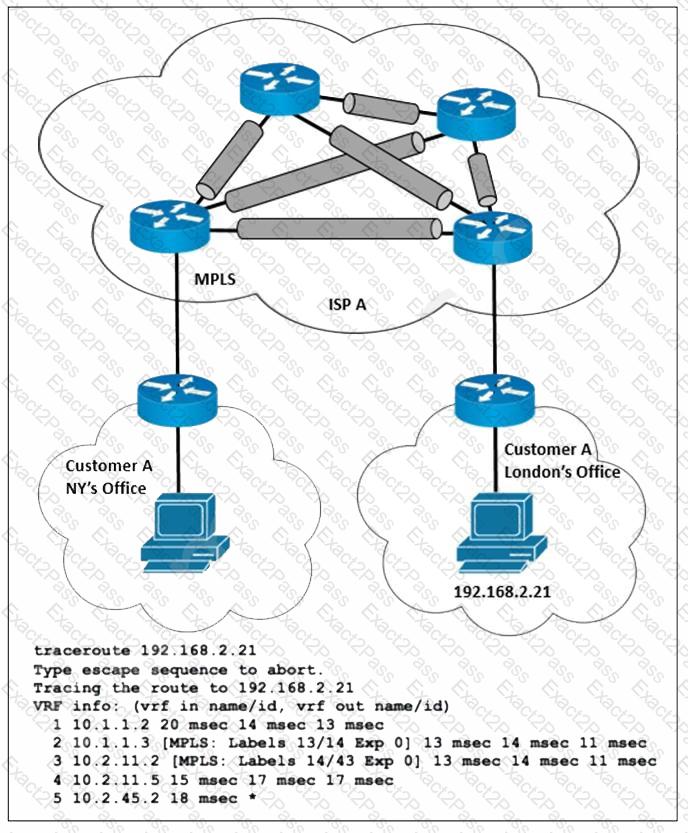
Refer to the exhibit. ISP A provides MPLS L3VPN service to customer A with BGP as the external routing protocol. Customer A has just opened a new branch office in London and requested the service provider to implement lossless service between its two offices. The LDP is enabled over the MPLS backbone and label exchange is working normally. Which action must the ISP engineering team take to enable the service?

A.

Configure LDP and redistribute the route from EIGRP.

B.

Configure BGP address family VPNv4.

C.

Configure IGP and redistribute the route from BGP.

D.

Configure IGP LDP synchronization

Question # 87

Which type of attack is an application attack?

A.

ping of death

B.

ICMP (ping) flood

C.

HTTP flood

D.

SYN flood

Question # 88

An organization with big data requirements is implementing NETCONF as part of its migration to a new cloud-based environment. The organization has multiple offices across widespread geography. A network engineer is configuring NETCONF on one of the border routers. Which configuration must the engineer apply to save the running configuration?

A.

< xml version= " 1.0 " encoding= " utf-8 " ? >

< rpc xmlns= " urn:letf:params:xml:ns:netconf:base:1.0 " message- id= " 1 " >

< edit-config >

< target >

< running/ >

< /target >

< config >

< /config >

< /edit-config >

< /rpc >

B.

< xml version= " 1.0 " encoding= " utf-8 " ? >

< rpc xmlns= " urn:ietf:params:xml:ns:netconf:base:1.0 " message- id= " 2 " >

< cisco-ia:save-config xmlns:cisco- ia= " http://cisco.com/yang/cisco-ia " / >

< /rpc >

C.

snmp-server community public RW

snmp-server trap link left

snmp-server enable traps snmp authentication linkdown linkup

snmp-server enable traps syslog

snmp-server manager

D.

logging history debugging

logging snmp-trap emergencies

logging snmp-trap alerts

logging snmp-trap critical

logging snmp-trap errors

logging snmp-trap warnings

logging snmp-trap notifications

logging snmp-trap information

logging snmp-trap debugging

Question # 89

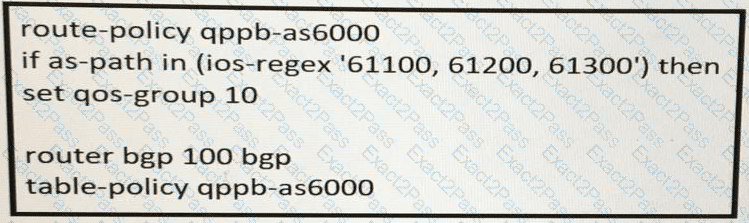
Refer to the exhibit:

Which statement supports QPPB implementation?

A.

QoS policies are identified in the MPLS forwarding table

B.

QoS policies rely exclusively on BGP attributes to manipulate traffic

C.

QoS policies use BGP to gain full coverage on the network.

D.

QPPB policies affect only egress traffic

Question # 90

Why do Cisco MPLS TE tunnels require a link-state routing protocol?

A.

Link-state routing protocols use SPF calculations that the tunnel endpoints leverage to implement the tunnel

B.

The link-state database provides a data repository from which the tunnel endpoints can dynamically select a source ID

C.

The tunnel endpoints can use the link-state database to evaluate the entire topology and determine the best path

D.

The link state database provides segmentation by area, which improves the path-selection process

Go to page: