Exact2Pass

Last Update 16 hours ago Total Questions : 260
The Management Accounting content is now fully updated, with all current exam questions added 16 hours ago. Deciding to include P1 practice exam questions in your study plan goes far beyond basic test preparation.
You'll find that our P1 exam questions frequently feature detailed scenarios and practical problem-solving exercises that directly mirror industry challenges. Engaging with these P1 sample sets allows you to effectively manage your time and pace yourself, giving you the ability to finish any Management Accounting practice test comfortably within the allotted time.
A company’s budget for the next period shows that it would breakeven at sales revenue of $800,000 and fixed costs of $320,000.
The sales revenue needed to achieve a profit of $200,000 in the next period would be:
The cost card for one unit of Product G is as follows:
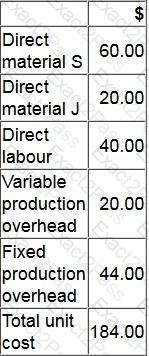
The opening and closing inventories of Product G for month 5 are budgeted to be 10 units and 60 units respectively.
Profit for month 5 using absorption costing is budgeted to be $15,000.
What is the budgeted profit for month 5 using throughput costing?
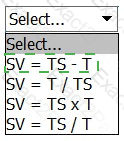
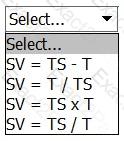
A time series (TS) is made up of two main components i.e. trend (T) and the seasonal variation (SV).
The equation that represents the seasonal variation under the additive model is:
A manufacturing company has a capacity of 10,000 units. The flexed production cost budget of the company is as follows:
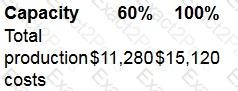
All costs are either fixed, variable or semi-variable.
What is the budgeted total production cost if the company operates at 85% capacity?
A company has budgeted to produce 5,000 units of Product B per month. The opening and closing inventories of Product B for next month are budgeted to be 400 units and 900 units respectively. The budgeted selling price and variable production costs per unit for Product B are as follows:
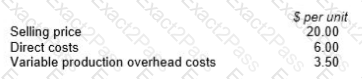
Total budgeted fixed production overheads are $29,500 per month.
The company absorbs fixed production overheads on the basis of the budgeted number of units produced. The budgeted profit for Product B for next month, using absorption costing, is $20,700.
Prepare a marginal costing statement which shows the budgeted profit for Product B for next month.
What was the marginal costing profit for the next month?
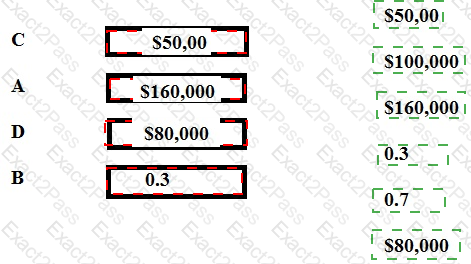
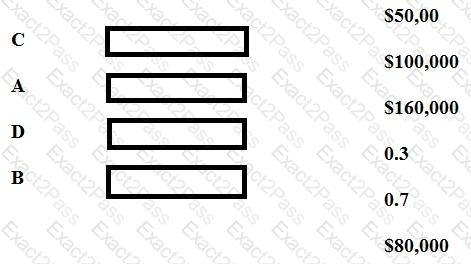
A company is forecasting its revenue for May and has established that sales will be either high, medium or low. The expected value of sales revenue for May has been calculated as $160,000. The following table includes data which relate to the potential sales in May.
Revenue Probability Expected Value
High $250,000 0.2 C
Medium A 0.5 D
Low $100,000 B $30,000
Place the figures given in to the spaces marked with the letters A, B, C and D, to complete the above table.
A company ' s product has the following standard selling price, variable costs and contribution:

Budgeted sales and production was 20,000 units and actual was 19,500 units.
Due to a market downturn the production and sales budget should have been 10% lower.
What is the operational sales volume contribution variance?
RT produces two products from different quantities of the same resources using a just-in-time (JIT) production system. The selling price and resource requirements of each of the products are shown below:
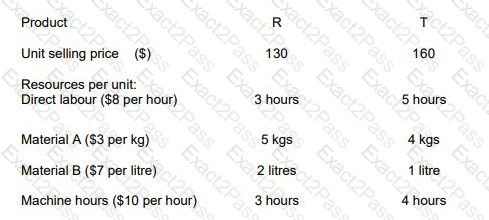
Market research shows that the maximum demand for products R and T during June 2010 is 500 units and 800 units respectively. This does not include an order that RT has agreed with a commercial customer for the supply of 250 units of R and 350 units of T at selling prices of $100 and $135 per unit respectively. Although the customer will accept part of the order, failure by RT to deliver the order in full by the end of June will cause RT to incur a $10,000 financial penalty. At a recent meeting of the purchasing and production managers to discuss the production plans of RT for June, the following resource restrictions for June were identified: Direct labour hours 7,500 hours
Material A 8,500 kgs
Material B 3,000 litres
Machine hours 7,500 hours
(Refer to previous 2 questions.)
You have now presented your optimum production plan to the purchasing and production managers of RT. During your presentation it became clear that the predicted resource restrictions were rather optimistic. In fact, the managers agreed that the availability of all of the resources could be as much as 10% lower than their original predictions.
Assuming that RT completes the order with the commercial customer, and using linear programming, show the optimum production plan for RT for June 2010 on the basis that the availability of all resources is 10% lower than originally predicted.
A company is preparing its annual budget and is estimating the number of units of Product A that it will sell in each quarter of year 2. Past experience has shown that the trend for sales of the product is represented by the following relationship:
y = a + bx where
y = number of sales units in the quarter a = 10,000 units b = 3,000 units x = the quarter number where 1 = quarter 1 of year 1
Actual sales of Product A in Year 1 were affected by seasonal variations and were as follows:
Quarter 1:14,000 units Quarter2: 18,000 units Quarter 3: 18,000 units Quarter 4: 20,000 units
Calculate the expected sales of Product A (in units) for each quarter of year 2, after adjusting for seasonal variations using the additive model.
A company is considering whether to develop an overseas market for its products. The cost of developing the new market is estimated to be $250,000. There is a 70% probability that the development of the new market will succeed and a 30% probability that the development of the new market will fail and no further expenditure will be incurred.
If the market development is successful, the profit from the new market will depend on prevailing exchange rates. There is a 50% chance that exchange rates will be in line with expectations and a profit of $500,000 will be made. There is a 20% chance that exchange rates will be favorable and a profit of $630,000 will be made and a 30% chance that exchange rates will be adverse and a profit of $100,000 will be made.
The profit figures stated are before taking account of the development costs of $250,000.
Use a decision tree to decide whether the company should develop an overseas market for its products.
Select one correct answer.