Exact2Pass

Last Update 20 hours ago Total Questions : 202
The Advanced Management Accounting content is now fully updated, with all current exam questions added 20 hours ago. Deciding to include P2 practice exam questions in your study plan goes far beyond basic test preparation.
You'll find that our P2 exam questions frequently feature detailed scenarios and practical problem-solving exercises that directly mirror industry challenges. Engaging with these P2 sample sets allows you to effectively manage your time and pace yourself, giving you the ability to finish any Advanced Management Accounting practice test comfortably within the allotted time.
A supermarket group has experienced operational problems during recent years, including a shortage of warehousing space due to increasing turnover and poor inventory management. The product portfolio has expanded considerably. Although this has led to increased sales volume, marketing and logistics costs have increased disproportionately. Non product-specific costs have also increased significantly.
Management is now considering using Direct Product Profitability (DPP).
Which of the following statements are valid in respect of the possible implementation of DPP within the supermarket group?
Select ALL that apply.
The following calculation of the net present value (NPV) of a project has been produced.
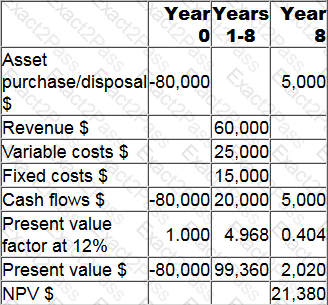
By how much can the forecast revenue decrease before the project is not viable?
An organization has the right to mine for gold on its land. The price of gold and the cost of extraction are such that mining is not currently financially viable. However, the organization has the right to commence mining at any time in the future if the price of gold increases and makes mining financially viable.
This right to commence mining in the future is an option to:
A company has just received the latest in a series of annual payments; this payment was $620. The annual payments are expected to continue for three more years with each payment being increased by the expected rate of inflation. The real cost of capital is 8% per year and the expected rate of inflation is 6% per year.
What is the present value of the future payments the company expects to receive?
Give your answer to the nearest $.
We have 2 divisions with the following information: Profit before depreciation: B1=$800,000, B2=S1,000,000; Assets: B1 =$2,000,000, B2=S3,000,000; Capital employed: B1 = $1,700,000 and B2 = $2,550,000. 20%
straight-line depreciation is used.
Calculate ROI for each division.
Which of the following are TRUE about the theory of constraints? Select ALL that apply.
K Supermarket spends $80,000 per year on checking and processing receipts of inventory. Annual warehouse costs are a further $70,000 per year. These costs are currently treated as fixed overheads in the company ' s costing system.
As an experiment, the company is preparing a direct profitability analysis of a small range of products, including fresh grapes.
K Supermarket receives a total of 3,600 deliveries every year. 20% of these deliveries are of perishable goods such as grapes. It takes twice as long to process a delivery of perishable goods compared to a normal delivery because perishable goods have to be checked more carefully.
Half of the warehouse costs are for the chilled store that is used to store perishable goods. At any time, the chilled store has 800 kilos of perishable goods in stock.
K Supermarket receives 150 deliveries of grapes every year. Each delivery is for 100 kilos of grapes. The grapes spend an average of two days in the chilled store before they are sold.
Calculate the total cost per kilo of checking, processing and storing grapes that should be taken into account in determining the profitability of grapes.
Give your answer to the nearest whole cent.
Performance measures that monitor the extent to which a not-for-profit organization ' s objectives have been achieved are measures of:
It is often claimed that a two-part transfer pricing system offers a number of advantages to organizations which use it.
Which of the following statements is NOT an advantage of using a two-part transfer pricing system?
Which of the following statements about learning curves is correct?

