Exact2Pass

Last Update 19 hours ago Total Questions : 202
The Advanced Management Accounting content is now fully updated, with all current exam questions added 19 hours ago. Deciding to include P2 practice exam questions in your study plan goes far beyond basic test preparation.
You'll find that our P2 exam questions frequently feature detailed scenarios and practical problem-solving exercises that directly mirror industry challenges. Engaging with these P2 sample sets allows you to effectively manage your time and pace yourself, giving you the ability to finish any Advanced Management Accounting practice test comfortably within the allotted time.
A project with a 6 year life generates a positive net present value of $1,100. The discount rate is 8%.
To the nearest $, the equivalent annual benefit is:
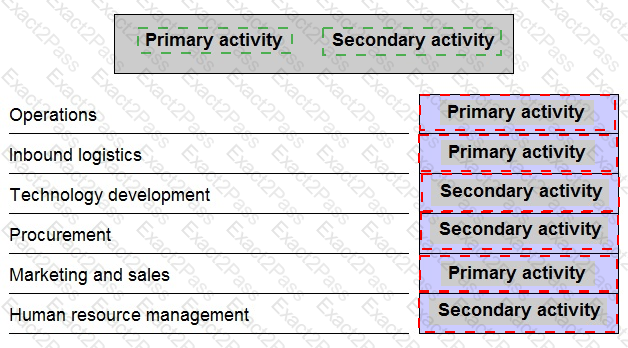
Place the correct category of Value Chain activity against each of the activities described below.

A goal congruent transfer price will always:
An 80% learning curve will apply to the production of a new product. The first unit will require 120 labor hours. The labor rate is $11 per hour.
To the nearest $1, the expected total labor cost for the first 4 units is:
An organization employs a dual pricing basis for the transfer of components between its divisions. This means that:
Kaizen costing is being used by an organization to gradually reduce the unit cost of one of its products in order to achieve a 20% mark up on the product ' s cost.
The selling price of the product must be $72 per unit and this selling price has been maintained for two years.
Two years ago the product ' s cost was $3 per unit more than its selling price. Kaizen costing has achieved an 8% reduction from the previous period ' s unit cost in each of the past two years. The organization expects to continue to achieve the same rate of cost reduction next year.
Which of the following statements provides an accurate analysis of the extent to which Kaizen costing has been successful in achieving the required unit cost for the product?
A public sector service organization is considering whether to use a balanced scorecard or a value for money approach based on the three Es to assess its performance.
Which of the following are correct comparisons of the balanced scorecard and value for money based on the three Es as performance measurement frameworks?
Select ALL that apply.
A very large organization is financed by both debt and equity. It evaluates all projects on the basis of their net present value (NPV) using an organization wide weighted average cost of capital as the discount rate.
For a small project, which TWO of the following would affect the project ' s cash flows AND the discount rate?
A company comprises several divisions.
One of these divisions was originally expected to earn an operating profit next year of $800,000 on net assets of $4 million.
However, the divisional manager is considering investing in a project that would generate a project return on investment (ROI) of 38% on additional net assets of $500,000.
What would be the divisional ROI next year if the project was implemented?
Give your answer to the nearest percentage.
An organization has carried out a risk assessment for a project.
Which of the following possible outcomes are examples of upside risk?
Select ALL that apply.