
Spring Sale Special Limited Time 70% Discount Offer - Ends in 0d 00h 00m 00s - Coupon code: buysanta

Exact2Pass Menu

PMI Agile Certified Practitioner (PMI-ACP)

Last Update 21 hours ago Total Questions : 481

The PMI Agile Certified Practitioner (PMI-ACP) content is now fully updated, with all current exam questions added 21 hours ago. Deciding to include PMI-ACP practice exam questions in your study plan goes far beyond basic test preparation.

You'll find that our PMI-ACP exam questions frequently feature detailed scenarios and practical problem-solving exercises that directly mirror industry challenges. Engaging with these PMI-ACP sample sets allows you to effectively manage your time and pace yourself, giving you the ability to finish any PMI Agile Certified Practitioner (PMI-ACP) practice test comfortably within the allotted time.

Question # 21

The agile coach of a development team uses a servant leadership approach. The team is starting the third iteration of an upgrade to a software product, and work is going slower than initially planned.

What should the coach do to help the team?

A.

Help the team to remove impediments that stall project progress.

B.

Work with the development team to adjust the work plan.

C.

Ask the product owner to assign more resources to the project.

D.

Command and control the team to achieve plan goals.

Question # 22

A project team is working with an enterprise agile center of excellence (CoE) to transition to a Scaled Agile Framework (SAFe). Many of the team members are not familiar with the new methodology and are worried that it will lead to more work and scrutiny.

What should the agile team lead do to help ensure a smooth transition?

A.

Set up lunch-and-learn sessions with the team to provide overviews about the new way of working.

B.

Encourage knowledge sharing and transparency among the working team.

C.

Request the enterprise coach to help the team through the process

D.

Discuss with the team what will change and when and establish a process to address concerns.

Question # 23

An agile lead is working with a team to deliver a new product. During a sprint, a junior team member has been taking too long to deliver a story. During daily coordination meetings, the junior team member does not mention any impediments they might be facing. Senior team members realize the delay but remain quiet. During a one-to-one conversation, the agile lead discovers the junior team member is struggling with a technical issue but feels too intimidated to ask for help.

What should the agile lead do?
An agile lead is working with a team to deliver a new product. During a sprint, a junior team member has been taking too long to deliver a story. During daily coordination meetings, the junior team member does not mention any impediments they might be facing. Senior team members realize the delay but remain quiet. During a one-to-one conversation, the agile lead discovers the junior team member is struggling with a technical issue but feels too intimidated to ask for help.

What should the agile lead do?

A.

Escalate the issue to the functional manager and request another team member with more experience.

B.

Ask the team to refer to the team charter on how to resolve this kind of impediment and help the team member.

C.

Coach the team by reminding them that a self-managed team requires everyone to be able to remove their impediments.

D.

Remind them that self-managed teams require everyone to be honest and supportive of one another to resolve impediments.

Question # 24

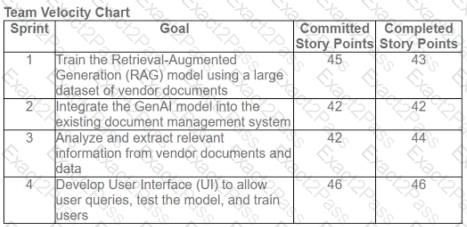
The team is considering committing to 44 story points for the upcoming sprint. Based on the

velocity chart, what advice should the scrum master offer the team?

A.

Reduce the commitment to 40 story points to ensure a higher chance of meeting the commitment.

B.

Maintain a commitment of 46 story points, representing the most frequently completed velocity.

C.

Increase the commitment to 48 story points to push the team toward higher performance.

D.

Commit to 44 story points as it aligns with the team ' s average velocity for completed story points.

Question # 25

While struggling to take ownership of delivery, an agile team fails to keep up with its sprint commitments.

What should the agile coach do?

A.

Work with the sponsor to develop team expectations

B.

Provide the customer with a list of deliverables and obtain agreement

C.

Encourage the team to more frequently interact with all stakeholders

D.

Work on finishing upfront product design rather than comprehensive documentation

Question # 26

Management decides to set up a new project to exploit an emergent market opportunity. Management suggests using an agile approach that is currently working for another project.

What should the agile leader do next?

A.

Conduct a workshop for all key stakeholders to analyze the case and decide on the proper approach.

B.

Suggest an approach that was successful in a previous project.

C.

Accept the manager ' s suggestion and avoid unnecessary conflicts and delays.

D.

Work with the team to analyze the market opportunity and create a tailored agile approach if needed.

Question # 27

What should the team have done to prevent this?

A.

Reprioritized requirements prior to committing to iteration work

B.

Ensured that requirements remained stable during the iteration cycle

C.

Had stakeholders focus on items created after the product backlog was initially built

D.

Worked on features rather than a set of components

Question # 28

What should the agile practitioner do next?

A.

Identify a team member to do a proof of concept using this framework.

B.

Email the team directing them to immediately begin using this new framework.

C.

Obtain feedback from team members on the new framework, and then suggest that the product owner create a backlog item to do a spike on it.

D.

Discuss this option at the next retrospective.

Question # 29

Based on the backlog metrics in the chart, what can explain the jump in points at the end of iteration 4?

A.

The team neglected to account for support and maintenance costs associated with other supported products

B.

The team discovered that previously accepted work could be greatly improved and added story points associated with that work

C.

The team realized that some stories were underestimated relative to other stories and reestimated as needed

D.

The team learned that the product owner needed to increase the output in the next release

Question # 30

An agile coach has been hired to improve the performance and quality of developed software. The coach performed an analysis of the software and discovered an excessive number of escaped defects, leading to external failures.

How can the agile coach effectively address and correct defects in the software development process while maintaining predictability and keeping workloads within capacity?


A.

Work with the team to create explicit rules such as coding and quality standards and testing policies.

B.

Discipline the team members and institute status meetings with penalties for any future escaped defects.

C.

Hire more generalized specialists because the current team members cannot keep up with the pace.

D.

Apply work in process (WIP) limits so the developers are not pressured to release code that is problematic.

Go to page: