
Spring Sale Special Limited Time 70% Discount Offer - Ends in 0d 00h 00m 00s - Coupon code: buysanta

Exact2Pass Menu

PMI Agile Certified Practitioner (PMI-ACP)

Last Update 21 hours ago Total Questions : 481

The PMI Agile Certified Practitioner (PMI-ACP) content is now fully updated, with all current exam questions added 21 hours ago. Deciding to include PMI-ACP practice exam questions in your study plan goes far beyond basic test preparation.

You'll find that our PMI-ACP exam questions frequently feature detailed scenarios and practical problem-solving exercises that directly mirror industry challenges. Engaging with these PMI-ACP sample sets allows you to effectively manage your time and pace yourself, giving you the ability to finish any PMI Agile Certified Practitioner (PMI-ACP) practice test comfortably within the allotted time.

Question # 61

A project team is currently working on sprint seven of a release that is estimated to require twelve sprints to complete. The team has reviewed the stories for this sprint and discovered that it will require rework from previous sprints.

What should the Scrum Master do?

A.

Ask the product owner to revisit the scope of the release and revise it so that the team can keep the current commitment schedule.

B.

Ask the team to find a workaround so that they can continue with the current project management plan.

C.

Advise the team to continue working on the sprints as the release plan has been set.

D.

Ask the team to estimate the amount of rework needed so that adjustments can be made to both the project and release plan.

Question # 62

A user interface (UI) developer has features for channels ready for review. During the team review, the architect is disappointed that Splunk software has not been implemented for better server and client logs. The architect insists on the implementation of Splunk software, which will impact the release date.

Which one of the following is the ideal option for the team to resolve this conflict?

A.

Have the team brainstorm and propose error logging at the client level, which will have a higher impact with less effort within the release timeline.

B.

The product owner should explain to the architect that monitoring, alerting, and logging are not essential for the customer and can be prioritized post-release.

C.

Inform the sponsor that features are being added and will extend the release date after getting approval and communicating this to the architect.

D.

Ask the developer to build and let the testing be postponed until after the release, and inform the architect that the feature will be implemented.

Question # 63

A stakeholder complains about the amount of changes that are being introduced to a project. What should the product owner do?

A.

Escalate the complaint to the scrum master

B.

Suggest implementing a more rigorous change governance

C.

Coach the stakeholder on agile principles

D.

Agree to limit scope changes going forward to control costs

Question # 64

New stakeholders are joining a project team where the agile coach will educate them about their roles and responsibilities.

How should the stakeholders ensure their objectives are met by product delivery?

A.

Provide feedback for completed user stories.

B.

Define how the features will be implemented.

C.

Tell the team which features to include in the backlog.

D.

Write acceptance criteria for the user stories.

Question # 65

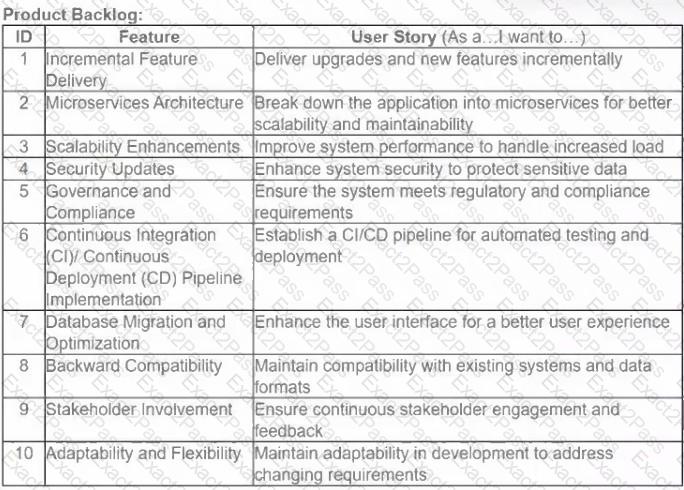
During a recent sprint review meeting with stakeholders, the product owner received detailed feedback indicating the critical changes needed for upgrading the legacy system to better align with the latest technologies and user needs. How should the product owner help ensure the product backlog is effectively managed, while helping the team remain focused? (Refer to the Product Backlog Exhibit)
A.

Prioritize the stakeholder feedback, considering the impact on strategic objectives and current workload, and discuss these priorities with the team in the next sprint planning meeting to collaboratively decide on the next steps.

B.

Implement the changes in the current sprint, reallocating resources and adjusting the sprint goals to accommodate the feedback immediately, regardless of the current workload and potential impact on ongoing tasks.

C.

Update the product backlog immediately without consulting the team, ensuring that the most critical feedback is addressed as soon as possible, even if it disrupts the current workflow.

D.

Disregard the feedback until the next product release, focusing solely on the current sprint commitments to avoid any disruption and maintain the current workflow, even if it means delaying potentially valuable changes.

Question # 66

What should the agile practitioner do?

A.

Ask the opinion of key stakeholders and the client to ensure the correct approach is being used

B.

Work with the team to use this approach and request a quality assurance iteration after every three iterations

C.

Propose to completely eliminate test automation, since this is a quality assurance function

D.

Suggest merging the quality assurance and delivery teams to enhance each iteration ' s test-automation levels and reduce redundancy

Question # 67

An agile team is working well together, but productivity has been flat. What can the project leader do to help them improve performance?

A.

Review the burndown chart to identify ways to increase efficiency.

B.

Chair a weekly team retrospective focusing on identifying areas for continuous improvement.

C.

Ask a senior manager to initiate a root-cause analysis.

D.

Identify team key performance indicators (KPIs) and create positive incentives when targets are achieved.

Question # 68

A project team has been working on a new application. The application is technically challenging, because the team is using new technology unknown to the development team and business requirements are unclear. The product owner has been working closely with the stakeholders to ensure alignment with requirements and other issues. The agile lead is working with the team and product owner on the product backlog.

What is the role of the team?

A.

Estimate and define the work items.

B.

Assess user story quality and independent, negotiable, valuable, estimable, small, and testable (INVEST) criteria.

C.

Add features to the product backlog.

D.

Determine if the demand is or is not feasible.

Question # 69

A product owner worked with the customer to define the success criteria for the launch of a new product in the manufacturing industry. The project team responsible for development is seeking guidance on what to develop first.

Which two actions should the product owner take? (Choose two.)

A.

Work with the team to establish goals for the product at the beginning of each scheduled iteration.

B.

Send the team the latest version of the release plan so they can provide feedback.

C.

Invite the customer to the sprint planning meeting to explain what is deemed most critical to their business.

D.

Ensure all iteration goals are fully developed at the beginning of the project.

E.

Refine the product backlog and identify the Minimum Viable Product

Question # 70

What should the agile coach do?

A.

Work with the team to determine points at which to celebrate its work.

B.

Provide the team with a break by scheduling a team event.

C.

Have the team increase work in progress (WIP) levels to more quickly complete the flow.

D.

Rejuvenate the team by temporarily reducing WIP levels.

Go to page:

