Exact2Pass

Last Update 20 hours ago Total Questions : 1337
The Certified Associate in Project Management (CAPM) content is now fully updated, with all current exam questions added 20 hours ago. Deciding to include CAPM practice exam questions in your study plan goes far beyond basic test preparation.
You'll find that our CAPM exam questions frequently feature detailed scenarios and practical problem-solving exercises that directly mirror industry challenges. Engaging with these CAPM sample sets allows you to effectively manage your time and pace yourself, giving you the ability to finish any Certified Associate in Project Management (CAPM) practice test comfortably within the allotted time.
A Project manager is using agile in a project. As development life cycle is adaptive, how does the project manager handle key stakeholder involvement?
Key stakeholders are regularly involved
Key stakeholders are continuously involved
Key stakeholders are involved at specific milestones
Key stakeholders are always involved
According to the PMBOK® Guide and the Agile Practice Guide, the nature of stakeholder engagement changes significantly when moving from a predictive (waterfall) to an adaptive (agile) lifecycle.
Continuous Involvement: In agile projects, key stakeholders (including customers and product owners) are continuously involved. They do not just provide requirements at the beginning and check the results at the end; they provide ongoing feedback, clarify requirements, and participate in iterative reviews.
Frequency of Interaction: High-frequency interaction reduces the risk of building the wrong product. By being continuously involved, stakeholders can see the product as it grows, allowing them to request changes or pivot the project ' s direction based on real-time learning.
Collaborative Environment: Adaptive environments emphasize " Customer Collaboration over Contract Negotiation. " This requires a partnership where stakeholders are integrated into the rhythm of the project, often participating in Daily Stand-ups, Sprint Reviews, and Backlog Refinement.
Why other options are incorrect:
Option A: Key stakeholders are regularly involved: While " regularly " implies a pattern, it doesn ' t quite capture the " always-on " nature of agile. In agile, the involvement is tighter than just " regular " intervals—it is a continuous loop.
Option C: Key stakeholders are involved at specific milestones: This is a characteristic of Predictive (Waterfall) lifecycles. In those projects, stakeholders are often only engaged during major phase gates or milestone approvals, which can lead to significant gaps between expectations and reality.
Option D: Key stakeholders are always involved: While it sounds similar to continuous, " always " can be misleading in a professional context. Stakeholders are not literally present 24/7 (as " always " might imply), but their feedback and presence are continuous throughout the iterative process. " Continuously " is the formal term used by PMI to describe the active, ongoing engagement model.
Exhibit A is an example of which of the following types of Sequence Activities?
Activity-on-arrow diagramming
Precedence diagramming
Project schedule network diagramming
Mathematical analysis diagramming
In the context of the PMI standards and the PMBOK® Guide, the Precedence Diagramming Method (PDM) is the standard tool and technique used for the Sequence Activities process.
Definition of PDM: This is a method used to create a project schedule network diagram. In this method, activities are represented by " nodes " (usually boxes), and the arrows represent the logical relationships (dependencies) between those activities.
Key Characteristics of PDM (Exhibit A Style):
It supports four types of dependencies: Finish-to-Start (FS), Finish-to-Finish (FF), Start-to-Start (SS), and Start-to-Finish (SF).
It is the most commonly used method in modern project management software.
It allows for the inclusion of leads and lags between activities.
Standard Representation: When an exam refers to a standard diagram showing boxes linked by arrows to show the flow of work, it is almost invariably referring to a Precedence Diagram.
Analysis of Other Options:
A. Activity-on-arrow (AOA) diagramming: Also known as Arrow Diagramming Method (ADM). In this older method, the arrows represent the activities, and the nodes represent milestones or events. It only supports Finish-to-Start relationships and is rarely used today.
C. Project schedule network diagramming: While PDM is a type of project schedule network diagram, " Project schedule network diagramming " is the general name of the output of the Sequence Activities process, whereas the question asks for the specific type or method shown in an exhibit (which typically illustrates the PDM technique).
D. Mathematical analysis diagramming: This is not a standard PMI term for a sequencing technique. Mathematical analysis usually refers to the Critical Path Method (CPM) or PERT, which are techniques used to calculate schedule dates using the network diagram, rather than the diagramming method itself.
Impacts to other organizational areas, levels of service, and acceptance criteria are typical components of which document?
Business case
Work breakdown structure
Requirements documentation
Risk register
According to the PMBOK® Guide, specifically within the Collect Requirements process, the Requirements Documentation describes how individual requirements meet the business need for the project.
Components of Requirements Documentation: Requirements can start at a high level and become progressively more detailed as more information is known. A well-structured requirements document typically includes:
Business requirements: Higher-level organizational needs.
Stakeholder requirements: Needs of a stakeholder or stakeholder group.
Solution requirements (Functional and Non-functional): Functional requirements describe the behaviors of the product, while non-functional requirements describe the environmental conditions or qualities required for the product to be effective (e.g., levels of service, performance, safety, security).
Project requirements: These include acceptance criteria and transition requirements.
Impacts to other organizational areas: This identifies how the project ' s result will affect other entities within the organization, such as the help desk, sales department, or existing infrastructure.
Comparison with other options:
A. Business case: This document focuses on the economic feasibility of the project and the cost-benefit analysis. While it justifies the project, it does not typically contain detailed acceptance criteria or specific levels of service.
B. Work breakdown structure (WBS): This is a deliverable-oriented hierarchical decomposition of the work to be executed. It shows " what " is being built but does not describe the qualitative requirements or impacts like levels of service.
D. Risk register: This document records identified risks, their analysis, and response plans. While an impact to another area could be a risk, the formal definition of these elements (especially service levels and acceptance criteria) resides in the requirements documentation.
Which of the following is an output of the Conduct Procurements process?
Project statement of work
Selected sellers
Risk register updates
Teaming agreements
According to the PMBOK® Guide, the Conduct Procurements process is the process of obtaining seller responses, selecting a seller, and awarding a contract. It is the execution phase of procurement management.
Selected Sellers: This is a primary output. These are the sellers who have been judged to be in a competitive range based upon the outcome of the proposal or bid evaluation. The process culminates in the finalization of the contract and the official selection of the vendor(s) who will provide the goods or services.
Other Key Outputs of Conduct Procurements:
Agreements: The formal documents (contracts) signed between the buyer and seller.
Resource Calendars: Documentation showing when the contracted resources (people or equipment) will be available.
Change Requests: Proposals to modify parts of the project management plan or its subsidiary plans based on the terms of the new agreement.
Project Management Plan Updates: Specifically to the cost baseline, schedule baseline, and procurement management plan.
Analysis of Other Options:
A. Project statement of work (SOW): This is now commonly referred to as the Procurement Statement of Work. It is an input to the Conduct Procurements process (created during Plan Procurement Management) to tell the sellers what is required.
C. Risk register updates: While the risk register can be updated during many processes, it is a secondary update and not the primary defining output of the selection process itself. Option B is the definitive direct output.
D. Teaming agreements: These are legal contractual agreements between two or more entities to form a joint venture or partnership. These are typically established before or during the Plan Procurement Management phase or as an input, rather than being the final output of the selection process.
Which of the following is used to classify stakeholders based on their assessments of power, urgency, and legitimacy?
Power interest grid
Stakeholder cube
Salience model
Directions of influence
According to the PMBOK® Guide (6th Edition), the Salience Model is a specific tool used for stakeholder analysis that categorizes stakeholders based on three distinct attributes:
Power: The level of authority or ability a stakeholder has to influence the project outcome.
Urgency: The degree to which a stakeholder ' s claims require immediate attention (based on time constraints or the stakeholder ' s high stake in the outcome).
Legitimacy: The perceived validity or appropriateness of the stakeholder ' s involvement or claim.
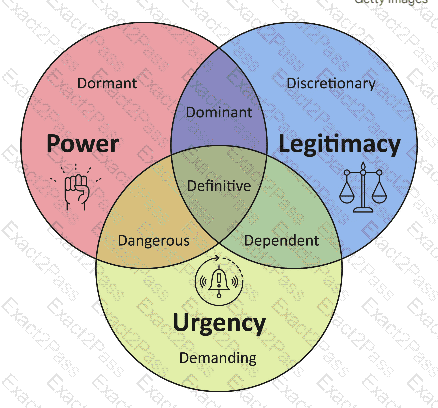
Why the Salience Model is used: This model is particularly useful in large, complex projects or where there are vast networks of stakeholders. By identifying where stakeholders overlap in these three areas (e.g., " Definitive " stakeholders possess all three), project managers can prioritize their engagement efforts and determine which stakeholders require the most proactive management.
Analysis of Distractors:
A (Power/interest grid): This is a simpler classification tool that groups stakeholders based on their level of authority (power) and their level of concern (interest) regarding the project. It does not account for urgency or legitimacy.
B (Stakeholder cube): This is a three-dimensional model that combines the grid elements into a multi-dimensional representation (e.g., Power, Interest, and Attitude). While more complex than a grid, it is not the specific model defined by power, urgency, and legitimacy.
D (Directions of influence): As discussed in previous questions, this classifies stakeholders by their relationship to the project team (Upward, Downward, Outward, Sideward) rather than by their inherent attributes of power or urgency.
The Monitoring and Controlling Process Group includes processes that:
Establish the scope, objectives, and course of action of a project,
Define a new project or a new phase of an existing project.
Track, review, and regulate the progress and performance of a project.
Complete the work defined in the project management plan.
In accordance with the PMBOK® Guide, the Monitoring and Controlling Process Group consists of those processes required to track, review, and regulate the progress and performance of the project; identify any areas in which changes to the plan are required; and initiate the corresponding changes.
The key benefit of this process group is that project performance is measured and analyzed at regular intervals, appropriate events, or exception conditions to identify variances from the project management plan. It involves:
Comparing actual performance against the project management plan.
Assessing performance to determine whether any corrective or preventive actions are indicated.
Identifying new risks and analyzing, tracking, and monitoring existing risks.
Maintaining an accurate, timely information base concerning the project’s product(s) and their associated documentation through completion.
Providing forecasts to update current cost and current schedule information.
Monitoring implementation of approved changes as they occur.
Analysis of Distractors:
A. Establish the scope, objectives, and course of action of a project: This defines the Planning Process Group. Planning is about establishing the " road map, " whereas Monitoring and Controlling is about ensuring the team stays on that map.
B. Define a new project or a new phase of an existing project: This defines the Initiating Process Group, which involves obtaining authorization to start the project or phase.
D. Complete the work defined in the project management plan: This defines the Executing Process Group. Execution is the act of performing the work, while Monitoring and Controlling is the act of overseeing that performance to ensure it meets the defined standards and baselines.
A product owner wants to ensure that the project ' s requirements, including product requirements, are met and validated. To do this project manager wants.
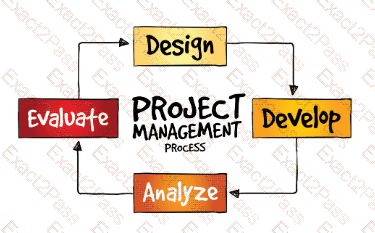
Match each process to its definition.
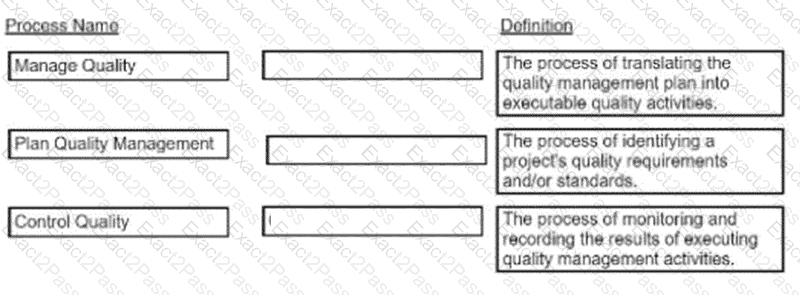

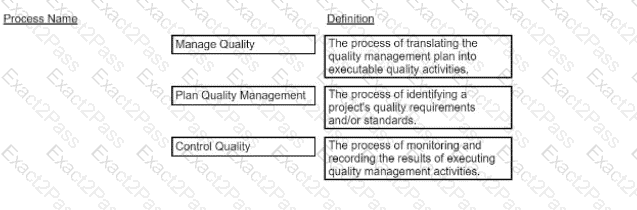 A group of words on a white background Description automatically generated
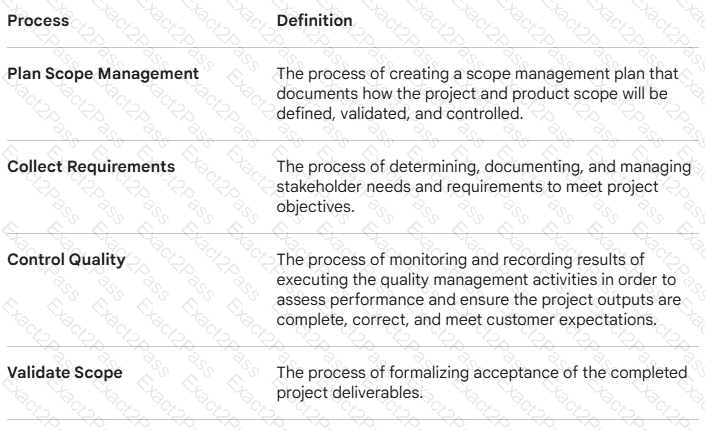
According to the PMBOK® Guide, ensuring that requirements are met and validated involves a flow from planning to execution and finally to formal acceptance.
Plan Scope Management: This is the foundational process. It provides guidance and direction on how scope will be managed throughout the project. The output is the Scope Management Plan, which acts as a " rulebook " for how the team will handle product requirements.
Collect Requirements: This is the active elicitation phase. It provides the basis for defining the product scope and project scope. Without this process, the project manager cannot know what " success " looks like for the Product Owner.
Control Quality: Often confused with Validate Scope, Control Quality is an internal process. It focuses on the correctness of the deliverables and ensures they meet the technical requirements. It is usually performed before Validate Scope to ensure the team isn ' t showing the customer a " broken " product.
Validate Scope: This is the process where the Product Owner or Customer officially signs off on the deliverables. The key benefit of this process is that it brings objectivity to the acceptance process and increases the probability of final product acceptance by validating each deliverable.
Crucial Distinction: A common point of failure in professional exams is the difference between Control Quality and Validate Scope.
Control Quality is about Correctness (Meeting technical specs; internal).
Validate Scope is about Acceptance (Meeting stakeholder needs; external).
Per PMI standards, these processes work in tandem to ensure that the final product delivered matches the original intent documented during the " Collect Requirements " phase.
The project management processes presented in the PMBOK Guide® should:
always be applied uniformly.
be selected as appropriate by the sponsor.
be selected as appropriate by the project team.
be applied based on ISO guidelines.
According to the PMBOK® Guide, specifically in the introduction regarding the Standard for Project Management, the processes described are considered " good practice " on most projects most of the time. However, this does not mean they should be applied uniformly to every project.
Tailoring: This is the critical concept that project management is not a " one size fits all " endeavor. The project manager and the project team are responsible for determining which processes are appropriate, and what the appropriate degree of rigor for each process is, given the specific needs of the project.
Selection Criteria: When selecting processes, the team considers the project ' s size, complexity, risk, resources, and organizational culture. This ensures that the management effort is proportionate to the value and scale of the work.
Shared Responsibility: While the Project Manager often leads the effort, the PMBOK® Guide emphasizes that the project team should collaborate on these selections to ensure all functional areas of the project are adequately addressed.
Analysis of other choices:
Choice A (Always be applied uniformly): Applying all 47+ processes to every project would result in significant " gold plating " of management effort and unnecessary bureaucracy for smaller or simpler projects.
Choice B (Be selected as appropriate by the sponsor): While the sponsor provides the resources and the business case, they generally do not have the granular expertise or the day-to-day involvement required to select specific project management processes. That is the functional role of the project team.
Choice D (Be applied based on ISO guidelines): While PMI standards often align with ISO standards (like ISO 21500), the PMBOK® Guide is a self-contained framework. The decision on which processes to use is based on the project ' s specific context, not a mandate to follow ISO guidelines.
When is a project finished?
After verbal acceptance of the customer or sponsor
After lessons learned have been documented in contract closure
When the project objectives have been met
After resources have been released
According to the PMBOK® Guide, a project is defined as a temporary endeavor undertaken to create a unique product, service, or result. The " temporary " nature of a project indicates that it has a defined beginning and end.
Reaching the End: A project reaches its conclusion when the project objectives have been achieved. This is the primary success criterion. If the goals outlined in the Project Charter and Scope Statement are fulfilled, the project work is technically complete.
Other Reasons for Termination: A project may also be finished if:
The objectives cannot be met.
The need for the project no longer exists (e.g., the customer no longer wants the product or the strategy has changed).
The funding is exhausted or no longer available.
Transition to Closing: Once the objectives are met, the project enters the Close Project or Phase process. This is where the administrative work happens to formally shut down the project.
Objective Achievement vs. Administrative Closure: While reaching objectives signifies the end of the project work, the project is not " officially " closed in the organization ' s records until administrative tasks (like final reporting and archiving) are finished. However, the definition of project completion is fundamentally tied to the status of its objectives.
Comparison with other options:
A. After verbal acceptance of the customer or sponsor: Verbal acceptance is insufficient in professional project management. Formal, written sign-off is required during the Validate Scope process to formalize acceptance of deliverables.
B. After lessons learned have been documented in contract closure: Documenting lessons learned is a critical activity within the Close Project or Phase process, but it is a part of the closing activities that happen because the project objectives were met or the project was terminated.
D. After resources have been released: The release of resources (staff, equipment, facilities) is one of the final steps in the Closing process. Like lessons learned, this is a procedural consequence of the project being finished, not the definition of its completion.
Which behavior is a management trait?
Asking what and why
Challenging the status quo
Innovating
Relying on control
According to the PMBOK® Guide (specifically the section on Project Manager Competencies and the comparison between Leadership vs. Management), PMI distinguishes between the traits of a leader and the traits of a manager.
Management is primarily concerned with stability, efficiency, and predictability within an organization or project. The key differences highlighted in the PMI standards are:
Relying on Control (Management): Managers ensure that work is performed according to the plan. They use systems, processes, and " control " mechanisms (like status reports, quality checks, and budget tracking) to minimize risk and maintain order.
Innovating and Challenging the Status Quo (Leadership): These are leadership traits. Leaders look toward the future, seeking to improve and change existing paradigms rather than just maintaining them.
Asking What and Why (Leadership): Leaders focus on the purpose and the bigger picture ( " What are we doing and why? " ). Conversely, managers typically focus on " How and When " to ensure the execution is timely and correct.
The following table summarizes the distinction according to PMI ' s Project Manager Competency Development Framework:
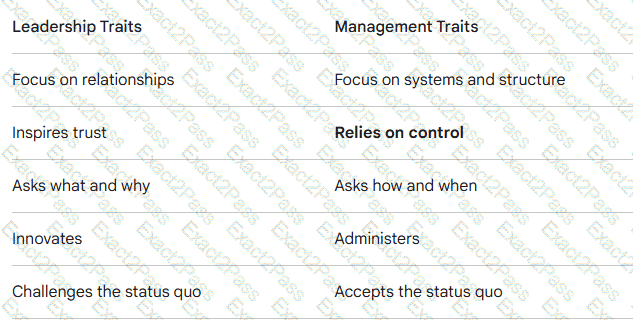
Therefore, Relying on control is the definitive management trait among the provided options.
A project reports an earned value (EV) of USS45 for work completed with an actual cost (AC) of US$40. What is the cost performance index (CPI)?
0.88
1.12
0.58
1.58
According to the PMBOK® Guide, the Cost Performance Index (CPI) is a measure of the cost efficiency of budgeted resources, expressed as the ratio of earned value to actual cost. It is one of the most critical metrics in Earned Value Management (EVM) for determining if a project is under or over budget.
The Formula: The formula for calculating CPI is:
$$CPI = \frac{EV}{AC}$$
Where:
EV (Earned Value): The value of the work actually performed (US$45).
AC (Actual Cost): The actual cost incurred for the work performed (US$40).
The Calculation:
$$CPI = \frac{45}{40} = 1.125$$
Rounding to two decimal places, the result is 1.12.
Interpretation:
A CPI greater than 1.0 (like 1.12) indicates that the project is under budget or performing better than planned regarding costs. For every dollar spent, the project has earned $1.12 worth of work.
A CPI equal to 1.0 indicates the project is exactly on budget.
A CPI less than 1.0 indicates the project is over budget.
Analysis of other options:
A. 0.88: This would be the result if the calculation were inverted ($AC / EV$ or $40 / 45$), which is incorrect. A value below 1.0 indicates poor cost performance.
C. 0.58 and D. 1.58: These values do not correspond to the mathematical relationship between the provided EV and AC figures.
Per PMI standards, the CPI is a primary indicator used to forecast the final project cost at completion (Estimate at Completion), making it a vital tool for the Control Costs process.
A recently hired project manager is looking for templates to use for projects on which they will work. To what category of enterprise environmental factors should the project manager refer?
Resource availability
Infrastructure
Academic research
Corporate knowledge base
According to the PMBOK® Guide, when a project manager needs historical information, files, or standard templates, they must look into the organization ' s Organizational Process Assets (OPAs), specifically the Corporate Knowledge Base.
Corporate Knowledge Base: This is a repository for storing and retrieving information. It includes:
Configuration management knowledge bases: Containing versions of software and hardware components and baselines of all performing organization standards, policies, and procedures.
Financial data knowledge bases: Containing information such as labor hours, incurred costs, budgets, and any project cost overruns.
Historical information and lessons learned knowledge bases: (e.g., project records and documents, all project closure information and documentation).
Templates: Standardized documents for things like Project Charters, WBS, and Risk Registers that the organization has developed over time to ensure consistency.
Important Correction on Question Terminology: In strict PMI standards, templates are officially categorized as Organizational Process Assets (OPAs), not Enterprise Environmental Factors (EEFs). However, in the context of many exam questions, the " Corporate Knowledge Base " is the specific " category " or " location " where these assets are stored.
Analysis of other options:
Resource availability (Option A): This is an EEF, but it refers to the physical or human resources available to the project, not documentation or templates.
Infrastructure (Option B): This is an EEF that refers to the organization ' s existing facilities, equipment, and telecommunication channels.
Academic research (Option C): This is an external EEF (industry studies, publications, and benchmarking) that provides general knowledge but would not contain the organization ' s internal project templates.
Per PMI standards, a new project manager should always begin by reviewing the Corporate Knowledge Base to leverage existing organizational wisdom and ensure their project documentation aligns with company standards.
What kind of skills should a project manager use when attempting to achieve consensus by balancing the conflicting and competing goals of project stakeholders?
Interpersonal skills and the ability to manage people
Strategic and business management skills
Technical and business management skills
Business analysis skills and expertise
According to the PMBOK® Guide, a project manager must navigate a complex environment of diverse stakeholders with often conflicting interests. Achieving consensus is a core leadership function that relies heavily on Interpersonal and Team Skills.
Conflict Management and Negotiation: To balance competing goals, the project manager uses interpersonal skills such as negotiation, conflict management, and active listening. These " Power Skills " (as defined in the PMI Talent Triangle®) allow the project manager to lead the team and stakeholders toward a common goal without necessarily having direct authority over all parties.
Leading People: Managing people involves understanding human behavior, motivating team members, and resolving disagreements to keep the project moving forward. The ability to influence stakeholders and facilitate meetings to reach a " win-win " agreement is fundamental to successful project integration.
Analysis of other options:
Strategic and business management skills (Option B): These skills are used to ensure the project aligns with high-level organizational goals and delivers business value. While they provide context for why a decision is made, they are not the primary tools used to manage the interpersonal friction of conflicting goals.
Technical project management skills (Option C): These refer to the knowledge of project management domains (like scheduling, cost, and scope). While necessary to understand project constraints, technical skills alone cannot resolve human-centric conflicts or build consensus.
Business analysis skills and expertise (Option D): These are used to define requirements and solve business problems. While they help identify what stakeholders need, they do not provide the framework for managing the stakeholders themselves.
Per PMI standards, the project manager’s role is primarily one of integration and communication. Success in a diverse environment depends on the mastery of Interpersonal skills and the ability to manage people to unify the team and stakeholders.
A project manager is assigned to a project, and the sponsor signals to perform first actions. However, the project manager is unsure how to apply organizational resources into project activities before a formal authorization. Which document should be used in this case?
Project plan
Business case
Budget requirement
Project charter
According to the PMBOK® Guide, specifically the Develop Project Charter process, the Project Charter is the foundational document that bridges the gap between organizational strategy and project execution.
Formal Authorization: The Project Charter is the document that formally authorizes the existence of a project. Without a signed charter, a project does not officially exist in the eyes of the organization, and the project manager lacks the legal or administrative standing to proceed.
Empowerment of the PM: The most critical function of the charter in this specific scenario is that it provides the project manager with the authority to apply organizational resources to project activities. Until the charter is approved by the sponsor or the initiating entity, the project manager cannot officially assign staff, spend budget, or utilize company equipment.
High-Level Scope: It establishes the high-level objectives and boundaries of the project. This ensures that when the PM does start applying resources, they are doing so in alignment with the goals the sponsor has officially sanctioned.
Analysis of other options:
Option A: The Project Management Plan is a detailed document created after the charter has been signed. You cannot effectively build a project plan without the authority and high-level direction provided by the charter.
Option B: The Business Case provides the economic justification for the project. While it explains why the project should happen, it does not grant the project manager the authority to manage resources.
Option C: Budget requirements are specific financial needs identified during the planning phase. Like the project plan, a budget cannot be officially executed or managed until the PM is authorized via the charter.
Per PMI standards, the Project Charter is the only document that solves the project manager ' s dilemma by providing the formal authorization necessary to move from a conceptual idea to an active project with assigned organizational resources.
Which process uses occurrence probability and impact on project objectives to assess the priority of identified risks?
Identify Risks
Perform Qualitative Risk Analysis
Plan Risk Management
Perform Quantitative Risk Analysis
According to the PMBOK® Guide, specifically within the Project Risk Management knowledge area, Perform Qualitative Risk Analysis is the process of prioritizing individual project risks for further analysis or action by assessing their probability of occurrence and impact.
The Probability and Impact Matrix: This is the primary tool used in this process. Each identified risk is evaluated against a scale (e.g., 0.1 to 1.0 for probability and low-to-high for impact). By multiplying these two factors, the project manager determines a Risk Score, which dictates the priority of the risk.
Subjective Assessment: Unlike quantitative analysis, which uses hard data and modeling, qualitative analysis is often faster and relies on the subjective perceptions of the project team and stakeholders. It is used to quickly filter out low-priority risks so the team can focus on the " high-threat " or " high-opportunity " items.
Data Quality Assessment: A critical component of this process is evaluating the quality of the data available about the risks. If the data is unreliable, the qualitative assessment may be flawed, requiring further research.
Urgency and Risk Categorization: Beyond probability and impact, this process also looks at Risk Urgency (how soon a response is needed) and categorizes risks by their source (using the Risk Breakdown Structure) to identify patterns or common causes.
Comparison with other options:
A. Identify Risks: This is the initial process of determining which risks may affect the project and documenting their characteristics in the Risk Register. It does not involve the formal scoring or prioritization of those risks.
C. Plan Risk Management: This is a Planning process that defines how to conduct risk management activities. It creates the framework and the scales for probability and impact but does not actually perform the assessment on specific risks.
D. Perform Quantitative Risk Analysis: This process follows qualitative analysis and uses numerical analysis (like Monte Carlo simulation or Decision Tree analysis) to provide a combined effect of identified risks on overall project objectives. While it uses probability, it is a much more complex, data-driven mathematical approach rather than a simple prioritization method.
A project was sent for early customer testing and the customer reported that some of the features do not features do not meet the requirements. What should the project manager have done to avoid this scenario?
Engage customer earlier
Conduct quality audits
Validate Scope
Validate quality requirements
According to the PMBOK® Guide, the scenario describes a situation where deliverables reached the customer but failed to meet the specified requirements. This indicates a breakdown in the Manage Quality and Control Quality processes. To avoid this, the project manager should have conducted Quality Audits.
The Role of Quality Audits: A quality audit is a structured, independent process used to determine if project activities comply with organizational and project policies, processes, and procedures. It is a key tool in the Manage Quality process.
Prevention of Non-conformance: Audits help identify inefficient or ineffective policies being used on the project. By conducting these audits early and often, the project manager can ensure that the " process " of building the features is correct, which results in a product that actually meets the requirements.
Closing the Gap: Audits confirm the implementation of approved change requests and ensure that the team is following the Quality Management Plan. If the team was deviating from requirements, a quality audit would have flagged this internal inconsistency before the product ever reached the customer for testing.
Why other options are incorrect:
Option A: Engage customer earlier: While stakeholder engagement is important, the prompt specifies that the features did not meet requirements. This is a technical quality issue, not necessarily a communication issue. If the requirements were already documented, the team failed to build to those standards.
Option C: Validate Scope: This is the process of formalizing acceptance of the completed project deliverables by the customer. Validate Scope is where the customer found the problem. You cannot " Validate Scope " to avoid the problem; validation is the point where the failure is officially recognized.
Option D: Validate quality requirements: This is not a standard PMI process name. While you " Plan Quality Management " to define requirements, " validating " them usually refers to the internal verification of the deliverables themselves (Control Quality), which is governed by the processes checked during a Quality Audit.
One of the tools and techniques of the Manage Project Team process is:
organization charts.
ground rules.
organizational theory,
conflict management.
According to the PMBOK® Guide, Conflict Management is a primary tool and technique used in the Manage Project Team process. This process involves tracking team member performance, providing feedback, resolving issues, and managing team changes to optimize project performance.
Role of the Project Manager: In a project environment, conflict is inevitable. Sources of conflict include scarce resources, scheduling priorities, and personal work styles. The project manager must use conflict management to minimize negative impacts and turn differences into positive outcomes.
Conflict Resolution Techniques: The PMBOK® identifies five general techniques for resolving conflict:
Withdraw/Avoid: Retreating from a potential conflict situation.
Smooth/Accommodate: Emphasizing areas of agreement rather than areas of difference.
Compromise/Reconcile: Searching for solutions that bring some degree of satisfaction to all parties.
Force/Direct: Pushing one ' s viewpoint at the expense of others (win-lose).
Collaborate/Problem Solve: Incorporating multiple viewpoints and insights from different perspectives to reach a consensus.
Comparison with Other Options:
Organization charts (A): These are a tool and technique for Plan Human Resource Management (now Plan Resource Management) used to document roles and reporting relationships.
Ground rules (B): These are established in the Develop Project Team process to set expectations regarding acceptable behavior by project team members.
Organizational theory (C): This is a tool and technique used in Plan Human Resource Management to provide information regarding the way in which people, teams, and organizational units behave.
The table represents the possible durations of a specific project task.
Using the three-point estimating technique what is the expected number of days it should take to complete the task?
2
3
4
6
In Project Management, when we are given a range of possible durations, we use the Three-Point Estimating formula to determine the expected duration ($t_E$).
While there are two formulas, the standard calculation for this problem (Triangular Distribution) is:
$$t_E = \frac{O + M + P}{3}$$
Where:
$O$ (Optimistic): 2 days
$M$ (Most Likely): 3 days
$P$ (Pessimistic): 7 days
Calculation:
$$t_E = \frac{2 + 3 + 7}{3}$$
$$t_E = \frac{12}{3}$$
$$t_E = 4$$
Why this matters:
Reduces Bias: Relying on a single " Most Likely " estimate can be risky. Three-point estimating forces the team to consider risks (Pessimistic) and opportunities (Optimistic).
Accuracy: It provides a more mathematically sound average than a simple guess, helping the Project Manager create a more realistic Schedule Baseline.
Note on PERT (Beta Distribution):
If the question specifically asked for PERT or a Weighted Average, the formula would be $t_E = \frac{O + 4M + P}{6}$. Using PERT for these numbers would result in $3.5$ days. Since $4$ is the available choice that aligns with the simple triangular average, Option C is the correct answer.
Per PMI standards, this technique is used within the Estimate Activity Durations process to improve the accuracy of time estimates when there is uncertainty associated with the activity.
What can a project1 manager review to understand the status of project?
Work breakdown structure (WBS) status
Quality and technical performance measures
Cost and scope baselines
Business case completeness
To understand the actual status of a project (how well it is performing against its objectives), a project manager must look at performance data that reflects the current state of the work being done.
Quality and Technical Performance Measures (Choice B): According to the PMBOK® Guide, specifically within the Monitor and Control Project Work and Control Quality processes, performance measures are vital for understanding project status. Quality measures (like defect rates or rework cycles) and technical performance measures (like weight, transaction speed, or storage capacity) indicate whether the project result is meeting the defined requirements. If these measures are off-target, the project is technically " in trouble " regardless of what the timeline says.
Work Breakdown Structure (WBS) Status (Choice A): The WBS is a decomposition of the total scope. While you can track completion against the WBS, " WBS status " is not a standard performance metric. You generally track the status of the work packages or activities derived from the WBS, often using Earned Value Management (EVM).
Cost and Scope Baselines (Choice C): These are the standards against which performance is measured, but they do not show the status themselves. The baselines represent the " Plan. " To understand status, you would need to compare the " Actuals " against these baselines (e.g., Variance Analysis or Earned Value Analysis). Reviewing the baseline alone only tells you what you planned to do, not what is actually happening.
Business Case Completeness (Choice D): The Business Case is a pre-project document that justifies the investment. While it is reviewed during the project to ensure the project remains viable (strategic alignment), its " completeness " does not provide the day-to-day operational status of project execution.
By reviewing Quality and Technical Performance Measures, a project manager can determine if the deliverables are being produced to the required standard and if the project is effectively meeting its functional goals, which is a key component of the overall project health.
Which of the following conditions should the project manager consider when working on the scheduling for an adaptive environment?
Defining, sequencing, estimating activity duration, and developing a schedule model are so tightly inked that they are viewed as a single process.
The detailed project schedule should remain flexible throughout the project to accommodate newly gained knowledge
An iteractive scheduling and on-demand, pull-based scheduling will be required.
To address the full delivery schedule, a range of techniques may be needed and then need to be adapted
According to the PMBOK® Guide, specifically in the section regarding Trends and Emerging Practices in Project Schedule Management, the approach to scheduling changes significantly when moving from a predictive (waterfall) environment to an adaptive (agile) environment.
Tight Integration of Processes: In adaptive environments, the traditional scheduling processes—Define Activities, Sequence Activities, Estimate Activity Durations, and Develop Schedule—are so tightly linked that they are often performed simultaneously or as a single, continuous process. This is because the team works on small batches of work (increments) rather than planning the entire project in one go.
Rapid Iteration: Instead of a linear flow where one process must end before the next begins, adaptive teams refine their understanding of the work in real-time. As soon as a requirement is defined, it is estimated and placed into the schedule (sprint/iteration) almost immediately.
Collaboration: This " single process " view is facilitated by high levels of team collaboration and the use of tools like backlogs and Kanban boards, where work items move from definition to execution rapidly.
Why other options are incorrect:
Option B: While it is true that schedules remain flexible in adaptive environments, this is a general characteristic of the environment, not a " condition " or technical process description provided by the PMBOK Guide for how scheduling is performed.
Option C: This describes specific types of scheduling (Iterative and Pull-based/Kanban). While these are used in adaptive environments, they are listed as separate techniques in the Guide. Option A is the more fundamental description of how the standard scheduling processes are treated in such environments.
Option D: This is a vague statement about " adapting techniques. " While project management always involves tailoring, it does not specifically address the scheduling mechanics of an adaptive environment as clearly as the integration of processes mentioned in Option A.
A software project has completed the first iteration, and the testing manager noted that some features were not incorporated and would not approve the software. The business unit manager who will use the software is satisfied with the software and wants to start the rollout.
What should the project manager do?
Escalate the issue to the project management office (PMO).
Organize a meeting between the two managers.
Ask the project team to resolve all of the open issues.
Escalate to the sponsor to decide when to commence the rollout.
In the PMBOK® Guide, a project manager often acts as a negotiator and facilitator when there are conflicting requirements or perspectives between key stakeholders. This scenario highlights a conflict between Quality/Compliance (Testing Manager) and Business Utility (Business Unit Manager).
Why Choice B is correct:
Stakeholder Management: The first step in resolving any conflict is to facilitate communication. By bringing both managers together, the Project Manager allows them to align on the " Definition of Done " and the " Minimum Viable Product " (MVP).
Understanding Trade-offs: The Business Unit Manager might find the software " good enough " for immediate needs, while the Testing Manager might be worried about long-term stability or technical debt. A meeting allows for a risk-based decision: can the rollout proceed with known issues, or are the missing features critical?
Conflict Resolution: According to PMI, Collaborating/Problem Solving (win-win) is the preferred conflict resolution technique. This meeting provides the platform to reach a consensus or a compromise without immediate escalation.
Analysis of other options:
A (Escalate to the PMO): Escalation should be a last resort. The PMO provides guidance and templates, but they are not typically responsible for resolving functional disputes between mid-level managers until the Project Manager has attempted to facilitate a resolution.
C (Resolve all open issues): While this sounds proactive, it ignores the Business Unit Manager ' s request to start the rollout now. It also assumes the project has the time and budget to fix everything immediately, which may not be the case in an iterative environment where some features are intentionally deferred to future iterations.
D (Escalate to the sponsor): Similar to Choice A, skipping straight to the Sponsor (the person providing the money/resources) is premature. The Sponsor expects the Project Manager to manage stakeholder expectations and only bring " unresolvable " issues to their attention.
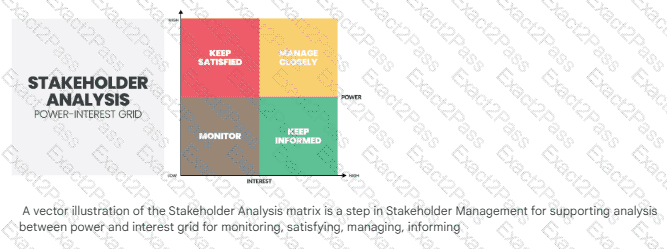
Key Concept: The Project Management Institute (PMI) emphasizes that a Project Manager must be an Integrator. By organizing a meeting (Choice B), the PM ensures that the rollout decision is informed by both technical quality standards and business necessity, ensuring that the final path forward is documented and agreed upon by both parties.
A new game development process must have three versions. Each version is to be developed in approximately five iteration cycles with a duration of one month each. This will help this small enterprise to have a return on investment (ROI) as the project runs from the first cycle. Which methodology should the project manager adopt and implement in the project?
Feature-driven development (FDD) as it will deliver product segments and the milestones are controlled by the development manager.
Kanban as it will provide flexibility to the team for working at their own pace in the time frame requested.
Scrum as it uses sprints and retrospectives, maximizing time delivery and the value of the product.
Extreme Programming (XP) as it will help deliver more quickly since developers will work in pairs.
According to the Agile Practice Guide and the PMBOK® Guide, the scenario describes a project that requires a high degree of structure within an adaptive environment to ensure early and continuous delivery of value (ROI).
Iterative and Incremental Delivery: The request for " five iteration cycles " of " one month each " perfectly aligns with the Scrum framework’s definition of a Sprint. Sprints are timeboxed to one month or less to create consistency and reduce complexity.
Maximizing ROI: Scrum is specifically designed to deliver a Potentially Shippable Product Increment at the end of every sprint. This allows the small enterprise to release versions of the game early, satisfying the requirement to see a return on investment " as the project runs from the first cycle. "
Empirical Process Control: Through ceremonies like the Sprint Review and Retrospective, the project manager and the team can inspect the product and the process, ensuring that the most valuable features are prioritized (via the Product Backlog) to maximize the product ' s market value.
Analysis of other options:
Option A: While Feature-driven development (FDD) does deliver segments, it is more focused on specific " features " and is often more hierarchical. Scrum is the industry standard for timeboxed, iteration-based game development where ROI is a primary driver.
Option B: Kanban is a flow-based methodology, not necessarily an iteration-based one. It does not natively use the fixed " five iteration cycles " mentioned in the prompt. Kanban focuses on reducing Work in Progress (WIP) rather than fixed-duration cycles.
Option C: Extreme Programming (XP) focuses heavily on engineering practices (like pair programming). While it is fast, the prompt specifically highlights the structure of iterations and the goal of ROI/Value, which are core tenets emphasized in the Scrum framework.
Per PMI standards, Scrum is the most appropriate methodology when a project requires fixed-duration iterations (Sprints) to ensure the frequent delivery of value and the achievement of early ROI for the organization.
Which of the following is an input to Direct and Manage Project Execution?
Performance reports
Project charter
Outputs from planning processes
Enterprise environmental factors
According to the PMBOK® Guide, the Direct and Manage Project Work (referred to in older versions as " Direct and Manage Project Execution " ) is the process of leading and performing the work defined in the project management plan and implementing approved changes to achieve the project ' s objectives.
Outputs from Planning Processes: This is a major input to this process. Because the execution phase is where the project team carries out the work, they must use the various plans and baselines developed during the planning processes to guide their actions. This includes the project management plan itself, which integrates all subsidiary plans (Scope, Schedule, Cost, etc.) and baselines.
The Nature of Execution: Execution is where the " plan " meets " action. " Therefore, the primary driver for what work is performed, how it is performed, and what the standards are, comes directly from the outputs produced during the planning phase.
Other Key Inputs:
Project Management Plan: The comprehensive document that describes how the project will be executed.
Approved Change Requests: These are specific directives to modify the work, often resulting from the Perform Integrated Change Control process.
Organizational Process Assets (OPAs): Procedures, guidelines, and historical data.
Enterprise Environmental Factors (EEFs): Organizational culture and infrastructure.
Analysis of Other Options:
A. Performance reports: These are outputs of the Monitor and Control Project Work process. They are used to communicate status but are not the primary inputs that tell the team how to execute the work.
B. Project charter: While the Charter is the foundation of the project, it is an input to the Develop Project Management Plan and Identify Stakeholders processes. By the time the project is in the " Execution " phase, the more detailed Project Management Plan has superseded the high-level Charter as the primary guiding document.
D. Enterprise environmental factors: While EEFs are listed as an input in many processes, PMI practice questions of this specific nature (Question 638) emphasize that " Outputs from planning processes " is the more specific and comprehensive answer, as it directly provides the " instructions " for the work being directed.
Types of internal failure costs include:
inspections.
equipment and training.
lost business.
reworking and scrapping.
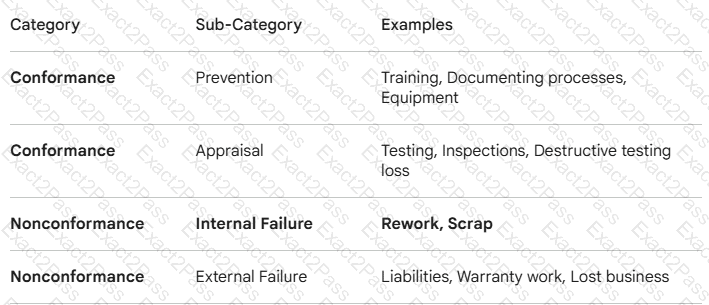
According to the PMBOK® Guide, specifically within the Plan Quality Management process, the Cost of Quality (COQ) is a critical tool used to ensure that the project deliverables meet the required standards. COQ is divided into two main categories: Cost of Conformance and Cost of Nonconformance.
Internal failure costs fall under the category of Cost of Nonconformance. These are costs incurred because the product or service does not meet quality requirements, but the deficiency is discovered before the product is delivered to the customer.
Rework: The action taken to bring a defective or nonconforming component into compliance with requirements or specifications.
Scrap: The cost of work or materials that cannot be repaired or used and must be discarded.
Timing: Because these failures are found internally (by the project team or quality department), they are generally less expensive than external failures, but they still represent a waste of project resources and time.
A. Inspections: These are Appraisal Costs (part of the Cost of Conformance). These are costs incurred to examine the work and ensure it meets requirements before a failure occurs.
B. Equipment and Training: These are Prevention Costs (part of the Cost of Conformance). These are proactive investments made to keep errors from happening in the first place.
C. Lost Business: This is an External Failure Cost. These costs occur when the product has already reached the customer and fails. Lost business, warranty claims, and damage to reputation are the most expensive types of quality costs.
An element of the modern quality management approach used to achieve compatibility with the International Organization for Standardization (ISO) is known as:
Forecasting,
Brainstorming.
Historical databases.
Cost of quality.
According to the PMBOK® Guide (Project Management Body of Knowledge), specifically within the Project Quality Management knowledge area, modern quality management serves to be compatible with International Organization for Standardization (ISO) standards.
Cost of Quality (COQ) (Option D): This is a fundamental element of modern quality management. It refers to the total cost of all efforts related to quality throughout the product life cycle, including investment in preventing nonconformance to requirements, appraising the product or service for conformance to requirements, and failing to meet requirements (rework). ISO standards and the PMI framework both emphasize that " quality is planned, designed, and built-in—not inspected in, " and COQ is the financial metric used to measure and achieve this goal.
Forecasting (Option A): This is a technique used primarily in Project Cost Management (within Earned Value Management) to estimate future performance based on current trends. While useful, it is not a defining characteristic of ISO compatibility in quality management.
Brainstorming (Option B): This is a general data-gathering tool used across almost all knowledge areas (Scope, Risk, Stakeholder, etc.). While used in quality planning, it is not a specific " element " that defines the modern approach ' s compatibility with ISO.
Historical Databases (Option C): These are part of Organizational Process Assets (OPAs). They provide context for past projects but do not represent the methodological shift toward modern quality standards like ISO 9000.
In the PMI framework, the Project Quality Management processes (Plan Quality Management, Manage Quality, and Control Quality) are intended to be compatible with those of the ISO. Both recognize the importance of customer satisfaction, prevention over inspection, continuous improvement, and management responsibility, all of which are reflected in the analysis of the Cost of Quality.
In which of the Risk Management processes is the project charter used as an input?
Plan Risk Responses
Implement Risk Responses
Plan Risk Management
Perform Quantitative Risk Responses
According to the PMBOK® Guide, the Project Charter is a foundational document that provides high-level boundaries for the project. In the context of Project Risk Management, it is specifically used as an input to the very first process: Plan Risk Management.
Why the Project Charter is used: The charter contains high-level project descriptions, boundaries, and requirements. Most importantly, it often outlines high-level risks, project objectives, and the pre-approved financial resources.
Context for Risk: To develop a Risk Management Plan, the project manager needs to understand the high-level risks already identified during the initiation phase (contained in the charter) and the overall project complexity to decide how much time and effort should be spent on risk management activities.
Analysis of other options:
A, B, and D: These processes (Plan Risk Responses, Implement Risk Responses, and Perform Quantitative Risk Analysis) occur later in the planning and execution stages. By the time these processes are reached, the project manager relies on the Risk Register, Risk Report, and the Project Management Plan (which includes the Risk Management Plan) rather than the high-level Project Charter.
As per PMI standards, the Plan Risk Management process is the only risk process that utilizes the Project Charter as a primary input to ensure the risk approach is aligned with the high-level goals established at the project ' s inception.
An output of the Perform Integrated Change Control process is:
Deliverables.
Validated changes.
The change log.
The requirements traceability matrix.
According to the PMBOK® Guide (Project Management Body of Knowledge), the Perform Integrated Change Control process is the process of reviewing all change requests, approving changes, and managing changes to deliverables, organizational process assets, project documents, and the project management plan.
The Change Log (Option C): This is a primary output of this process. The change log is used to document changes that occur during a project. It contains the status of all change requests (approved, deferred, or rejected) and is updated continuously as the Change Control Board (CCB) or Project Manager makes decisions.
Deliverables (Option A): These are an output of the Direct and Manage Project Work process, not change control. While a change request might result in a modified deliverable later, the deliverable itself is not an output of the change control process.
Validated Changes (Option B): These are an output of the Control Quality process. Once a change is approved in Integrated Change Control, it is implemented, and then Control Quality " validates " that the change was implemented correctly.
Requirements Traceability Matrix (Option D): This is an output of the Collect Requirements process. While it may be updated as a result of a change (as part of Project Document Updates), it is not a primary output unique to the Perform Integrated Change Control process.
Other key outputs of this process include Approved Change Requests, Project Management Plan Updates, and Project Documents Updates.
What is a tool to improve team performance?
Staffing plan
External feedback
Performance reports
Co-location
According to the PMBOK® Guide, Co-location is a primary tool and technique used within the Develop Project Team process to improve team performance.
Mechanism of Improvement: Co-location involves placing the most active project team members in the same physical location. This " tight matrix " strategy improves the team ' s ability to perform by enhancing communication, facilitating the rapid exchange of information, fostering a sense of community, and reducing technical or interpersonal conflict.
Team Dynamics: By working in the same environment, team members develop trust more quickly and can engage in " osmotic communication, " where they pick up relevant information simply by being near their colleagues. This is a direct contributor to increased synergy and overall team effectiveness.
Analysis of Other Options:
A. Staffing plan: This is a component of the Human Resource Management Plan (now known as the Resource Management Plan). It is a document that describes when and how human resource requirements will be met, rather than a tool used to actively improve performance.
B. External feedback: While feedback is useful, it is not listed as a standard, formal tool/technique for team development in the PMI framework compared to internal strategies like co-location or training.
C. Performance reports: These are an input to the Manage Project Team process, used to compare actual project results against the project management plan. They are used for monitoring and controlling, but they do not inherently " improve " the team ' s performance; they simply report on it.
Which of the following tools and techniques is used in the Verify Scope process?
Inspection
Variance analysis
Expert judgment
Decomposition
According to the PMBOK® Guide, specifically within the Validate Scope process (historically referred to as Verify Scope), Inspection is the primary tool and technique used to obtain formal acceptance of the completed project deliverables.
Core Function: Inspection includes activities such as measuring, examining, and validating to determine whether the work and deliverables meet requirements and product acceptance criteria.
The Goal: The main objective of this process is to have the customer or sponsor formally sign off on the deliverables. Inspection confirms that the results match the documented scope and requirements.
Terminology: Inspections are sometimes called reviews, product reviews, audits, or walkthroughs.
Comparison with Other Options:
Variance Analysis (B): This is a tool used in Control Scope to determine the cause and degree of difference between the baseline and actual performance, but it does not facilitate formal acceptance of a deliverable.
Expert Judgment (C): While experts may be involved in the inspection, " Inspection " is the specific, named technique for this process.
Decomposition (D): This is a tool used in Create WBS to break down the project scope into smaller, manageable components.
The Validate Scope process differs from Quality Control in that Validate Scope is primarily concerned with the acceptance of the deliverables by the customer, while Quality Control is concerned with the correctness of the deliverables and meeting the quality requirements.
When managing costs in an agile environment, what should a project manager consider?
Lightweight estimation methods can be used as changes arise.
Agile environments make cost aggregation more difficult.
Agile environments make projects more costly and uncertain.
Detailed cost calculations benefit from frequent changes.
According to the PMBOK® Guide and the Agile Practice Guide, managing costs in an adaptive (Agile) environment differs significantly from predictive environments due to the high frequency of change and the focus on value-driven delivery.
Lightweight Estimation: Because requirements in Agile are progressively elaborated and subject to frequent change, detailed, bottom-up cost estimates for the entire project are often inaccurate and wasteful. Instead, teams use lightweight estimation methods such as Story Points, T-shirt Sizing, or Relative Sizing. These methods allow for quick " high-level " forecasts that can be refined as more information becomes available.
Embracing Change: In Agile, cost management is integrated into the iterative cycle. As new requirements arise or priorities shift during a Sprint, the " lightweight " nature of these estimates allows the project manager and team to adjust the forecast without the heavy administrative burden of a formal, rigid change control process for every minor cost deviation.
Fixed Budget/Variable Scope: Often, Agile projects operate with fixed costs (based on the team ' s burn rate per iteration) and a variable scope. Cost management focuses on ensuring that the team is working on the highest-value items first, ensuring the best return on investment (ROI) for the spent budget.
Analysis of Other Options:
B. Agile environments make cost aggregation more difficult: This is incorrect. Cost aggregation is often simpler in Agile because costs are typically tracked by the iteration (Sprint) or team velocity, rather than through complex, thousands-of-line-item WBS structures.
C. Agile environments make projects more costly and uncertain: Agile is specifically designed to reduce the financial risk of uncertainty by delivering value in small increments and allowing for early pivots. While it deals with uncertainty, it does not inherently make projects " more costly. "
D. Detailed cost calculations benefit from frequent changes: Frequent changes are actually the enemy of " detailed " cost calculations. If you perform a highly detailed cost analysis and the scope changes the next day, the effort spent on that calculation is wasted. This is why " lightweight " methods are preferred.
Which process involves determining, documenting, and managing stakeholders ' needs and requirements to meet project objectives?
Collect Requirements
Plan Scope Management
Define Scope
Define Activities
According to the PMBOK® Guide, specifically within the Project Scope Management knowledge area, it is essential to distinguish between the various processes used to create the project ' s boundaries:
Collect Requirements (Option A): This is the specific process of determining, documenting, and managing stakeholder needs and requirements to meet project objectives. The key benefit of this process is that it provides the basis for defining and managing the project scope and product scope. It utilizes tools such as interviews, focus groups, surveys, and prototypes to capture what the stakeholders expect from the final result.
Plan Scope Management (Option B): This is the process of creating a scope management plan that documents how the project and product scope will be defined, validated, and controlled. It creates the " rulebook " but does not involve the actual gathering of specific requirements.
Define Scope (Option C): This process involves developing a detailed description of the project and product. While it relies on the requirements collected in the previous step, its primary output is the Project Scope Statement, which describes the project ' s boundaries, deliverables, and acceptance criteria.
Define Activities (Option D): This process belongs to the Project Schedule Management knowledge area. It involves identifying and documenting the specific actions to be performed to produce the project deliverables.
In the PMI framework, the Collect Requirements process ensures that the project team has a clear understanding of what needs to be delivered to satisfy the stakeholders, which is then formally documented in the Requirements Traceability Matrix.
The Plan Stakeholder Management process belongs to which Process Group?
Executing
Initiating
Planning
Monitoring and Controlling
According to the PMBOK® Guide and the Standard for Project Management, the Plan Stakeholder Engagement process (referred to as Plan Stakeholder Management in some earlier versions and study guides) is situated within the Planning Process Group.
This process is a key part of the Project Stakeholder Management Knowledge Area. Its primary purpose is to develop appropriate management strategies to effectively engage stakeholders throughout the project life cycle, based on the analysis of their needs, interests, and potential impact on project success.
The mapping of the Stakeholder Management processes across Process Groups is as follows:
Initiating: Identify Stakeholders.
Planning: Plan Stakeholder Engagement.
Executing: Manage Stakeholder Engagement.
Monitoring and Controlling: Monitor Stakeholder Engagement.
The other options are incorrect based on the PMI Process Group and Knowledge Area Mapping:
Initiating: This group is where stakeholders are first identified (Identify Stakeholders), but the strategic plan for managing them is developed later.
Executing: This group involves the actual " Manage Stakeholder Engagement " process, where the project manager works with stakeholders to meet their needs and address issues as they occur.
Monitoring and Controlling: This group contains the " Monitor Stakeholder Engagement " process, which focuses on monitoring overall project stakeholder relationships and adjusting strategies for engaging stakeholders.
As per the PMI Lexicon of Project Management Terms, the Plan Stakeholder Engagement process provides a clear, actionable plan to interact with project stakeholders to support the project’s interests.
Which process occurs within the Monitoring and Controlling Process Group?
Control Costs
Plan Quality
Perform Quantitative Risk Analysis
Determine Budget
In accordance with the PMBOK® Guide and the Process Group mapping, the processes of project management are divided into five distinct groups: Initiating, Planning, Executing, Monitoring and Controlling, and Closing.
Control Costs: This is a specific process within the Project Cost Management knowledge area that falls under the Monitoring and Controlling Process Group. Its primary function is to monitor the status of the project to update the project costs and manage changes to the cost baseline. It involves comparing actual spending against the planned budget to identify variances.
Comparison with Other Options:
Plan Quality (B): This is part of the Planning Process Group. It identifies quality requirements and/or standards for the project and its deliverables.
Perform Quantitative Risk Analysis (C): This is part of the Planning Process Group. It numerically analyzes the effect of identified risks on overall project objectives.
Determine Budget (D): This is part of the Planning Process Group. It involves aggregating the estimated costs of individual activities or work packages to establish an authorized cost baseline.
The Monitoring and Controlling Process Group consists of those processes required to track, review, and regulate the progress and performance of the project; identify any areas in which changes to the plan are required; and initiate the corresponding changes. Every Knowledge Area (Scope, Schedule, Cost, Quality, etc.) has at least one " Control " or " Monitor " process that belongs to this group.
A project manager is reviewing the change requests for project documents, deliverables, and the project plan. In which project management process does this review belong?
Monitor and Control Project Work
Direct and Manage Project Work
Close Project or Phase
Perform Integrated Change Control
According to the PMBOK® Guide, the Perform Integrated Change Control process is the specific process conducted from project inception through completion to review all change requests, approve changes, and manage changes to deliverables, project documents, and the project management plan.
Centralized Responsibility: This process is where the project manager and, in many cases, a Change Control Board (CCB), evaluate the impact of a requested change across all knowledge areas (Scope, Schedule, Cost, Quality, Risk, etc.).
Key Activities:
Reviewing, evaluating, and approving or rejecting change requests.
Ensuring that only approved changes are incorporated into a revised baseline.
Maintaining the integrity of the baselines by releasing only approved changes into the project work.
Documenting the complete impact of change requests in the Change Log.
The Workflow: A change request is typically generated in Monitor and Control Project Work or Direct and Manage Project Work, but it is officially reviewed and decided upon only within the Perform Integrated Change Control process.
Analysis of Other Options:
A. Monitor and Control Project Work: This process involves tracking, reviewing, and reporting the overall progress to meet the performance objectives defined in the project management plan. While it may identify the need for a change, the actual review and approval happens in Integrated Change Control.
B. Direct and Manage Project Work: This is an Executing process where the team performs the work defined in the project plan. If a change is approved, this is the process where that change is actually implemented.
C. Close Project or Phase: This process involves finalizing all activities for the project, phase, or contract. It occurs at the end of the project life cycle and does not involve the ongoing review of change requests for deliverables or plans.
A project is at risk of delivering the solution late because of poor quality that prevents the user acceptance testing (UAT) from being finalized. The product owner does not want to sign off until all the Severity 1 (S1) defects are fixed. What should the project manager do to manage this risk?
Create a risk in the risk register for each S1 defect and assign actions.
Consult the risk register and implement the risk response actions.
Ask the developers to work longer hours and resolve the defects.
Review the organizational chart to find out who else can sign off UAT.
According to the PMBOK® Guide, specifically the Monitor Risks and Implement Risk Responses processes, a project manager must follow the established risk management plan when an identified risk triggers.
Risk Realization: In this scenario, the " risk " of late delivery due to poor quality has materialized into an Issue. However, PMI methodology dictates that if a risk was previously identified and documented, the first step is to refer to the Risk Register to execute the pre-defined Contingency Plan or Risk Response.
Cohesion with Quality Management: The issue involves User Acceptance Testing (UAT) and Severity 1 (S1) defects. These are critical blockers. The Risk Register should ideally contain responses for " Quality Issues " or " UAT Delays, " which might include re-allocating senior resources, utilizing specific testing tools, or adjusting the schedule based on a pre-approved buffer.
Structured Management: By implementing established risk response actions, the project manager ensures that the solution is handled systematically rather than through " knee-jerk " reactions. This maintains the integrity of the project ' s governance and ensures that the response is one that stakeholders have already agreed to in principle.
Analysis of other options:
Option A: Creating a new risk for each defect is redundant and reactive. The risk (late delivery due to quality) is already known. Individual defects are issues to be tracked in a Defect/Issue Log, not a Risk Register.
Option C: Asking developers to work longer hours is a form of Crashing. This is a last-resort schedule compression technique that often leads to lower quality and more defects due to burnout. It should not be the first step without consulting the plan.
Option D: Attempting to find a different person to sign off on UAT to bypass the Product Owner is a violation of project governance. The Product Owner is the authority on value and quality; bypassing them undermines the project ' s success and the Stakeholder Engagement Plan.
Per PMI standards, the most professional and effective action when a project hits a known roadblock is to Consult the Risk Register and act upon the strategies that were developed during the planning phase to handle exactly this type of situation.
The project manager implemented the stakeholder engagement plan and realized that some uploads should be made. Which components of the project management plan should be modified?
Project charter and stakeholder engagement plan
Risk management plan and stakeholder engagement plan
Communications management plan and stakeholder engagement plan
Project charter and communications management plan
According to the PMBOK® Guide, when a project manager implements the Stakeholder Engagement Plan and identifies that specific information (such as " uploads " or status reports) needs to be shared or handled differently, it directly affects how information is distributed and how stakeholders are kept informed.
Communications Management Plan: This document defines the " who, what, when, where, and how " of project information. If " uploads " (a form of information distribution) need to be modified, this plan must be updated to reflect the new requirements for data transfer, storage, or distribution methods.
Stakeholder Engagement Plan: This document identifies the strategies and actions required to promote productive involvement of stakeholders. If the project manager realizes that the current engagement approach is not meeting the needs (evidenced by the need for new uploads), this plan must be updated to align with the revised engagement strategy.
Why other options are incorrect:
The Project Charter (Options A and D) is a high-level document that authorizes the project. It is not modified for tactical changes in communication or stakeholder engagement during the execution or monitoring and controlling phases.
The Risk Management Plan (Option B) deals with how risks will be structured and performed. While communication can be a risk, the primary documents governing " uploads " and stakeholder needs are the Communications and Stakeholder plans.
These updates are typically processed through a Change Request that, once approved, results in updates to these specific components of the Project Management Plan.
Who should the stakeholders consult to discuss concerns about the current work package?
Project manager
Business analyst
Project coordinator
Project sponsor
According to the PMBOK® Guide, specifically within the Project Communications Management and Project Stakeholder Management knowledge areas, the Project Manager (PM) is the primary point of contact for project-related concerns and the central hub for integration.
Integration and Communication: The Project Manager is responsible for managing the expectations of stakeholders and ensuring that the work being performed aligns with the project management plan. When a stakeholder has a concern regarding a specific Work Package (the lowest level of the Work Breakdown Structure), the PM is the individual authorized to investigate the status, address variances, and facilitate communication between the technical team and the stakeholders.
Issue Resolution: Per the Manage Stakeholder Engagement process, the project manager uses communication and interpersonal skills to resolve issues. Since a " concern about a work package " could imply a scope, quality, or schedule issue, the PM must be the first point of contact to ensure the issue is logged in the Issue Log and addressed through formal project channels.
Accountability: While the project team performs the work and the sponsor provides the funding, the project manager is the one accountable for the project ' s daily execution. Directing concerns to the PM prevents " scope creep " and ensures that the communication flow is controlled and documented.
Analysis of other options:
Option B: The Business Analyst focuses on requirements and business value. While they might help clarify a requirement within a work package, the overall management and concern-resolution for that package fall under the PM ' s jurisdiction.
Option C: A Project Coordinator typically has less authority than a PM and acts in a functional or weak matrix environment to assist with schedules and documentation. They generally do not have the authority to resolve stakeholder concerns regarding work package execution.
Option D: The Project Sponsor should be shielded from granular, day-to-day work package concerns. Stakeholders should only escalate to the sponsor if the project manager is unable to resolve a high-level issue that threatens the project ' s business case.
Per PMI standards, the Project Manager is the designated leader responsible for managing stakeholder relationships and ensuring that any concerns regarding project deliverables or work packages are identified, analyzed, and resolved.
Perform Integrated Change Control is the process of:
Reviewing, approving, and managing all change requests
Facilitating change management, manuals, or automation tools
Comparing actual results with planned results in order to expand or change a project
Documenting changes according to the change control system by the change control board
According to the PMBOK® Guide, specifically within the Project Integration Management knowledge area, Perform Integrated Change Control is the critical process of reviewing all change requests; approving changes and managing changes to deliverables, organizational process assets, project documents, and the project management plan; and communicating their disposition.
Reviewing, approving, and managing (Option A): This is the verbatim definition provided by PMI. This process is conducted from project inception through completion and is the ultimate responsibility of the project manager, though a Change Control Board (CCB) often handles formal approval for baseline changes. It ensures that only documented and approved changes are implemented.
Facilitating change management (Option B): While manuals and automation tools (like a Configuration Management System) are used within the process, they do not define the process itself. They are part of the " Tools and Techniques " (specifically Project Management Information Systems).
Comparing actual with planned results (Option C): This describes the Monitor and Control Project Work process. While performance data may trigger a change request, the act of comparison is a monitoring function, not the change control function.
Documenting changes by the CCB (Option D): This is too narrow. While the CCB plays a major role and documentation is required, the process is much broader, encompassing the entire lifecycle of a change from the initial request through implementation and communication.
In the PMI framework, Perform Integrated Change Control ensures that the project remains aligned with its objectives by ensuring every change is assessed for its impact on all project constraints (Scope, Schedule, Cost, Quality, Risk, and Resources).
Configuration identification, configuration status accounting, and configuration verification and audit are all activities in which process?
Perform Quality Assurance
Direct and Manage Project Work
Monitor and Control Project Work
Perform Integrated Change Control
According to the PMBOK® Guide (Project Integration Management), specifically within the Perform Integrated Change Control process, configuration management activities are essential for maintaining the integrity of the project baselines. Configuration management is often integrated into the overall change control system.
The three specific activities mentioned are the core components of a Configuration Management System:
Configuration Identification: Selection and identification of a configuration item to provide the basis for which the product configuration is defined and verified, products and documents are labeled, changes are managed, and accountability is maintained.
Configuration Status Accounting: Information is recorded and reported as to when appropriate data about the configuration item should be provided. This includes a listing of approved configuration identification, status of proposed changes to the configuration, and the implementation status of approved changes.
Configuration Verification and Audit: Configuration verification and configuration audits ensure the composition of a project’s configuration items is correct and that corresponding changes are registered, assessed, approved, tracked, and correctly implemented. This ensures the functional requirements defined in the configuration documentation have been met.
Analysis of Distractors:
A. Perform Quality Assurance: This process (now called Manage Quality) focuses on auditing the quality requirements and results from quality control measurements to ensure appropriate quality standards are used. It does not manage the functional or physical characteristics of project artifacts (configuration).
B. Direct and Manage Project Work: This is an execution process where the work is performed and deliverables are produced. While it follows the configuration rules, it does not define the management of the configuration identification or audits.
C. Monitor and Control Project Work: This is a broad process for tracking, reviewing, and reporting the overall progress to meet performance objectives defined in the project management plan. It does not contain the specific technical sub-activities of configuration management, which are housed under Integrated Change Control.
What is the first step in the Stakeholder Management process?
Plan Stakeholder Engagement
Identify Stakeholders
Manage Stakeholder Responsibility
Monitor Stakeholder Activity
According to the PMBOK® Guide (6th Edition) and the Standard for Project Management, the very first process in the Project Stakeholder Management knowledge area is Identify Stakeholders.
This process occurs in the Initiating Process Group, often starting as soon as the Project Charter is approved (or even while it is being developed). The logical flow of stakeholder management dictates that you must know who is involved before you can plan how to engage them.
The key steps in the Project Stakeholder Management Knowledge Area are:
Identify Stakeholders: Identifying the people, groups, or organizations that could impact or be impacted by a decision, activity, or outcome of the project.
Plan Stakeholder Engagement: Developing approaches to involve stakeholders based on their needs, interests, and potential impact.
Manage Stakeholder Engagement: Communicating and working with stakeholders to meet their needs and address issues.
Monitor Stakeholder Engagement: Monitoring project stakeholder relationships and tailoring strategies for engaging stakeholders.
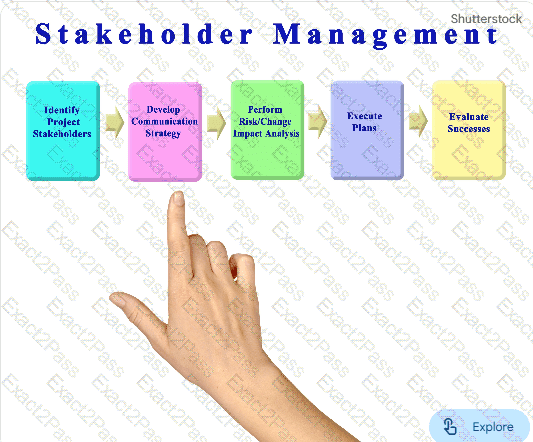
Analysis of Distractors:
A (Plan Stakeholder Engagement): This is the second step. You cannot create an engagement plan until you have a Stakeholder Register (the output of Identify Stakeholders) listing who needs to be engaged.
C (Manage Stakeholder Responsibility): This is not a formal PMI process name. While a project manager manages engagement and clarifies roles (often via a RACI chart), " Manage Stakeholder Responsibility " is not a defined step in the PMBOK® Guide.
D (Monitor Stakeholder Activity): This is part of the final, ongoing process (Monitor Stakeholder Engagement) that occurs during the Monitoring and Controlling phase, not at the beginning of the project.
Which of the following tools or techniques is used for Estimate Activity Durations?
Critical path method
Rolling wave planning
Precedence diagramming method
Parametric estimating
According to the PMBOK® Guide, the Estimate Activity Durations process is the process of estimating the number of work periods needed to complete individual activities with estimated resources.
Parametric Estimating: This is a core tool and technique used in this process. It involves using an algorithm or a statistical relationship between historical data and other variables (e.g., square footage in construction, lines of code in software development) to calculate an estimate for activity parameters, such as cost, budget, and duration.
Accuracy: The accuracy of this method depends on the sophistication and underlying data built into the model. It is generally more accurate than analogous estimating when the data is reliable.
Example: If the historical data shows that a painter can cover 20 square meters per hour, and the total area is 200 square meters, the parametric estimate for the duration would be 10 hours ($200 / 20 = 10$).
Comparison with other options:
A. Critical path method (CPM): This is a technique used in the Develop Schedule process to calculate the theoretical minimum duration of the project. It uses the activity durations (which were already estimated) to find the path with the least amount of float.
B. Rolling wave planning: This is a technique used in the Define Activities process. It is a form of iterative planning where the work to be accomplished in the near term is planned in detail, while future work is planned at a higher level.
C. Precedence diagramming method (PDM): This is a technique used in the Sequence Activities process to create a schedule model by representing activities as nodes and showing their logical dependencies (Finish-to-Start, etc.). It does not estimate the duration of the tasks themselves.
A project requires a component with well-understood specifications. Performance targets are established at the outset, and the final contract price is determined after completion of all work based on the seller ' s performance. The most appropriate agreement with the supplier is:
Cost Plus Incentive Fee (CPIF).
Fixed Price Incentive Fee (FPIF).
Cost Plus Award Fee (CPAF).
Fixed Price with Economic Price Adjustment (FP-EPA).
According to the PMBOK® Guide, specifically the Plan Procurement Management process, selecting the correct contract type depends on the nature of the statement of work and the distribution of risk between the buyer and the seller.
Fixed Price Incentive Fee (FPIF): This contract type is used when the requirements and specifications are well-understood (a hallmark of Fixed Price contracts), but the buyer wants to provide a financial incentive for the seller to meet specific performance targets (such as cost, schedule, or technical performance).
Determining the Price: In an FPIF contract, a price ceiling is set, and all costs above that ceiling are the responsibility of the seller. The final contract price is determined after completion of all work based on the seller ' s performance relative to the pre-established incentive formula (often involving a " share ratio " for cost savings or overruns).
Risk Distribution: This contract type shifts some risk to the seller (due to the fixed-price nature) but aligns the seller ' s goals with the buyer ' s objectives through the incentive fee.
Comparison with other options:
A. Cost Plus Incentive Fee (CPIF): While this also uses performance incentives, it is a cost-reimbursable contract. It is typically used when the scope is not well-defined at the outset, and the buyer bears more risk by paying the seller ' s actual costs plus a fee.
C. Cost Plus Award Fee (CPAF): In this type, the majority of the fee is earned based on the satisfaction of certain broad subjective performance criteria. The " Award " is typically determined by a board and is subjective, whereas the question specifies " performance targets established at the outset, " which points toward a mathematical incentive formula.
D. Fixed Price with Economic Price Adjustment (FP-EPA): This is a fixed-price contract used for long-term projects (spanning years) to protect the seller from inflation or fluctuations in the cost of specific commodities. It does not primarily focus on performance-based incentives.
Which are inputs for the Plan Quality Management process?
Quality metrics, project documents, and financial performance
Quality management plan, project documents, and quality metrics
Project management plan, project documents, and organizational process assets
Project management plan, quality metrics. and project documents
According to the PMBOK® Guide, the Plan Quality Management process is the process of identifying quality requirements and/or standards for the project and its deliverables, and documenting how the project will demonstrate compliance with quality requirements and/or standards.
The primary inputs for this process include:
Project Management Plan: Specifically the requirements management plan, risk management plan, stakeholder engagement plan, and the scope baseline (which contains the project scope statement and WBS).
Project Documents: Key documents used as inputs include the assumption log, requirements documentation, requirements traceability matrix, risk register, and stakeholder register.
Enterprise Environmental Factors (EEF): These include governmental regulations, rules, standards, and guidelines specific to the application area.
Organizational Process Assets (OPA): These include the organization’s quality policy, procedures, and historical databases from previous projects.
Analysis of Other Options:
A. Quality metrics, project documents, and financial performance: Quality metrics are an output of the Plan Quality Management process, not an input. Financial performance is generally not a direct input to quality planning.
B. Quality management plan, project documents, and quality metrics: Both the Quality Management Plan and Quality Metrics are outputs of this specific process. They cannot be inputs to the process that creates them.
D. Project management plan, quality metrics, and project documents: Again, quality metrics are an output of this process. This option incorrectly identifies an output as an input.
Which document describes the necessary information to determine if a project is worth the required investment?
Cost baseline
Service level agreement
Memorandum of understanding
Business case
According to the PMBOK® Guide and the Standard for Project Management, the Business Case is the primary economic feasibility study used to establish the validity of the benefits of a selected component which is used as a basis for the authorization of further project management activities.
The Business Case describes the necessary information from a business standpoint to determine whether the expected outcomes of the project justify the required investment. It typically includes:
Business Need: The reason why the project is being undertaken (e.g., market demand, legal requirement, or organizational need).
Analysis of the Situation: Identifying organizational goals, strategies, and objectives.
Recommendation: A statement of the recommended solution.
Evaluation: A statement describing the plan for measuring the benefits the project will deliver.
The other options are incorrect based on the following PMI definitions:
Cost Baseline: This is the approved version of the time-phased project budget, excluding any management reserves, which can be changed only through formal change control procedures. It is used as a basis for comparison to actual results.
Service Level Agreement (SLA): A contract between a service provider and a customer that defines the level of service expected. It is a functional document rather than a feasibility document.
Memorandum of Understanding (MOU): This is an agreement between two or more parties outlined in a formal document. It is not a financial justification document for investment.
As per the PMI Standard for Portfolio Management, the Business Case is a key input to the Develop Project Charter process, ensuring that the project aligns with the organization ' s strategic goals and financial capabilities.
The purpose of inspection in Perform Quality Control is to keep errors:
in line with a measured degree of conformity.
out of the hands of the customer.
in a specified range of acceptable results.
out of the process.
According to the PMBOK® Guide, specifically within the Control Quality process (formerly Perform Quality Control), the primary purpose of Inspection is to keep errors out of the hands of the customer.
Definition of Inspection: Inspection is the examination of a work product to determine if it conforms to documented standards. It is often referred to as a " peer review, " " audit, " or " walkthrough. "
The Goal of Control Quality: While " Prevention " (in the Manage Quality process) keeps errors out of the process, " Inspection " (in the Control Quality process) focuses on identifying errors in the final product before that product is delivered to the client.
Verified Deliverables: The result of a successful inspection is a Verified Deliverable. This becomes an input to the Validate Scope process, where the customer formally accepts the deliverable. If the inspection fails, the deliverable is flagged for defect repair to ensure the customer never receives a non-conforming item.
Comparison with Other Options:
In line with a measured degree of conformity (A): This describes the result of the measurement, but " degree of conformity " is more closely related to Precision and Attribute Sampling rather than the fundamental purpose of inspection.
In a specified range of acceptable results (C): This is the definition of Tolerances. While inspection checks if a result falls within a tolerance, the purpose is to catch the outliers before they reach the user.
Out of the process (D): This is the definition of Prevention. Prevention is about designing the process so that errors are not created in the first place. Inspection is the safety net that catches errors that the prevention stage missed.
The following is a network diagram for a project.
The free float for Activity H is how many days?
4
5
10
11
According to the PMBOK® Guide, Free Float (FF) is defined as the amount of time that a schedule activity can be delayed without delaying the early start date of any successor or violating a schedule constraint.
Calculating Free Float: The formula for Free Float is:
$$FF = ES_{successor} - EF_{activity} - 1$$
(Note: The " -1 " is used if using the " Day 1 " start convention; if using " Day 0 " , it is simply $ES - EF$).
Analysis of the Network Diagram (Standard PMI Question Set 259-261):
In the standard diagram for this specific question sequence:
Activity H and Activity G are parallel paths leading into the final Activity I.
The Critical Path usually runs through Activity G (A-B-C-F-G-I), meaning Activity G determines the Early Start (ES) for Activity I.
If Activity I has an Early Start of Day 31, and Activity H finishes on Day 20, then Activity H has 10 days of " Free Float " because it can slip until Day 30 without pushing the start of Activity I.
Free Float vs. Total Float: Unlike Total Float (which is the delay allowed without delaying the project finish date), Free Float is strictly concerned with the immediate successor. In this diagram, since Activity H is the last activity before the final node, its Free Float often equals its Total Float, provided there are no other constraints.
Comparison with other options:
A and B (4 or 5 days): These numbers typically represent the duration of individual activities or the float of a different path (like the D-E path) rather than the specific buffer available for Activity H.
D. 11: This is often a result of a calculation error where the finish day of the activity is subtracted from the start day of the successor without accounting for the inclusive nature of the workday (the " off-by-one " error). In PMI standards, if an activity finishes on the evening of Day 20, and the next starts on the morning of Day 31, there are exactly 10 full days of float (Days 21 through 30).
Which of the following can a project manager conduct if they have a stakeholder who is unresponsive and/or unsupportive?
Interactive communications
Pull communications
Push communications
Communication style assessment
According to the PMBOK® Guide, specifically the Plan Stakeholder Engagement and Manage Communications processes, when a stakeholder is not engaging as expected, the project manager must shift from " broadcasting " information to " analyzing " the interpersonal dynamics.
Communication Style Assessment: This is a tool and technique used to identify the preferred communication method, format, and content for stakeholders. If a stakeholder is unresponsive, it often means the current approach is not resonating with their personality, level of authority, or professional needs. An assessment helps the project manager determine if the stakeholder prefers direct data, high-level summaries, personal face-to-face interaction, or formal documentation.
Interpersonal and Team Skills: By assessing the style, the project manager can adapt their own communication to match the stakeholder ' s preferences. This is a key part of Stakeholder Engagement. For example, an " unsupportive " stakeholder might be won over if the communication is adjusted to focus on the specific benefits the project brings to their department.
Root Cause Analysis: While not explicitly in the option, a style assessment often reveals the root cause of the unresponsiveness—such as " information overload " or a " misalignment of expectations " —allowing for a more targeted engagement strategy.
Analysis of other options:
Option A: Interactive communications (like meetings or phone calls) require a willing participant. If the stakeholder is already " unresponsive, " attempting more interactive communication may lead to further frustration or continued silence.
Option B: Pull communications (like placing documents on a shared portal) are passive. An unsupportive or unresponsive stakeholder is unlikely to go out of their way to " pull " information that they are already ignoring.
Option C: Push communications (like emails or memos) are what the project manager is likely already doing. If the stakeholder is unresponsive, sending more " pushed " content usually results in the same lack of engagement.
Per PMI standards, the most effective way to address a breakdown in stakeholder engagement is to perform a Communication style assessment. This allows the project manager to pivot their strategy based on a better understanding of the stakeholder ' s behavioral and professional communication preferences.
Which process involves identifying and documenting the logical relationships between project activities?
Develop Schedule
Sequence Activities
Create WBS
Applying leads and lags
According to the PMBOK® Guide, the process of identifying and documenting the logical relationships between project activities is the formal definition of Sequence Activities.
Core Objective: The primary purpose of this process is to define the logical sequence of work to obtain the greatest efficiency given all project constraints. Every activity and milestone (except the first and last) should be connected to at least one predecessor and one successor.
Logical Relationships (Dependencies): This process identifies how tasks relate to one another using four types of dependencies:
Finish-to-Start (FS): The successor activity cannot start until the predecessor activity has finished (the most common type).
Finish-to-Finish (FF): The successor activity cannot finish until the predecessor activity has finished.
Start-to-Start (SS): The successor activity cannot start until the predecessor activity has started.
Start-to-Finish (SF): The successor activity cannot finish until the predecessor activity has started (rarely used).
Tools and Techniques: The main tool used here is the Precedence Diagramming Method (PDM), which is used to create a project schedule network diagram.
Comparison with Other Options:
Develop Schedule (A): This is the subsequent process that analyzes activity sequences, durations, resource requirements, and schedule constraints to create the actual project schedule model.
Create WBS (C): This is a scope management process that breaks down deliverables into work packages; it does not deal with the timing or logical order of tasks.
Applying leads and lags (D): While this is a tool/technique used within the Sequence Activities process to refine the relationships, it is not the name of the process itself.
A project team is starting to work on a project based on a Kanban approach. In order to frame the capacity of the team ' s workflow at any moment, the project manager will need to restrict the maximum amount of activities to be performed.
Which element will the project manager handle?
Capacity limit
Pull system
Work in progress
Virtual board
In the Agile Practice Guide and Kanban methodology, the primary goal is to optimize the flow of work and increase efficiency by identifying and removing bottlenecks.
Why Choice C is correct:
WIP Limits: The project manager implements Work in Progress (WIP) limits. These are constraints placed on the number of work items that can be in a specific stage of the workflow (e.g., " In Development " or " Testing " ) at any given time.
Restricting Capacity: By restricting the maximum amount of activities, the team is forced to finish current tasks before starting new ones. This prevents the " multitasking trap " and ensures that work moves through the system faster.
Flow Management: If a column reaches its WIP limit, no new work can enter that stage. This makes bottlenecks immediately visible, allowing the team to collaborate (or " swarm " ) to clear the blockage.
Analysis of other options:
A (Capacity limit): While " capacity " is what is being managed, " Capacity limit " is not the formal technical term used in Kanban. The specific mechanism used to enforce that limit is called a WIP limit.
B (Pull system): A pull system is the result of using WIP limits. In a pull system, a team member only " pulls " new work into a column when there is available capacity (i.e., when they are below the WIP limit). It describes the movement of work, not the restriction itself.
D (Virtual board): This is simply the tool (like Jira, Trello, or a physical whiteboard) used to visualize the work. While the board displays the WIP limits, the board itself is not the element being " handled " to restrict the work.
Key Concept: The Project Management Institute (PMI) emphasizes that in a Kanban approach, the focus is on Cycle Time and Throughput. By managing Work in Progress (Choice C), the project manager ensures the team doesn ' t become overwhelmed, leading to a more predictable and sustainable pace of delivery.
The following is a network diagram for a project.
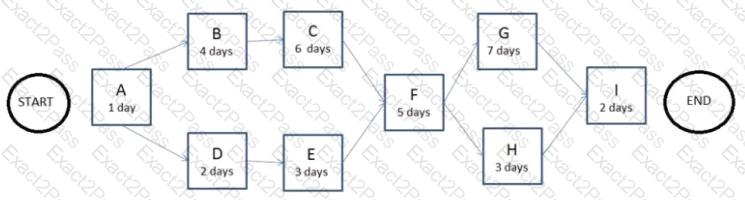
What is the critical path for the project?
A-B-C-F-G-I
A-B-C-F-H-I
A-D-E-F-G-I
A-D-E-F-H-I
The Critical Path Method (CPM) is used to estimate the minimum project duration and determine the amount of scheduling flexibility on the logical network paths within the schedule model.
Definition of Critical Path: According to PMI, the critical path is the longest sequence of activities through a project network diagram that determines the shortest possible project duration.
Total Float: Activities on the critical path have zero total float. Any delay in a critical path activity will delay the project finish date.
Calculation Steps:
Identify all possible paths from the start node (A) to the finish node (I).
Sum the durations of the activities along each specific path.
The path with the highest numerical total is the Critical Path.
How to solve this specific question:
Path A: A + B + C + F + G + I
Path B: A + B + C + F + H + I
Path C: A + D + E + F + G + I
Path D: A + D + E + F + H + I
To verify the answer, simply add the numbers associated with each letter in your diagram. The option (A, B, C, or D) that results in the largest sum is the verified critical path.

