Exact2Pass

Last Update 20 hours ago Total Questions : 1337
The Certified Associate in Project Management (CAPM) content is now fully updated, with all current exam questions added 20 hours ago. Deciding to include CAPM practice exam questions in your study plan goes far beyond basic test preparation.
You'll find that our CAPM exam questions frequently feature detailed scenarios and practical problem-solving exercises that directly mirror industry challenges. Engaging with these CAPM sample sets allows you to effectively manage your time and pace yourself, giving you the ability to finish any Certified Associate in Project Management (CAPM) practice test comfortably within the allotted time.
A project team identifies defects that will require a modification to a tool ' s functionality. What process should the project manager follow to obtain stakeholder buy-in?
Control Schedule
Perform Qualitative Risk Analysis
Perform Integrated Change Control
Control Scope
According to the PMBOK® Guide, any change to a project deliverable, project management plan, or project document must be processed through the Perform Integrated Change Control process.
Handling Defects and Modifications: When defects are identified that require a modification to functionality (a change in scope or product requirements), it is not enough to simply fix the defect. The change must be formally requested and evaluated for its impact on the project ' s constraints (cost, time, scope, and quality).
Stakeholder Buy-in: The core of " obtaining stakeholder buy-in " for changes lies within the Change Control Board (CCB) or the formal change process. This process ensures that the Sponsor, Customer, and other key stakeholders review the change, understand its implications, and provide formal approval or rejection. This prevents " scope creep " and ensures all parties are aligned before the modification is implemented.
Analysis of other options:
Control Schedule (Option A): This process is focused on monitoring the status of project activities to update progress and manage changes to the schedule baseline. It does not provide the framework for approving functional modifications.
Perform Qualitative Risk Analysis (Option B): This involves prioritizing individual project risks by assessing their probability and impact. While a defect could be viewed as a realized risk (an issue), the process for getting " buy-in " for a fix is the change control process, not risk analysis.
Control Scope (Option D): This process monitors the status of the project and product scope. While it identifies the need for a change (variance), the actual approval and " buy-in " for that change happen through Integrated Change Control.
Per PMI standards, the project manager is responsible for ensuring that no changes are made to the project ' s baselines without going through the Perform Integrated Change Control process, which serves as the formal mechanism for stakeholder communication and agreement regarding modifications.
The project manager and project team are developing approximations of the cost of resources needed to complete the project work. On which process are they working?
Plan Cost Management
Estimate Activity Resources
Estimate Costs
Determine Budget
According to the PMBOK® Guide, the process described is Estimate Costs. This is the process of developing an approximation of the monetary resources needed to complete project work.
Purpose: The key benefit of this process is that it determines the monetary resources required for the project. These estimates are expressed in units of currency (e.g., dollars, euros, etc.) to facilitate comparison between activities and projects.
Accuracy over Time: Cost estimates are refined throughout the project. For example, a project in the initiation phase may have a Rough Order of Magnitude (ROM) estimate in the range of −25% to +75%. Later in the project, as more information is known, estimates could narrow to a Definitive Estimate range of −5% to +10%.
Inputs and Tools: This process uses inputs such as the project management plan, project documents (like the lessons learned register and project schedule), and enterprise environmental factors. Common tools include Analogous, Parametric, Bottom-up, and Three-point estimating.
Why other options are incorrect:
Option A: Plan Cost Management: This is the process that establishes the policies, procedures, and documentation for planning, managing, expending, and controlling project costs. It defines how costs will be estimated, not the actual estimates themselves.
Option B: Estimate Activity Resources: This process (part of Project Resource Management) is about identifying the types and quantities of material, human resources, equipment, or supplies required. While it is a precursor to estimating costs, it focuses on the physical/human requirements rather than the monetary approximation.
Option D: Determine Budget: This is the process of aggregating the estimated costs of individual activities or work packages to establish an authorized cost baseline. Estimating the individual resource costs (Option C) must happen before they can be aggregated into a budget.
What scenario describes when a project must be created due to market demand?
A public company authorizes a project to create a new service for electric car sharing to reduce pollution.
A car company authorizes a project to build more fuel-efficient cars in response to gasoline shortages.
Researchers develop an autonomous car. with several new features to be commercialized in the future.
Stakeholders request that raw matenais be changed due to locally high costs.
According to the PMBOK® Guide, projects are initiated in response to factors that influence an organization. These are often categorized as Project Initiation Contexts. One of the primary reasons is Market Demand.
Market Demand: This occurs when a change in the marketplace, consumer behavior, or the economy creates a need for a new product or service.
The Scenario: In Option B, a gasoline shortage represents a significant shift in market conditions. Consumers will naturally seek vehicles that cost less to operate, creating a " demand " for fuel efficiency. The company initiates the project specifically to capture this market opportunity.
Other Initiation Contexts:
Strategic Opportunity/Business Need: High-level goals of the organization.
Social Need: Improving the well-being of a community.
Environmental Considerations: Projects aimed at sustainability or conservation.
Legal/Regulatory Requirements: Projects mandated by new laws.
Technological Advance: Using new tech to improve products.
Analysis of Other Options:
A. A public company authorizes a project to create a new service for electric car sharing to reduce pollution: This is primarily driven by Environmental Considerations or Social Need. While there may be a market for it, the stated intent (reducing pollution) aligns with sustainability goals rather than a reaction to market demand.
C. Researchers develop an autonomous car with several new features to be commercialized in the future: This is an example of a project initiated due to Technological Advance. The researchers are pushing the boundaries of what is possible, which may create a market later, but the project itself is driven by innovation.
D. Stakeholders request that raw materials be changed due to locally high costs: This is typically handled through a Change Request or an operational adjustment. If it were a project, it would be driven by a Business Need to improve profitability or reduce costs, rather than a demand from the external market for a specific product.
Match the project life cycle type with its corresponding definition.
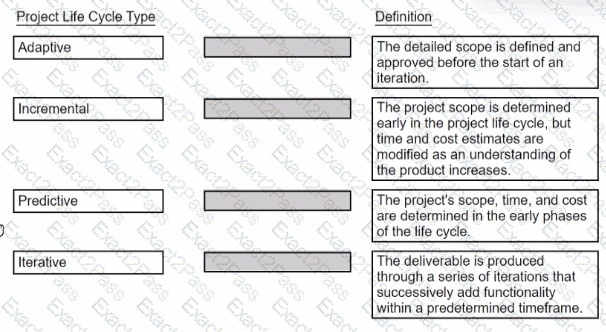

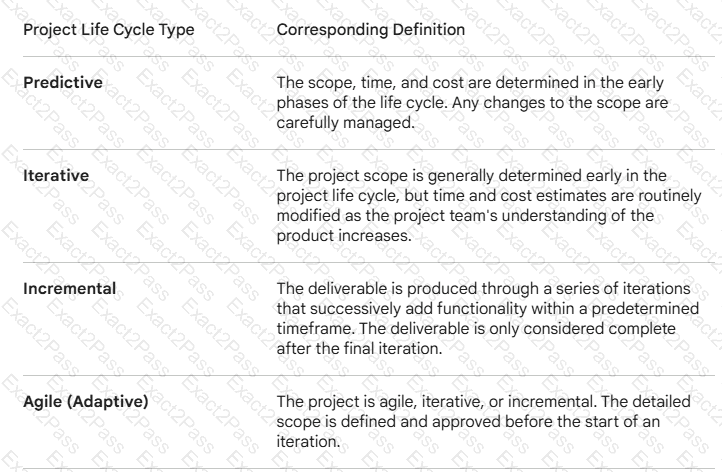
The PMBOK® Guide (6th Edition), Section 1.2.4.1, and the Agile Practice Guide define these life cycles based on how they handle change and the frequency of delivery:
Predictive (Waterfall): This is the traditional approach where the project is planned in detail from the start. It is best used when the product to be delivered is well understood and there is a stable environment. The focus is on following the plan and managing deviations.
Iterative: This approach develops the product through a series of repeated cycles (iterations). It is best used when the scope is known but the best way to implement it needs to be discovered through feedback. It focuses on getting the " correctness " of the solution right.
Incremental: This approach provides a finished deliverable that the customer can use immediately after each increment. Each increment adds a functional layer to the previous one. The focus is on the " speed of delivery " of functional parts.
Agile/Adaptive: These life cycles are both iterative and incremental. They are designed to handle high levels of change and require ongoing stakeholder involvement. The scope is decomposed into a backlog of requirements that are prioritized and delivered in short, fixed-length bursts (sprints/iterations).
In a project, the cost performance indicator (CPI) is less than 1 and the schedule performance indicator (SPI) is more than 1. What is the status of the project?
The project is over budget and behind schedule.
The project is over budget and ahead of schedule.
The project is under budget and behind schedule.
The project is under budget and ahead of schedule.
The project is over budget and ahead of schedule . In earned value management, the Cost Performance Index is calculated as earned value divided by actual cost. PMI defines CPI as a measure of cost efficiency expressed as the ratio of earned value to actual cost. A CPI less than 1 means the project is earning less value than the money being spent; therefore, cost efficiency is unfavorable and the project is over budget. The Schedule Performance Index is calculated as earned value divided by planned value. PMI defines SPI as a measure of schedule efficiency expressed as the ratio of earned value to planned value. An SPI greater than 1 means the project has earned more value than planned by the measurement date; therefore, schedule efficiency is favorable and the project is ahead of schedule. The combination is mixed performance: schedule is positive, cost is negative. This is a classic earned value interpretation question and should be solved by remembering the threshold value of 1.0: below 1 is unfavorable, equal to 1 is on target, and above 1 is favorable. References/topics: Earned Value Management, CPI, SPI, Cost Control, Schedule Control.
Which of the following set of items belongs to the communications management plan?
Escalation processes and meeting management
Project schedule and glossary of common terminology
Escalation processes and stakeholder communication requirements
Interactive communication model and information to be communicated
According to the PMBOK® Guide, the Communications Management Plan is a component of the project management plan that describes how, when, and by whom information about the project will be administered and disseminated.
Escalation Processes and Stakeholder Communication Requirements (Choice C): These are two core elements explicitly listed in the PMI standards as part of the plan:
Stakeholder Communication Requirements: This identifies which stakeholders need what information, the format they require, and the frequency of the communication.
Escalation Processes: This defines the time frames and the names of the people (higher-level management) to whom an issue should be escalated if it cannot be resolved at a lower level.
Escalation and Meeting Management (Choice A): While " Escalation " is correct, Meeting Management is generally considered a set of techniques or procedures rather than a formal component of the subsidiary plan itself, though meeting schedules are included.
Project Schedule and Glossary (Choice B): The Project Schedule is a separate subsidiary document/baseline. While a Glossary of Common Terminology is indeed part of the Communications Management Plan, the inclusion of the schedule makes this choice incorrect.
Interactive Communication Model and Information (Choice D): The " Information to be communicated " is part of the plan. however, the Interactive Communication Model is a Communication Technology/Method (a tool), not a part of the formal plan ' s contents. The plan describes which methods will be used, but it doesn ' t " contain " the model itself.
The Communications Management Plan acts as the " roadmap " for all project interactions. By including clear Escalation Processes, the project manager ensures that roadblocks are handled efficiently without causing unnecessary delays to the project timeline.
The Define Scope process is in which of the following Process Groups?
Initiating
Planning
Monitoring and Controlling
Executing
According to the PMBOK® Guide, the Define Scope process is a critical component of the Planning Process Group within the Project Scope Management knowledge area.
Purpose: The primary objective of the Define Scope process is to develop a detailed description of the project and product. This process is essential because it describes the project, service, or result boundaries and acceptance criteria.
The Planning Process Group: This group consists of those processes required to establish the scope of the effort, refine the objectives, and define the course of action required to attain the objectives that the project was undertaken to achieve. Since Define Scope is where the project boundaries are solidified, it naturally sits within the Planning phase.
Key Output: The major output of this process is the Project Scope Statement. This document provides a common understanding of the project scope among project stakeholders and contains the detailed project scope, major deliverables, assumptions, and constraints.
Context: It follows the Collect Requirements process (where all stakeholder needs are gathered) and precedes the Create WBS process (where the scope is broken down into manageable work packages).
Comparison with other options:
A. Initiating: This group includes the Develop Project Charter process. While the Charter contains a high-level project description, the detailed " Define Scope " work happens later during planning.
C. Monitoring and Controlling: This group includes Validate Scope and Control Scope. These processes are concerned with formalizing acceptance of deliverables and monitoring the status of the project scope, rather than defining it.
D. Executing: There are no Scope Management processes in the Executing Process Group. Execution focuses on " Direct and Manage Project Work " based on the scope defined during the Planning phase.
Under which type of contract does the seller receive reimbursement for all allowable costs for performing contract work, as well as a fixed-fee payment calculated as a percentage of the initial estimated project costs?
Cost Plus Fixed Fee Contract (CPFF)
Cost Plus Incentive Fee Contract (CPIF)
Firm Fixed Price Contract (FFP)
Fixed Price with Economic Price Adjustment Contract (FP-EPA)
According to the PMBOK® Guide, specifically within Project Procurement Management, a Cost Plus Fixed Fee (CPFF) contract is a type of cost-reimbursable contract where the buyer pays the seller for all allowable costs (as defined in the contract) plus a fixed fee.
The Fixed Fee: The fee is calculated as a percentage of the initial estimated project costs. A critical characteristic of this contract is that the fee amount remains constant (fixed) unless the project scope changes. It does not change based on the seller ' s actual performance or actual costs.
Risk Allocation: In this arrangement, the buyer carries the risk of cost overruns, as they must reimburse the seller for all legitimate costs. However, because the fee is fixed, the seller has no incentive to unnecessarily inflate costs, as their profit does not increase with higher spending.
Usage: CPFF contracts are typically used when the scope of work is not well-defined or involves high risk, such as in research and development projects where the final outcome is uncertain.
Analysis of Other Options:
B. Cost Plus Incentive Fee Contract (CPIF): In this type, the seller is reimbursed for costs, but the fee is adjusted based on whether the seller meets specific performance targets (like cost savings). It involves a sharing formula (e.g., 80/20) rather than a fixed payment.
C. Firm Fixed Price Contract (FFP): This is the opposite of a cost-reimbursable contract. The price is set at the beginning and does not change regardless of the seller ' s costs. The seller carries all the cost risk.
D. Fixed Price with Economic Price Adjustment Contract (FP-EPA): This is a fixed-price contract that allows for pre-defined adjustments to the contract price due to changed conditions, such as inflation or cost increases for specific commodities (e.g., fuel or steel), over a long-term period.
At which stage of team development do members begin to work together, adjust work habits, and trust each other?
Forming
Storming
Norming
Performing
According to the PMBOK® Guide, the Tuckman Ladder is a model used to describe the stages of team development. This model is a core tool and technique of the Develop Team process.
The Norming Stage: This is the pivotal phase where the team begins to function as a cohesive unit. Key characteristics include:
Collaboration: Members begin to work together and adjust their work habits and behaviors to support the team.
Trust and Cohesion: Conflict from the previous stage subsides, and team members begin to trust one another.
Alignment: The team develops shared expectations, rules, and procedures (norms) for how work is to be done.
Significance for the Project Manager: In this stage, the project manager can shift from a " directing " or " coaching " style toward a more " supporting " role, as the team is becoming more self-managed and effective.
Analysis of Other Options:
A. Forming: This is the initial stage where the team meets and learns about the project and their formal roles. Members tend to be independent and not as open.
B. Storming: This stage is characterized by conflict and competition as individual personalities and perspectives emerge. Members may resist the influence of the project manager or each other.
D. Performing: At this stage, the team functions as a " well-oiled machine. " They are highly motivated, knowledgeable, and competent. They can work through issues smoothly and effectively.
Which document includes the project scope, major deliverables, assumptions, and constraints?
Project charter
Project scope statement
Scope management plan
Project document updates
According to the PMBOK® Guide, specifically the Define Scope process, the Project Scope Statement is the primary output that provides a documented description of the project scope, major deliverables, and the work required to create those deliverables.
Detailed Content: While the Project Charter contains high-level information, the Project Scope Statement contains a much more detailed description of the scope components. It explicitly includes:
Product scope description: Progressively elaborates the characteristics of the product, service, or result.
Deliverables: Any unique and verifiable product, result, or capability.
Acceptance criteria: A set of conditions that is required to be met before deliverables are accepted.
Project Exclusions: Explicitly states what is excluded from the project to manage stakeholder expectations (the " out of scope " list).
Assumptions: Factors in the planning process that are considered to be true, real, or certain without proof.
Constraints: Limiting factors that affect the execution of a project, such as budget, schedule, or resources.
Comparison with other options:
A. Project charter: The charter is a high-level document. While it may contain a summary of scope and major deliverables, the " detailed " and " typical " repository for specific assumptions, constraints, and granular deliverables is the Scope Statement.
C. Scope management plan: This is a component of the Project Management Plan that describes how the scope will be defined, developed, monitored, controlled, and validated. It does not contain the actual scope itself.
D. Project document updates: This is a generic output category. While the scope statement is a project document, this option is too broad to be the correct answer for a document defined by these specific contents.
In a construction project schedule, what is the logical relationship between the delivery of the concrete materials and the pouring of concrete?
Start-to-start (SS)
Start-to-finish (SF)
Rnish-to-finish (FF)
Finish-to-start (FS)
According to the PMBOK® Guide, specifically within the Sequence Activities process, the Precedence Diagramming Method (PDM) defines four types of logical relationships (dependencies) between activities.
Finish-to-start (FS): This is the most commonly used logical relationship. In this setup, a successor activity cannot start until a predecessor activity has finished.
Application to the Scenario: In construction, you logically cannot begin the " pouring of concrete " (Successor) until the " delivery of concrete materials " (Predecessor) has been completed. The first activity must Finish before the second can Start.
Analysis of Other Options:
A. Start-to-start (SS): A relationship where a successor activity cannot start until a predecessor activity has started. (e.g., leveling concrete can start as soon as pouring starts).
B. Start-to-finish (SF): A rare relationship where a successor activity cannot finish until a predecessor activity has started.
C. Finish-to-finish (FF): A relationship where a successor activity cannot finish until a predecessor activity has finished.
A project team member agrees to change a project deliverable after a conversation with an external stakeholder. It is later discovered that the change has had an adverse effect on another deliverable. This could have been avoided if the project team had implemented:
Quality assurance.
A stakeholder management plan.
Project team building.
Integrated change control.
According to the PMBOK® Guide (Project Management Body of Knowledge), specifically within the Project Integration Management knowledge area and the Perform Integrated Change Control process:
Integrated Change Control (Option D): This scenario describes " scope creep " or an unauthorized change. The Perform Integrated Change Control process is designed to prevent exactly this type of issue. By requiring that all changes—regardless of the source—be formally documented, evaluated for their impact on all project constraints (scope, schedule, cost, quality, etc.), and approved by a Change Control Board (CCB) or the Project Manager, the team would have discovered the adverse effect on the other deliverable before the change was implemented.
Quality Assurance (Option A): This process (now called Manage Quality) focuses on the processes used to create deliverables to ensure they meet quality standards. While it helps ensure the result is correct, it is not the primary mechanism for managing the intake and approval of scope changes.
Stakeholder Management Plan (Option B): This plan identifies how to effectively engage stakeholders. While it might define who can request changes, the actual mechanism for processing those requests and analyzing their cross-functional impact is the Change Control System.
Project Team Building (Option C): This is part of the Develop Team process. While a cohesive team might communicate better, team building itself is not a procedural control for managing technical changes to project deliverables.
In the PMI framework, Integrated Change Control is critical because no change exists in a vacuum. A change to one deliverable often ripples through the project, affecting others. By following a formal process, the Project Manager ensures that the " big picture " is maintained and that the project baseline remains protected from uncoordinated modifications.
Power, urgency, and legitimacy are attributes of which stakeholder classification model?
Salience
Influence/impact
Power/interest
Power/influence
According to the PMBOK® Guide (Project Management Body of Knowledge), specifically within the Project Stakeholder Management knowledge area and the Identify Stakeholders process, several models are used to classify stakeholders. The model described is defined as follows:
Salience Model (Option A): This model describes classes of stakeholders based on their assessments of three specific attributes:
Power: The level of authority or ability to influence the project outcome.
Urgency: The need for immediate attention or the time-constrained nature of the stakeholder’s claim.
Legitimacy: The perception that the stakeholder’s involvement is appropriate or right. The Salience Model is particularly useful in large, complex communities of stakeholders or where there are complex networks of relationships within the community. It helps project managers determine the " relative importance " of identified stakeholders.
Power/Interest Grid (Option C): This model groups stakeholders based on their level of authority (power) and their level of concern (interest) regarding project outcomes. It is a 2x2 matrix.
Power/Influence Grid (Option D): Similar to the power/interest grid, this groups stakeholders based on their level of authority (power) and their active involvement (influence) in the project.
Influence/Impact Grid (Option B): This model groups stakeholders based on their active involvement (influence) and their ability to effect changes to the project ' s planning or execution (impact).
In the PMI framework, the Salience Model is the only one that utilizes the three-way intersection of power, urgency, and legitimacy to categorize stakeholders into groups such as " Latent, " " Expectant, " or " Definitive " stakeholders.
Using parametric estimating, if an assigned resource is capable of producing 120 units per hour, how many hours are required to produce 12,000 units?
100
120
1,000
1,200
According to the PMBOK® Guide (Project Management Body of Knowledge), specifically within the Project Schedule Management and Project Cost Management knowledge areas, Parametric Estimating is an estimating technique in which an algorithm is used to calculate cost or duration based on historical data and project parameters.
The Calculation: Parametric estimating uses a statistical relationship between historical data and other variables. In this specific scenario, the calculation is straightforward:
$$\text{Total Hours} = \frac{\text{Total Units to be Produced}}{\text{Production Rate per Hour}}$$
$$\text{Total Hours} = \frac{12,000 \text{ units}}{120 \text{ units/hour}} = 100 \text{ hours}$$
Application (Option A): The result of 100 hours is the mathematically accurate estimate derived from the provided parameters.
PMI Context: This technique is often used for work that is highly repetitive and standardized. It provides a higher level of accuracy than Analogous Estimating, provided that the underlying data used in the parameter (the 120 units per hour) is reliable and scalable. It is frequently applied in manufacturing, software lines of code, or construction (e.g., cost per square foot).
In the PMI framework, Parametric Estimating can be applied to an entire project or specific parts of a project, in conjunction with other estimating methods, to refine the project ' s schedule and budget baselines.
A key stakeholder has left the project management team. The team now has a new key stakeholder who is requesting project reports from team members out of sequence.
What should the project manager do first?
Extend an iteration review invite to the new stakeholder.
Perform qualitative risk analysis.
Engage with the new stakeholder.
Allow team members to share project status reports.
According to the PMBOK® Guide, specifically the Stakeholder Engagement and Communications Management knowledge areas, the arrival of a new key stakeholder is a significant change that requires immediate management action.
Why Choice C is correct:
Assess and Align: The project manager must first engage with the new stakeholder to understand their specific information needs, expectations, and influence on the project. This is a prerequisite to any other action.
Clarify Procedures: By engaging directly, the PM can explain the existing Communications Management Plan and the established reporting cadence. This prevents team disruption (team members being distracted by ad-hoc requests) while ensuring the stakeholder feels supported.
Relationship Building: Building rapport with a " key " stakeholder early is essential for long-term project success and conflict prevention.
Analysis of other options:
A (Extend an iteration review invite): While this is a good secondary step for transparency (especially in Agile), it doesn ' t address the immediate issue of the stakeholder ' s " out of sequence " report requests. The PM first needs to understand why they need those reports before just inviting them to a meeting.
B (Perform qualitative risk analysis): While the change in stakeholders is a risk, the PMBOK® Guide emphasizes that personal engagement and communication management are the primary tools for stakeholder issues. Risk analysis is a backend process; engagement is the active resolution.
D (Allow team members to share reports): This is incorrect. Allowing " out of sequence " reporting bypasses the Communications Management Plan and the Change Control processes. It leads to " noise, " potential misinformation, and wastes the team ' s productive time. The PM should act as a buffer.
Key Concept: When a new stakeholder enters the project, the Project Manager must perform the Identify Stakeholders and Plan Stakeholder Engagement processes. Choice C is the " first " logical step in these processes—initiating a dialogue to align the stakeholder ' s needs with the project ' s governance framework.
Which key interpersonal skill of a project manager is defined as the strategy of sharing power and relying on interpersonal skills to convince others to cooperate toward common goals?
Collaboration
Negotiation
Decision making
Influencing
According to the PMBOK® Guide (Project Management Body of Knowledge), specifically within the Project Resource Management knowledge area and the Develop Team and Manage Team processes:
Influencing (Option D): This is a key interpersonal skill defined by PMI as the strategy of sharing power and relying on interpersonal skills to convince others to cooperate toward common goals. In many organizational structures (especially matrix organizations), project managers may have little or no direct authority over team members or stakeholders. Therefore, the ability to influence others—by building rapport, exercising ethical persuasion, and demonstrating competence—is essential to gain support and commitment to the project objectives.
Collaboration (Option A): This is a conflict resolution technique (also known as " Problem Solve " ) where parties work together to find a " win-win " solution. While it involves cooperation, it is a method of addressing disagreement rather than the broad power-sharing strategy used to motivate others toward a goal.
Negotiation (Option B): This is the process of reaching an agreement between parties with different interests. While influencing is often used during a negotiation, negotiation is typically more transactional or focused on specific terms (like resource allocation or scope) rather than the general strategy of power-sharing for common goals.
Decision Making (Option C): This refers to the ability to select a course of action from among different alternatives. While a PM must decide how to influence, the act of deciding is a cognitive process, not the interpersonal strategy of convincing others.
In the PMI framework, Influencing is considered a critical competency because it allows the Project Manager to navigate organizational politics and secure the necessary resources and buy-in without relying solely on formal " legitimate " power.
Which is a tool or technique used in Define Scope?
Templates, forms, and standards
Change requests
Product analysis
Project assumptions
According to the PMBOK® Guide, the Define Scope process is the process of developing a detailed description of the project and product. To do this effectively, the project manager and team must move from high-level requirements to specific technical deliverables.
Product Analysis: This is a critical tool and technique for projects that have a product as a deliverable (as opposed to a service or result). It includes techniques such as product breakdown, systems analysis, requirements analysis, systems engineering, value engineering, and value analysis.
Translating Requirements: Product analysis helps the team translate high-level descriptions into meaningful deliverables. It asks questions like: " What are the components of this product? " and " How will it function to meet the customer ' s needs? "
Scope Definition: By performing product analysis, the team can define the boundaries of the project more clearly, ensuring that all necessary work—and only the necessary work—is included in the Project Scope Statement.
Integration with Technical Teams: This tool often requires the involvement of subject matter experts (SMEs) who understand the technical specifications required to build the product.
Comparison with other options:
A. Templates, forms, and standards: These are examples of Organizational Process Assets (OPAs). While they are used as an input to the Define Scope process to provide a framework, they are not categorized as a " tool or technique " in the PMI methodology.
B. Change requests: These are a common output of many monitoring and controlling processes. While defining scope might trigger a change to the charter or requirements, it is not a " tool " used to define the scope itself.
C. Project assumptions: Assumptions are factors that, for planning purposes, are considered to be true, real, or certain without proof. These are documented in the Project Scope Statement (an output) or analyzed as part of a data analysis technique, but " assumptions " themselves are not a tool.
Fast tracking is a schedule compression technique used to shorten the project schedule without changing project scope. Which of the following can result from fast tracking?
The risk of achieving the shortened project time is increased.
The critical path will have positive total float.
Contingency reserves are released for redeployment by the project manager.
Duration buffers are added to maintain a focus on planned activity durations.
According to the PMBOK® Guide, specifically within the Develop Schedule process, Fast Tracking is a schedule compression technique used to shorten the project duration without reducing the project scope.
Mechanism: Fast tracking involves performing activities in parallel that would normally be done in sequence. For example, starting the construction of a building ' s foundation before the final architectural drawings are 100% complete.
Impact on Risk and Rework: Because activities are performed out of their natural or logical sequence, fast tracking often results in increased risk and a higher probability of rework. If the drawings change after the foundation is poured, the work may need to be corrected.
Comparison with Crashing: Unlike Crashing (which adds resources and increases costs), Fast Tracking primarily impacts the risk profile and does not necessarily increase costs, though the potential for rework can lead to indirect cost increases later.
Analysis of Other Options:
B. The critical path will have positive total float: Incorrect. The critical path, by definition, has zero or negative total float. Compressing the schedule aims to meet a target date, but it does not create " slack " or positive float on the critical path itself.
C. Contingency reserves are released: Incorrect. Since fast tracking increases project risk, the project manager would likely need to maintain or even increase contingency reserves rather than release them.
D. Duration buffers are added: This describes Critical Chain Method, not fast tracking. In fast tracking, the focus is on overlapping existing activities rather than adding specific buffers to the schedule.
What does a CPI value greater than 1.0 indicate?
Cost right at the estimated value
Cost under the estimated value
Cost right at the actual value
Cost over the estimated value
According to the PMBOK® Guide, the Cost Performance Index (CPI) is the most critical Earned Value Management (EVM) metric for measuring the cost efficiency of a project.
The Formula: $CPI = \frac{EV}{AC}$ (Earned Value divided by Actual Cost).
Interpreting a CPI > 1.0: A value greater than 1.0 indicates that for every dollar spent on the project, more than one dollar ' s worth of work was actually accomplished. This means the project is performing more efficiently than planned and is currently under budget (cost under the estimated value).
Benchmarking Performance:
CPI = 1.0: The project is exactly on budget (Cost = EV).
CPI < 1.0: The project is over budget (Cost > EV).
CPI > 1.0: The project is under budget (Cost < EV).
Analysis of Other Options:
A. Cost right at the estimated value: This would result in a CPI of exactly 1.0.
C. Cost right at the actual value: This is a tautology; actual cost is always the actual value spent, but CPI measures that against the value earned.
D. Cost over the estimated value: This would result in a CPI of less than 1.0 (e.g., 0.85), indicating cost inefficiency.
A new project has been set. Four main stakeholders besides the project manager and four other team members have been identified. How many communication channels are available?
8
18
36
40
According to the PMBOK® Guide, specifically within the Plan Communications Management process, the number of potential communication channels represents the complexity of project communications. As the number of people involved increases, the number of channels grows exponentially.
The Formula: The standard formula used by PMI to calculate the number of communication channels is:
$$n \times \frac{(n - 1)}{2}$$
Where $n$ represents the total number of stakeholders (including the project manager).
The Calculation:
Identify the total number of people ($n$):
Project Manager = 1
Main Stakeholders = 4
Team Members = 4
Total ($n$) = 9
Apply the formula:
$$9 \times \frac{(9 - 1)}{2}$$
$$9 \times \frac{8}{2}$$
$$9 \times 4 = 36$$
Interpretation: In this scenario, there are 36 possible paths for information to flow between all participants. This calculation is vital for a project manager to understand because it highlights why communication management becomes increasingly difficult as more members are added to a project.
Analysis of other options:
A. 8: This is close to the number of people, but does not account for the interconnected paths between them.
B. 18: This might result from an incorrect application of the formula (e.g., forgetting to divide by 2).
D. 40: This value does not correspond to the calculation for 9 participants.
Per PMI standards, the project manager must use this understanding of Communication Channels to design a communication plan that ensures the right information reaches the right people without causing " noise " or information overload.
In a functional organization, the director of an important stakeholder business group expressed concern to a line manager about the progress of the project. What should the line manager do next?
Hold a face-to-face meeting with the project manager and warn them.
Point the director to a link where they can take a look at the reports.
Invite stakeholders to attend monthly progress review meetings.
Ask the project manager to update the monthly status report distribution list.
According to the PMBOK® Guide, specifically regarding the Monitor Communications and Manage Stakeholder Engagement processes, the goal is to ensure that information needs are met efficiently and transparently.
Self-Service Information (Pull Communication): In a functional organization, where lines of authority are often rigid, providing a director with direct access to existing reports is the most efficient and professional first step. This utilizes Pull Communication, which allows stakeholders to access information at their own discretion.
Transparency and Professionalism: Directing the stakeholder to the official project reports ensures they are receiving the same verified data as everyone else. This addresses their concern with facts rather than hearsay or emotional escalation.
Organizational Context: In a functional structure, the project manager often has limited authority. By providing a link to reports, the line manager supports the project ' s visibility without overstepping or causing unnecessary friction between departments.
Analysis of other options:
A. Hold a face-to-face meeting and warn them: This is an aggressive and reactive approach. A " warning " assumes the project manager is at fault before the data (the reports) has even been reviewed. It bypasses formal communication channels.
C. Invite stakeholders to attend monthly meetings: While engagement is good, this is a future-dated solution. It does not address the director ' s immediate concern about current progress.
D. Ask the project manager to update the distribution list: This is a Push Communication fix. While helpful for the future, the director expressed a concern now. Simply adding them to a list for next month does not provide them with the immediate clarity they are seeking.
Per PMI standards, the most effective way to manage stakeholder expectations and concerns is to ensure they have immediate access to the appropriate project performance data.
A project manager is reviewing the change requests, deliverables, and the project plan in Which project management process does this review belong?
Monitor and Control Project Work
Direct and Manage Project Work
Closes Project or Phase
Perform itegrated Change Control
According to the PMBOK® Guide, the review of change requests, deliverables, and the project management plan occurs within the Monitor and Control Project Work process. This process is concerned with tracking, reviewing, and reporting the overall progress to meet the performance objectives defined in the project management plan.
Reviewing Change Requests: During this process, the project manager monitors the status of change requests and ensures that only approved changes are implemented.
Reviewing Deliverables: The project manager compares actual project performance (deliverables produced) against the project management plan to see if any variances exist.
Context within Integration Management: This process provides the project management team with insight into the health of the project and identifies any areas requiring special attention. It is the " big picture " monitoring process that looks across all knowledge areas.
Why other options are incorrect:
Direct and Manage Project Work (Option B): This is the Executing process where the work is actually performed and deliverables are created. While it involves " Work Performance Data, " the high-level review against the plan happens in Monitoring and Controlling.
Close Project or Phase (Option C): This process happens at the end of a project or phase. While it involves a final review of deliverables, it does not focus on the ongoing monitoring of change requests and plan performance throughout the project lifecycle.
Perform Integrated Change Control (Option D): This process is specifically focused on approving or rejecting change requests. While it involves reviewing change requests, it does not encompass the broad review of all project deliverables and overall plan performance that characterizes " Monitor and Control Project Work. "
Identify Stakeholders is the process of identifying all of the people or organizations impacted by the project and documenting relevant information regarding their interests in, involvement in, and impact on the project:
manager.
success.
deadline.
scope.
According to the PMBOK® Guide, specifically within the Project Stakeholder Management knowledge area, Identify Stakeholders is the process of identifying the people, groups, or organizations that could impact or be impacted by a decision, activity, or outcome of the project.
Impact on Success: The core purpose of documenting their interests, involvement, interdependencies, and potential impact is to manage their influence in relation to the project ' s success. Stakeholders can have a positive or negative influence; failing to identify a key stakeholder early can lead to delays, increased costs, or project failure.
Information Gathered: During this process, the project manager creates the Stakeholder Register, which includes:
Identification Information: Names, positions, and contact details.
Assessment Information: Major requirements, expectations, and potential influence on the project.
Stakeholder Classification: Whether they are internal/external, supporters/neutral/resistors, etc.
Timing: This process is part of the Initiating Process Group. It should happen as early as possible in the project life cycle, although it is repeated throughout the project as new stakeholders emerge or existing ones change their level of interest.
Analysis of Other Options:
A. manager: While stakeholders certainly impact the project manager ' s daily work, the ultimate goal of the process is the successful delivery of the project itself, not just the management of a single person.
C. deadline: Stakeholders certainly impact the schedule (deadlines), but this is only one component of the project. The definition focuses on the broader outcome.
D. scope: Similar to the deadline, scope is a specific element. While stakeholders define and impact scope, the PMBOK® definition specifically links this identification process to the overall success of the venture.
Which of the following techniques is used during Control Scope?
Cost-benefit analysis
Variance analysis
Reserve analysis
Stakeholder analysis
According to the PMBOK® Guide, Control Scope is the process of monitoring the status of the project and product scope and managing changes to the scope baseline. The primary goal is to ensure that all requested changes and recommended corrective or preventive actions are processed through the Perform Integrated Change Control process.
One of the key Tools and Techniques used in this process is Variance Analysis.
Mechanism: Variance analysis is used to compare the baseline (the Project Scope Statement, WBS, and WBS Dictionary) against the actual results (the work that has been performed) to determine if a variance exists.
Purpose: It helps the project manager determine the magnitude and cause of any deviations from the scope baseline. If the " actual " scope performed differs from the " planned " scope, the project manager must decide whether corrective or preventive action is required.
Scope Creep: This technique is essential for identifying Scope Creep, which is the uncontrolled expansion of product or project scope without adjustments to time, cost, and resources. By constantly comparing actual work to the baseline, the team can catch unauthorized work early.
Analysis of other choices:
Choice A (Cost-benefit analysis): This is typically used during the Initiation phase (to justify a project) or during Plan Quality Management to determine the trade-off between the cost of quality and the expected benefit. It is not a primary tool for controlling scope.
Choice C (Reserve analysis): This technique is used in Control Costs and Control Risks. It involves checking the status of contingency and management reserves to see if they are still needed or if additional reserves are required. It does not measure scope performance.
Choice D (Stakeholder analysis): This is used in Identify Stakeholders and Plan Stakeholder Engagement to understand the influence, interests, and impact of project stakeholders. While stakeholders influence scope, " Stakeholder Analysis " is not the technical tool used to monitor scope performance against a baseline.
What is a tool or technique used in the Control Quality process?
Attribute sampling
Parametric estimating
Statistical sampling
Expert judgment
According to the PMBOK® Guide (6th Edition), Statistical Sampling is a primary tool and technique used in the Control Quality process. Control Quality is the process of monitoring and recording results of executing quality management activities to assess performance and ensure the project outputs are complete, correct, and meet customer expectations.
Statistical Sampling involves choosing part of a population of interest for inspection. It is used to measure the quality of deliverables without having to inspect every single item, which is particularly useful when:
The population is very large.
Inspection is time-consuming or costly.
Inspection is destructive (e.g., testing the strength of a component until it breaks).
Analysis of Distractors:
A (Attribute sampling): While " Attribute Sampling " is a method used within quality (measuring whether a result conforms or does not conform), the PMBOK® Guide lists Statistical Sampling as the broad Tool and Technique under the Control Quality process (Section 8.3.2.5). Attribute sampling is a specific data logic applied during the sampling process.
B (Parametric estimating): This is a tool and technique used in Estimate Costs and Estimate Activity Durations. It uses a statistical relationship between historical data and other variables (e.g., square footage in construction) to calculate an estimate. It is not used to verify quality.
D (Expert judgment): While expert judgment is used in many processes (including Plan Quality Management and Manage Quality), it is not listed as a primary tool and technique for the Control Quality process in the 6th Edition. Control Quality relies more heavily on data representation, inspection, and testing.
Regression analysis, failure mode and effect analysis (FMEA), fault tree analysis (FTA), and trend analysis are examples of which tool or technique?
Expert judgment
Forecasting methods
Earned value management
Analytical techniques
According to the PMBOK® Guide, specifically within the Monitor and Control Project Work process, these specific methods are categorized under Data Analysis, which falls under the broader umbrella of Analytical techniques.
Analytical Techniques: These are used to evaluate, study, or forecast potential outcomes based on variations of project or environmental variables and their relationships with other variables.
Regression Analysis: Used to examine the relationship between a dependent variable and one or more independent variables to predict future performance.
Failure Mode and Effect Analysis (FMEA): A procedure in which each potential failure mode in every component of a product is analyzed to determine its effect on the reliability of that component and on the system.
Fault Tree Analysis (FTA): A top-down, deductive failure analysis in which an undesired state of a system is analyzed using Boolean logic to combine a series of lower-level events.
Trend Analysis: Uses mathematical models to forecast future outcomes based on historical results.
Why the other options are incorrect:
A. Expert judgment: While experts may perform these analyses, the specific mathematical and logical models listed (Regression, FMEA, FTA) are defined as techniques of data analysis, not the judgment itself.
B. Forecasting methods: While trend and regression analysis can be used for forecasting, FMEA and FTA are primarily risk and quality analysis tools used to identify failures, not necessarily to forecast project completion dates or costs.
C. Earned value management (EVM): EVM is a specific methodology that combines scope, schedule, and resource measurements. While it uses some analytical logic (like CPI and SPI), it does not encompass the structural failure or logical deduction models like FTA or FMEA.
Which of the following is a tool and technique for Estimate Activity Durations?
Parametric estimating
Monte Carlo analysis
Alternatives analysis
Bottom-up estimating
According to the PMBOK® Guide, the Estimate Activity Durations process is the process of estimating the number of work periods needed to complete individual activities with estimated resources.
Parametric Estimating: This is a core tool and technique for this process. It uses an algorithm or a statistical relationship between historical data and other variables (e.g., square footage in construction, lines of code in software development) to calculate an estimate for activity parameters, such as cost, budget, and duration.
Accuracy: This technique can produce higher levels of accuracy depending on the sophistication and underlying data built into the model.
Example: If the historical data shows that a technician can install 25 meters of cable per hour, the duration to install 1,000 meters is 40 hours ($1,000 / 25 = 40$).
Other Tools and Techniques for Estimate Activity Durations:
Expert Judgment: Consulting individuals with specialized knowledge.
Analogous Estimating: Using the actual duration of a previous, similar project as the basis for estimating the duration of the current project.
Three-Point Estimating: Considering uncertainty and risk by using three estimates (Most Likely, Optimistic, and Pessimistic).
Bottom-up Estimating: (Used in Estimate Activity Resources and Costs, and sometimes for duration when activities cannot be estimated with reasonable confidence).
Data Analysis: Including Alternatives Analysis and Reserve Analysis.
Comparison with other options:
B. Monte Carlo analysis: This is a Data Analysis technique (specifically a simulation) used in Develop Schedule and Perform Quantitative Risk Analysis. While it helps determine the probability of finishing on time, it is not the primary technique for estimating individual activity durations.
C. Alternatives analysis: This is a technique used in Estimate Activity Resources to evaluate different resource options (e.g., different levels of resource capability or skills). It is a " Data Analysis " sub-technique but " Parametric Estimating " is a more definitive standalone technique for duration.
D. Bottom-up Estimating: While frequently used in Cost and Resource estimation, the PMBOK® Guide primarily lists it as a tool for Estimate Activity Resources and Estimate Costs. For durations, the guide emphasizes Analogous, Parametric, and Three-Point methods.
Which Manage Communications tool or technique focuses on identifying and managing barriers?
Communication methods
Information technology
Communication models
Information management systems
According to the PMBOK® Guide, specifically within the Project Communications Management knowledge area, Communication models are the specific tool and technique used to facilitate the efficient and effective transfer of information between the sender and the receiver.
Identifying and Managing Barriers: The primary purpose of a communication model (such as the basic sender-receiver model) is to represent how information is sent, received, and interpreted. This process explicitly includes the identification of noise or barriers that can interfere with the message.
The Model Components:
Encode: Translating thoughts into language.
Transmit Message: Sending the info via a channel.
Decode: The receiver translating the message back into meaningful thoughts.
Acknowledge/Feedback: Confirming receipt or understanding.
Managing Noise: Barriers can include distance, unfamiliar terminology, cultural differences, or inadequate technology. By using formal communication models, the project manager can systematically address these barriers to ensure the " receiver " perceives the message as intended by the " sender. "
Comparison with other options:
A. Communication methods: These refer to the systematic procedures used to share information (e.g., push, pull, or interactive communication) but do not inherently focus on the mechanics of overcoming internal barriers/noise.
B. Information technology: This refers to the physical tools (computers, software, networks) used to facilitate communication, which is a sub-component but not the theoretical framework for managing barriers.
D. Information management systems: These are the facilities and processes used to capture, store, and distribute information to stakeholders, focusing on organization rather than the interpersonal/structural barriers of the message itself.
A project manager builds consensus and overcomes obstacles by employing which communication technique?
Listening
Facilitation
Meeting management
Presentation
According to the PMBOK® Guide (Project Communications Management and Project Resource Management), Facilitation is a key communication and interpersonal skill used to lead a group toward a successful decision, solution, or conclusion.
A facilitator acts as a neutral party to ensure that there is effective communication among participants, that all sides of an issue are heard, and that the group works together to reach a common goal. In the context of project management, facilitation is specifically used to:
Build Consensus: By ensuring that all stakeholders ' requirements and concerns are considered, a facilitator helps the team reach a " win-win " agreement or a collective decision.
Overcome Obstacles: Facilitation techniques help resolve conflicts and remove roadblocks by focusing the team on the project objectives rather than personal disagreements.
Support Processes: It is a critical tool in processes like Develop Project Charter, Collect Requirements, and Plan Risk Responses.
Analysis of Distractors:
A. Listening: While active listening is a vital component of communication, it is a passive-receptive skill. Facilitation is the active application of listening and other skills to drive a group toward a specific outcome.
C. Meeting management: This involves the logistics of a meeting (preparing an agenda, inviting the right people, and keeping time). While good meeting management helps, it does not inherently guarantee consensus-building or the overcoming of complex obstacles like facilitation does.
D. Presentation: This is a formal delivery of information to an audience. It is generally a one-way communication flow and is less effective for building consensus or solving interactive team obstacles.
A project manager providing information to the right audience, in the right format, at the right time is an example of which type of communication?
Efficient
Effective
Push
Pull
According to the PMBOK® Guide, specifically within the Project Communications Management knowledge area, PMI distinguishes between two fundamental dimensions of successful communication: Effectiveness and Efficiency.
Effective Communication: This is defined as providing the information in the right format, at the right time, to the right audience, and with the right impact. The focus is on the quality and relevance of the communication to ensure the message is understood and achieves its intended purpose.
Efficient Communication: This refers to providing only the information that is needed. The focus here is on minimizing the waste of resources (such as time or budget) by avoiding " information overload " or sending unnecessary data.
Why the other options are incorrect:
A. Efficient: While a project manager should strive to be efficient, efficiency is about the quantity and resource usage (providing " only " what is needed). The specific criteria mentioned in the question (right audience, format, and time) are the literal definition of " Effective " communication in PMI standards.
C. Push: This is a Communication Method where information is sent to specific recipients who need to receive the information (e.g., emails, memos, reports). It does not guarantee that the information reached the right audience at the right time in the right format.
D. Pull: This is a Communication Method used for very large volumes of information or very large audiences. It requires the recipients to access the communication content at their own discretion (e.g., intranet sites, e-learning, lessons learned databases). Like push communication, it is a method, not a qualitative description like " effective. "
At which point of the project is the uncertainty the highest and the risk of failing the greatest?
Final phase of the project
Start of the project
End of the project
Midpoint of the project
According to the PMBOK® Guide, specifically in the sections covering Project Stakeholders and Governance and Project Life Cycle, there is a clear relationship between the project timeline and the levels of uncertainty and risk.
Risk and Uncertainty: These are at their highest at the start of the project. This is because at the beginning, the least amount is known about the project ' s requirements, stakeholders, environment, and technical challenges. As the project progresses, more information is discovered, and more work is completed, which progressively reduces uncertainty.
Probability of Failure: The probability of failing to complete the project is greatest at the start. As the project moves toward completion, the probability of success generally increases because the remaining work and the number of unknown variables decrease.
Cost of Changes vs. Risk: It is important to distinguish this from the cost of changes. While risk and uncertainty are highest at the start, the cost of making changes is lowest at the start and increases significantly as the project nears completion.
Analysis of other choices:
Choice A (Final phase of the project) and Choice C (End of the project): At these points, uncertainty is at its lowest because most of the work has been completed and the outcomes are known. While the impact of a risk occurring might be high (costly), the overall level of uncertainty is minimal.
Choice D (Midpoint of the project): By the midpoint, many initial risks have been mitigated or have passed, and the project team has a much clearer understanding of the path to completion than they did at the initiation.
Which process is usually a rapid and cost-effective means of establishing priorities for Plan Risk Responses?
Identify Risks
Plan Risk Management
Perform Qualitative Risk Analysis
Perform Quantitative Risk Analysis
According to the PMBOK® Guide (Project Management Body of Knowledge), specifically within the Project Risk Management knowledge area:
Perform Qualitative Risk Analysis (Option C): This is the process of prioritizing individual project risks for further analysis or action by assessing their probability of occurrence and impact. It is specifically described by PMI as a rapid and cost-effective means of establishing priorities for the Plan Risk Responses process. It allows the project manager to focus on high-priority risks (the " top risks " ) without the time and expense required for complex numerical modeling.
Identify Risks (Option A): This is the initial process of determining which risks may affect the project and documenting their characteristics. While it creates the Risk Register, it does not involve the assessment or prioritization required to set the stage for risk responses.
Plan Risk Management (Option B): This is the process of defining how to conduct risk management activities for a project. It establishes the " rules of engagement " and the methodology but does not evaluate specific risks.
Perform Quantitative Risk Analysis (Option D): This process numerically analyzes the combined effect of identified individual project risks and other sources of uncertainty on overall project objectives. While it provides a higher level of detail and accuracy, it is much more time-consuming, requires specialized expertise, and is significantly more expensive than qualitative analysis.
In the PMI framework, Perform Qualitative Risk Analysis is an iterative process that provides the foundation for risk response planning. By using a Probability and Impact Matrix, the project team can quickly categorize risks as high, medium, or low, ensuring that project resources are allocated to the most critical threats and opportunities first.
Activity cost estimates are quantitative assessments of the probable costs required to:
Create WBS.
complete project work.
calculate costs.
Develop Project Management Plan.
According to the PMBOK® Guide, specifically within the Estimate Costs process, Activity Cost Estimates are the quantitative assessments of the probable costs required to complete project work.
Nature of the Estimate: These estimates include the costs for all resources that will be charged to the project. This includes, but is not limited to, direct labor, materials, equipment, services, facilities, information technology, and special categories such as an inflation allowance or a contingency reserve.
Granularity: Cost estimates are developed for each activity identified in the project. These individual activity estimates are then aggregated to develop the Cost Baseline and the overall project budget.
Goal: The ultimate purpose of generating these estimates is to determine the amount of funding required to physically execute the activities and produce the deliverables as defined in the project scope.
Analysis of Other Options:
A. Create WBS: This is a planning process that occurs before cost estimation. While the WBS provides the framework for estimating, the estimates themselves are not " required to create " the WBS; rather, the WBS is required to create the estimates.
C. calculate costs: This is redundant. While you do calculate costs to get the estimates, the PMBOK® definition specifically links the purpose of the quantitative assessment to the completion of the actual work/activities.
D. Develop Project Management Plan: While activity cost estimates are eventually integrated into the Project Management Plan (as part of the Cost Management Plan or Cost Baseline), they are specific to the execution of work, not the act of writing the management plan itself.
When a permitting agency takes longer than planned to issue a permit, this can be described as a risk:
event.
response,
perception.
impact.
According to the PMBOK® Guide, a project risk is an uncertain event or condition that, if it occurs, has a positive or negative effect on one or more project objectives.
Risk Event: This is the specific occurrence that triggers the risk. In this scenario, the permitting agency taking longer than planned is the " occurrence. " It is the discrete event that deviates from the original plan.
The Anatomy of a Risk:
Cause: The reason the agency is slow (e.g., bureaucracy, staff shortage).
Event: The actual delay in the permit issuance.
Impact: The result of that event (e.g., the construction start date is pushed back, resulting in increased costs).
Identification: During the Identify Risks process, the project manager records these events in the Risk Register. Describing it as an event allows the team to analyze its probability and prepare a response.
Analysis of Other Options:
B. response: This refers to the action taken to manage the risk (e.g., paying for an expedited review or starting non-permitted work early). The delay itself is the problem, not the solution.
C. perception: This relates to how stakeholders view or feel about the risk. While stakeholders might perceive a long delay as a major threat, the delay itself is an objective event.
D. impact: The impact is the consequence of the event. While a delay in permitting has an impact (like a schedule delay), the act of the agency taking too long is the event that causes that impact.
The primary benefit of the Plan Schedule Management process is that it:
provides guidance to identify time or schedule challenges within the project.
tightly links processes to create a seamless project schedule.
guides how the project schedule will be managed throughout the project.
creates an overview of all activities broken down into manageable subsections.
According to the PMBOK® Guide, Plan Schedule Management is the process of establishing the policies, procedures, and documentation for planning, developing, managing, executing, and controlling the project schedule.
Primary Benefit: The key benefit of this process is that it provides guidance and direction on how the project schedule will be managed throughout the project life cycle. It ensures that all stakeholders have a clear understanding of the rules of engagement for scheduling.
The Schedule Management Plan: The output of this process is the Schedule Management Plan, a subsidiary of the Project Management Plan. It defines:
Project schedule model development.
Level of accuracy and units of measure.
Organizational procedure links (WBS alignment).
Project schedule model maintenance.
Control thresholds and performance measurement rules.
Reporting formats and frequency.
Comparison with other options:
A. Guidance to identify challenges: While a well-managed schedule helps identify challenges, the primary benefit of the planning process itself is the overarching framework for management, not just the identification of specific risks.
B. Tightly links processes: While the plan does define how processes (Define Activities, Sequence Activities, etc.) relate, the term " seamless " is not the formal PMI definition of the process benefit.
C. Overview of all activities: This more accurately describes the Work Breakdown Structure (WBS) or the Activity List, which are outputs of different processes (Create WBS and Define Activities, respectively).
In which domain of project management would a Pareto chart provide useful information?
Project Scope Management
Project Time Management
Project Communications Management
Project Quality Management
In accordance with the PMBOK® Guide, the Pareto chart is a specific type of vertical bar chart used as a tool and technique within the Project Quality Management knowledge area, specifically in the Manage Quality and Control Quality processes.
The Pareto Principle: It is based on the 80/20 rule, which states that a relatively small number of causes (20%) typically produce the majority of the problems or defects (80%).
Purpose and Use:
Prioritization: It ranks causes from most frequent to least frequent, helping the project team identify the " vital few " problems that should be addressed first to achieve the greatest improvement in quality.
Data Visualization: The chart displays the frequency of occurrences along with a cumulative percentage line.
Application: By using a Pareto chart, a Project Manager can see which categories of defects are occurring most often. For example, if 80% of software bugs are coming from one specific module, the team knows to focus their quality improvement efforts there.
Comparison with Other Domains:
Project Scope Management (A): Uses tools like the WBS and Requirements Traceability Matrix.
Project Time Management (B): Uses Gantt charts, Network Diagrams, and Critical Path Method.
Project Communications Management (C): Uses Communication Requirements Analysis and Reporting systems.
A project using the agile/adaptive approach has reached the Project Integration Management phase. What is the project manager ' s key responsibility during this phase?
Defining the scope of the project
Building a collaborative environment
Creating a detailed project management plan
Directing the delivery of the project
According to the PMBOK® Guide and the Agile Practice Guide, the role of the project manager in Project Integration Management shifts significantly when using an agile or adaptive approach.
In a predictive (waterfall) environment, the project manager is the primary integrator who consolidates various plans into a single, cohesive document. However, in an Agile/Adaptive environment:
Distributed Responsibility: The responsibility for integration and decision-making is often distributed among the team. The team members take the lead in integrating the various functional elements of the product themselves.
The PM ' s Role: The project manager’s (or servant-leader’s) primary responsibility becomes building a collaborative environment. This involves ensuring that the team has the necessary tools, resources, and culture to make integrated decisions.
Empowerment: The PM focuses on facilitating collaboration between the team and the Product Owner to ensure that the evolving product scope is integrated with the organizational goals and stakeholder expectations.
Analysis of other options:
A. Defining the scope: In Agile, the scope is evolving and managed primarily through the Product Backlog, often led by the Product Owner rather than being a " key responsibility " of the PM during the Integration phase.
C. Creating a detailed project management plan: This is a hallmark of Predictive project management. Agile avoids high-level, up-front detailed planning in favor of iterative planning.
D. Directing the delivery: Agile emphasizes " self-organizing teams. " The PM facilitates and supports rather than " directs " the team ' s delivery in a top-down manner.
Per PMI standards for adaptive environments, the Project Manager ' s value in integration is found in fostering communication and removing impediments so that the team can effectively integrate their own work.
For a stakeholder with low interest and high power, the project manager should:
Monitor the stakeholder.
Manage the stakeholder closely.
Keep the stakeholder satisfied.
Keep the stakeholder informed.
According to the PMBOK® Guide (Project Management Body of Knowledge), specifically within the Project Stakeholder Management knowledge area and the Power/Interest Grid tool and technique used in the Identify Stakeholders process:
Keep Satisfied (Option C): Stakeholders with high power but low interest are influential individuals who are not currently concerned with the day-to-day details of the project. However, because of their high power, they can significantly impact the project ' s success if they become dissatisfied. The Project Manager ' s strategy is to keep them satisfied by meeting their needs and ensuring they do not become a source of resistance, without overwhelming them with excessive information.
Monitor (Option A): This strategy is reserved for stakeholders with low power and low interest. The Project Manager monitors them for any changes in their status but puts forth minimal effort.
Manage Closely (Option B): This is the strategy for " Key Stakeholders " who have both high power and high interest. These individuals require the highest level of engagement and frequent communication.
Keep Informed (Option D): This strategy applies to stakeholders with low power but high interest. These stakeholders are often helpful with project details and should be kept informed to maintain their support, but they lack the authority to dictate project direction.
In the PMI framework, the Power/Interest Grid is a fundamental tool for performing Stakeholder Analysis. By categorizing stakeholders into these four quadrants, the Project Manager can tailor the Stakeholder Engagement Plan to allocate resources efficiently, ensuring that the most influential figures are appropriately managed to support the project ' s strategic objectives.
A project manager engages a highly specialized resource who is in a different location and cannot join the regular team meetings. This is leading to delays in productivity. How can the project manager assist the team to resolve the issue?
Request the new resource be relocated with the rest of the team and document a change request forthe project.
Ask the team to identify possible options to resolve the issue with minimal impact to the new resource.
Log this issue in the issue log and escalate it to the management team, asking them to replace the new team member.
Consult the communications management plan to review available options, such as special virtual meetings, with the new resource.
According to the PMBOK® Guide, managing a distributed or virtual team requires specific strategies to ensure that geographical distance does not become a barrier to productivity and collaboration.
Virtual Teams and Communications: In today’s project environment, it is common to have highly specialized resources in different time zones or locations. The Communications Management Plan is the primary artifact that defines how communication will be handled for such team members. It should contain the " who, what, when, where, and how " of information exchange, including the use of technology to bridge the gap.
Tailoring Communication: If a resource cannot attend regular meetings (perhaps due to time zone differences), the project manager must look at the plan to find alternative communication methods. This could include:
Asynchronous communication: Using collaborative tools, shared dashboards, or recorded meetings.
Special Virtual Meetings: Scheduling specific 1-on-1s or rotating meeting times to accommodate the specialized resource ' s schedule.
Problem-Solving Approach: Before escalating or making drastic changes (like relocation), a project manager should always utilize the existing project management framework and tools to find a solution that maintains project momentum without unnecessary cost or disruption.
Analysis of other options:
Option A: Requesting relocation and a change request is a high-cost, high-impact solution. It should only be considered after all communication and virtual collaboration options have been exhausted. Furthermore, highly specialized resources are often " specialized " precisely because they are in a specific location (e.g., a specific lab or region).
Option B: While involving the team in problem-solving is generally good (Agile mindset), the project manager first needs to check what communication protocols and tools are already authorized and available in the project ' s Communications Management Plan.
Option C: Escalating to management to replace a " highly specialized " resource because of a meeting conflict is a premature and likely detrimental move. The PM’s role is to facilitate the success of the resources they have, especially those with rare skills.
Per PMI standards, the project manager is responsible for ensuring the effectiveness of project communications. By consulting the Communications Management Plan, the PM can implement virtual team strategies that integrate the specialized resource into the workflow without causing further delays.
An executive sponsor wants to be briefed on how the product will change over time. Which document should the business analyst use to prepare their presentation?
Project charter
Product roadmap
Project management plan
Product requirements
According to the PMI Guide to Business Analysis and the Agile Practice Guide, communicating the long-term direction of a product requires a high-level, strategic visual tool rather than detailed project documentation.
The Product Roadmap: A Product Roadmap is a high-level visual summary that maps out the evolution of a product over time. It communicates the " why " and the " what " behind the product ' s development, showing major releases, key milestones, and the transition of features or value over a specific timeline (e.g., quarterly or annually).
Executive Briefing: Sponsors and executives are typically interested in the strategic " big picture " and the timing of business value delivery. The roadmap is the most appropriate tool for this audience because it abstracts away the granular task-level details and focuses on how the product will grow to meet business goals.
Strategic Alignment: It serves as a bridge between the product vision and the tactical execution. For a Business Analyst, the roadmap helps manage stakeholder expectations by showing which features are planned for immediate delivery versus those scheduled for the future.
Analysis of other options:
Option A: The Project Charter is an initiation document that authorizes the project. While it contains high-level objectives, it is a static document and does not provide a timeline or a visual guide on how the product will evolve over multiple phases or releases.
Option C: The Project Management Plan is a comprehensive set of sub-plans (risk, cost, schedule, etc.) used by the project manager to execute the project. It is too detailed and operationally focused for an executive briefing on product evolution.
Option D: Product requirements (often found in a Requirements Documentation or Backlog) are specific, granular descriptions of functionality. They describe what the product does, but they do not inherently show the chronological " change over time " in a way that is digestible for an executive sponsor.
Per PMI standards, the Product Roadmap is the primary artifact used to provide stakeholders with a clear, visual representation of the product ' s strategic path and its planned evolution.
A project manager is experiencing a project with a high degree of change. Which type of stakeholder engagement does this project require?
Discussing with management
Escalating to the sponsors
Engaging regularly with stakeholders
Engaging only with decision makers
According to the PMBOK® Guide and the Agile Practice Guide, projects characterized by a high degree of change (such as those using adaptive, iterative, or agile life cycles) necessitate a different approach to stakeholder management than predictive projects.
Frequent and Regular Engagement: When requirements are volatile or the environment is rapidly changing, the project manager must engage stakeholders regularly and frequently. This ensures that the team and the stakeholders remain in constant alignment regarding the project ' s direction and priorities.
Feedback Loops: Regular engagement creates shorter feedback loops. This allows the project manager to identify changes in stakeholder expectations or business needs early, reducing the risk of rework and ensuring that the final product delivers the intended value.
Proactive Management: Instead of waiting for formal reviews, the project manager uses continuous engagement (such as sprint reviews, demonstrations, or collaborative backlog refinement) to manage the " high degree of change " effectively.
Analysis of other options:
A. Discussing with management: While management is a stakeholder group, focusing only on them ignores the end-users, customers, and technical experts who are often the primary drivers of change in a project.
B. Escalating to the sponsors: Escalation is a conflict resolution or risk management path, not a proactive engagement strategy for handling high-change environments. Over-escalation can lead to a breakdown in the project manager ' s authority.
D. Engaging only with decision makers: In a high-change project, valuable information often comes from " influencers " or " users " who may not be final decision-makers. Ignoring these groups leads to missing critical requirements or identifying changes too late.
Per PMI standards, regular engagement with a broad range of stakeholders is the most effective way to navigate uncertainty and maintain agility throughout the project life cycle.
The ways in which the roles and responsibilities, reporting relationships, and staffing management will be addressed and structured within a project is described in the:
Human resource management plan.
Activity resource requirements.
Personnel assessment tools,
Multi-criteria decision analysis.
According to the PMBOK® Guide, specifically within the Project Resource Management knowledge area (formerly focused specifically on Human Resources), the Human Resource Management Plan (or Resource Management Plan in the 6th and 7th editions) is the primary document that provides guidance on how project resources should be categorized, allocated, managed, and released.
Roles and Responsibilities: This section of the plan identifies the functions assumed by or assigned to persons on the project, including their authority, responsibility, and competency levels.
Project Organization Charts: This is a graphic display of project team members and their reporting relationships.
Staffing Management Plan: A component of the resource management plan that describes when and how team members will be acquired and how long they will be needed (staffing management).
Analysis of Distractors:
B. Activity resource requirements: This is an output of the Estimate Activity Resources process. It identifies the types and quantities of resources required for each activity in a work package, but it does not define reporting structures or management strategies.
C. Personnel assessment tools: These are tools (such as attitude surveys or focus groups) used to give the project management team insight into the strengths and weaknesses of the team. They are a tool/technique, not a descriptive plan.
D. Multi-criteria decision analysis: This is a technique used during the Acquire Resources process to rate or score potential team members based on criteria like availability, cost, or experience. It is not a document that describes the project structure.
Which tool or technique is used in the Plan Scope Management process?
Document analysis
Observations
Product analysis
Expert judgment
According to the PMBOK® Guide, the Plan Scope Management process is the process of creating a scope management plan that documents how the project and product scope will be defined, validated, and controlled. This process occurs early in the Planning Process Group.
Expert Judgment: This is a standard tool and technique for the Plan Scope Management process. It involves input from individuals or groups with specialized knowledge or training in similar projects, the specific industry, or the technical area. Experts help define how the scope will be managed based on organizational culture, complexity, and historical information.
Other Tools for this Process: In addition to Expert Judgment, this process utilizes Data Analysis (specifically alternatives analysis) and Meetings.
Why the other options are incorrect:
A. Document analysis: This is a tool and technique used in the Collect Requirements process, not Plan Scope Management. It involves reviewing existing documentation to identify requirements.
B. Observations: Also known as " job shadowing, " this is a tool and technique used in Collect Requirements to understand business processes or requirements that users may find difficult to articulate.
C. Product analysis: This is a tool and technique used in the Define Scope process. It involves defining the product and its requirements in more detail through techniques like systems engineering or value engineering.
Which document can help a project manager to leverage historical project information?
Lessons learned register
Schedule baseline
Work performance data
Deliverable acceptance forms
According to the PMBOK® Guide, specifically the Manage Project Knowledge process, the Lessons Learned Register is the primary document used to record knowledge gained during a project so that it can be used to improve the performance of the current project and future projects.
Leveraging Information: At the end of a project or phase, the information in the lessons learned register is transferred to a Lessons Learned Repository, which is an Organizational Process Asset (OPA). This allows project managers to " leverage historical information " to avoid repeating mistakes and to replicate successful techniques used in previous work.
Content: It typically includes the category of the situation, a description of the event, the impact, recommendations, and proposed actions.
Why other options are incorrect:
B. Schedule baseline: This is a specific version of the project schedule used as a basis for comparison to actual results. It is used for current project control rather than for leveraging historical information across projects.
C. Work performance data: These are the raw observations and measurements identified during activities being performed to carry out the project work (e.g., actual costs, actual durations). It is current status data, not historical knowledge.
D. Deliverable acceptance forms: These are formal documents indicating that the customer or sponsor has signed off on a deliverable. While they are records, they do not provide the " how-to " or " lessons " context required to leverage knowledge for future success.
A tool or technique in Perform Quality Control that a project manager would use is:
quality audits.
process analysis.
benchmarking.
inspection.
According to the PMBOK® Guide, specifically within the Control Quality process (formerly known as Perform Quality Control), Inspection is a primary tool and technique used to determine if work and deliverables conform to requirements and product acceptance criteria.
Definition of Inspection: An inspection involves examining a work product to determine if it conforms to documented standards. The results of an inspection generally include measurements and may be called reviews, peer reviews, audits, or walkthroughs in some application areas.
Focus: While quality assurance (Manage Quality) focuses on the processes used in the project, Control Quality (and specifically Inspection) focuses on the physical deliverables themselves.
Application: Inspections can be conducted at any level of the project. For example, the inspection of a single activity or the inspection of the final product of the project.
Comparison with Other Options:
Quality audits (A): This is a tool and technique of the Manage Quality (Quality Assurance) process. It is a structured, independent process to determine if project activities comply with organizational and project policies, processes, and procedures.
Process analysis (B): This is also a tool and technique of Manage Quality. It follows the steps outlined in the process improvement plan to identify needed improvements from an environmental and continuous improvement perspective.
Benchmarking (C): This is a tool and technique used in Plan Quality Management. it involves comparing actual or planned project practices to those of comparable projects to identify best practices and generate ideas for improvement.
Which input to the Identify Stakeholders process provides information about internal or external parties related to the project?
Procurement documents
Communications plan
Project charter
Stakeholder register
According to the PMBOK® Guide and the Standard for Project Management, the Project Charter is a critical input to the Identify Stakeholders process because it provides the initial list of internal and external parties related to the project.
During the initiation phase, the Project Charter is developed to formally authorize the project. As per PMI standards, the charter includes high-level information such as:
Key Stakeholder List: A preliminary identification of the entities (individuals, groups, or organizations) that have a vested interest in the project ' s outcome.
Project Sponsor: The individual or group providing resources and support.
Customer/User: The entity that will receive the project ' s product, service, or result.
High-level requirements and constraints: These often point toward specific regulatory bodies or internal departments that must be considered stakeholders.
The other options are incorrect based on their sequence and definition within the PMI framework:
Procurement documents: While these provide information about external parties (sellers/contractors), they are only relevant if the project is being performed under a contract. The Project Charter is a more universal and foundational input for identifying both internal and external parties.
Communications plan: This is an output of the Plan Communications Management process, which occurs after stakeholders have been identified. You cannot plan how to communicate with people until you know who they are.
Stakeholder register: This is the primary output of the Identify Stakeholders process, not an input to it. It is the document where the information gathered from the Project Charter and other inputs is formally recorded and categorized.
As per the PMI Lexicon of Project Management Terms, the Project Charter serves as the " starting point " for stakeholder identification, ensuring that the project manager understands the landscape of influence from the very beginning of the project life cycle.
How can working in iterations increase the quality of the product being built?
Teams have to do less planning and focus more on quality.
The project manager has more time to document goals in advance.
Less testing is required since it is done at the end of the project.
Requirements are frequently clarified by users of the product.
According to the Agile Practice Guide and the PMBOK® Guide, the iterative approach is specifically designed to improve quality through frequent feedback loops and the reduction of waste (rework).
Continuous Feedback: In an iterative environment, the team delivers small, functional increments of the product to the users or stakeholders at the end of every iteration (Sprint). This allows users to interact with the product and provide immediate feedback.
Clarification and Refinement: By seeing the product evolve, users can clarify their requirements and identify misunderstandings early. This ensures that the team isn ' t building the " wrong " thing based on a static, potentially misinterpreted document from months ago.
Small Batch Sizes: Working in short cycles (iterations) means that if a defect or a misunderstanding is found, it is limited to the work done in that short timeframe. This makes it significantly easier and cheaper to fix, thereby increasing the overall Quality of the Product and the Quality of the Process.
Built-in Quality: Agile emphasizes " shifting left " on quality, meaning testing and review happen concurrently with development rather than as a separate phase at the end.
Analysis of other options:
Option A: This is incorrect. Agile teams actually do more frequent planning (Iteration Planning, Daily Stand-ups, Backlog Refinement) than traditional teams; the planning is simply spread out rather than done all at once.
Option B: In an adaptive/iterative environment, the project manager (or team) documents goals progressively. " Documenting in advance " is a characteristic of Predictive (Waterfall) management, which often struggles with quality if requirements change.
Option C: This is factually incorrect. Iterative development requires more frequent testing, as testing is integrated into every iteration. Waiting until the end of the project for testing is a high-risk Waterfall approach.
Per PMI standards, the iterative life cycle increases quality by ensuring a shared understanding of requirements through constant stakeholder engagement and the ability to pivot based on real-world usage and feedback.
How does planning for prevention costs assist in meeting stakeholder needs and expectations, while still providing required performance and reliability?
It details product or service failures experienced by the customer
It clarifies the costs associated with assessing the quality of the product or service
It accounts for costs used to avoid poor quality in the product or service
It communicates product or service failures discovered by the project team
According to the PMBOK® Guide, specifically within the Project Quality Management knowledge area, the Cost of Quality (COQ) is a critical concept used to ensure that the project ' s outputs meet stakeholder expectations while maintaining fiscal responsibility.
Prevention Costs: These are the costs incurred to ensure that the product or service is produced without defects. The primary goal is to " build quality in " rather than " inspecting it in. "
Avoiding Poor Quality: By investing in prevention—such as training the team, setting up rigorous processes, performing research, and ensuring the right equipment is used—the project avoids the much higher costs of internal and external failures.
Meeting Stakeholder Needs: Stakeholders expect reliability and performance. Planning for prevention costs ensures that the project team is proactive rather than reactive. This aligns with the PMI philosophy that " Quality is planned, designed, and built in—not inspected in. "
Why other options are incorrect:
Option A: It details product or service failures experienced by the customer: This describes External Failure Costs. These are the most expensive costs (warranty work, lost business, damage to reputation) and represent a failure to meet stakeholder expectations.
Option B: It clarifies the costs associated with assessing the quality: This describes Appraisal Costs. These are costs for activities such as testing, destructive testing loss, and inspections to see if the product matches the requirements.
Option D: It communicates product or service failures discovered by the project team: This describes Internal Failure Costs. These are costs for rework or scrapping a product discovered to be defective before it reaches the customer.
Which item is an input to the Define Activities process?
Schedule data
Activity list
Risk register
Scope baseline
According to the PMBOK® Guide, specifically within the Project Schedule Management knowledge area, the Define Activities process is the process of identifying and documenting the specific actions to be performed to produce the project deliverables.
Scope Baseline: This is a primary input to the Define Activities process. The scope baseline consists of the Project Scope Statement, the Work Breakdown Structure (WBS), and the WBS Dictionary. Since the goal of Define Activities is to break down work packages into specific activities, the project manager must start with the WBS (found within the scope baseline) to ensure all required work is accounted for.
The Breakdown Process: In the hierarchy of project planning, you first define the scope, then decompose that scope into work packages (Create WBS), and finally decompose those work packages into activities (Define Activities). Therefore, the baseline containing those work packages is a mandatory starting point.
Why the other options are incorrect:
A. Schedule data: This is an output of the Develop Schedule process. It includes items such as schedule milestones, activity attributes, and documentation of assumptions and constraints. It is created much later in the planning sequence.
B. Activity list: This is the primary output of the Define Activities process itself. It is the comprehensive list of all schedule activities required to be performed on the project.
C. Risk register: While risks can influence activity durations or resource requirements, the Risk Register is not a standard formal input for the initial identification of activities in the Define Activities process. It becomes more relevant during Estimate Activity Durations and Develop Schedule.
Which Collect Requirements output links the product requirements to the deliverables that satisfy them?
Requirements documentation
Requirements traceability matrix
Project management plan updates
Project documents updates
According to the PMBOK® Guide (Project Scope Management), the Requirements Traceability Matrix (RTM) is a grid that links product requirements from their origin to the deliverables that satisfy them.
The implementation of an RTM provides a structure to ensure that each requirement adds business value by linking it to the business and project objectives. It provides a means to track requirements throughout the project life cycle, helping to ensure that requirements approved in the requirements documentation are delivered at the end of the project.
Key attributes tracked in the Requirements Traceability Matrix often include:
Business needs, opportunities, goals, and objectives.
Project objectives.
Project scope/WBS deliverables.
Product design.
Product development.
Test strategy and test scenarios.
High-level requirements to more detailed requirements.
Analysis of Distractors:
A. Requirements documentation: This document describes how individual requirements meet the business need for the project. While it lists the requirements, it does not inherently provide the " linkage " or " traceability " to the specific deliverables in a matrix format.
C. Project management plan updates: While the requirements management plan or scope baseline might be updated, these documents do not serve the specific functional purpose of linking requirements to deliverables.
D. Project documents updates: This is a generic output category. While the RTM is a project document, the question asks for the specific output that performs the linking function.

