Exact2Pass

Last Update 20 hours ago Total Questions : 1337
The Certified Associate in Project Management (CAPM) content is now fully updated, with all current exam questions added 20 hours ago. Deciding to include CAPM practice exam questions in your study plan goes far beyond basic test preparation.
You'll find that our CAPM exam questions frequently feature detailed scenarios and practical problem-solving exercises that directly mirror industry challenges. Engaging with these CAPM sample sets allows you to effectively manage your time and pace yourself, giving you the ability to finish any Certified Associate in Project Management (CAPM) practice test comfortably within the allotted time.
The milestone list is an input to which process from the Planning Process Group?
Define Activities
Estimate Activity Durations
Estimate Activity Resources
Sequence Activities
According to the PMBOK® Guide, the Milestone List is a primary input to the Sequence Activities process within the Project Schedule Management knowledge area.
Process Relationship: While the Milestone List is created as an output of the Define Activities process, it must then be funneled into Sequence Activities to ensure that these significant points or events are logically linked to the activities that lead up to them or follow them.
Definition of a Milestone: A milestone is a significant point or event in a project. It has zero duration because it represents a moment in time rather than work being performed.
The Logic of Sequencing: When building a Project Schedule Network Diagram, the project manager must sequence not just the work packages and activities, but also the milestones (such as " Design Approved " or " Contract Signed " ). This ensures that the schedule model reflects the true logical flow of the project, including these critical constraints or achievement markers.
Comparison with Other Options:
Define Activities (A): This is the process that produces the Milestone List as an output. An output of a process cannot be an input to the same process in the standard linear planning flow.
Estimate Activity Durations (B): This process focuses on the amount of time needed to complete individual activities. Since milestones have zero duration, the milestone list is not a primary driver for estimating the time required for work.
Estimate Activity Resources (C): This process identifies the types and quantities of resources (people, equipment, materials) required. Milestones do not consume resources themselves; they are markers of progress.
A project manager oversees a project in an adaptive environment. After each iteration, which type of meeting should the project manager conduct?
Iteration planning
Retrospective
Backlog refinement review
Daily standup
According to the Agile Practice Guide and the PMBOK® Guide, the Retrospective is a critical ceremony held at the end of every iteration to ensure continuous improvement (Kaizen).
Purpose of the Retrospective: Unlike a project review or demo which focuses on the product (the " what " ), the Retrospective focuses on the process (the " how " ). The team reflects on their performance, communication, tools, and relationships during the iteration.
Continuous Improvement: The primary goal is to identify what went well, what didn ' t, and most importantly, to agree on specific actionable improvements to be implemented in the very next iteration. This allows the team to correct issues early rather than letting them persist throughout the project.
Timing: The Retrospective occurs after the Iteration Review (where the product is demonstrated) but before the Iteration Planning for the next cycle. This ensures that the lessons learned can be immediately applied to the upcoming work.
Analysis of other options:
Iteration planning (Option A): This meeting occurs at the beginning of an iteration to define what will be built and how it will be achieved.
Backlog refinement review (Option C): Also known as grooming, this is an ongoing process throughout the iteration (not necessarily just at the end) to prepare user stories for future sprints.
Daily standup (Option D): This is a short, daily meeting (typically 15 minutes) held during the iteration to synchronize activities and identify blockers. It is not an " end of iteration " meeting.
Per PMI standards, the Retrospective is the cornerstone of the " Inspect and Adapt " pillar of Agile, ensuring that the team ' s velocity and quality increase over time through self-correction and shared learning.
The handoff of the first version of a software application to the operational team has taken a month longer than anticipated. How could this extended transition time have been avoided?
If the operation team members were trained externally
If the transition process was agreed upon during the build
If the end-user documentation was more thorough
If the operations manager was invited to all sprint reviews
In adaptive (Agile) and DevOps environments, a common bottleneck occurs at the boundary between " Project/Build " and " Operations/Run. " According to the Agile Practice Guide and the PMBOK® Guide, successful transitions require early and continuous engagement from the people who will support the product after its release.
Why Choice D is correct: The Sprint Review is the primary ceremony for demonstrating the working increment to stakeholders and gathering feedback. By inviting the Operations Manager to every sprint review:
Early Visibility: Operations can see the architecture and functionality as it evolves, rather than being surprised by a " finished " package at the end.
Non-Functional Requirements: The Ops Manager can provide feedback on logging, monitoring, and deployability requirements during the build phase, preventing rework later.
Knowledge Transfer: The " handoff " becomes a gradual " knowledge bleed " rather than a cold transfer. This directly reduces the time needed for the final transition because the operational team is already familiar with the application.
Analysis of other options:
A (External training): While training is helpful, external training often lacks the project-specific context. Internal knowledge transfer is more effective for reducing transition time.
B (Process agreed upon during build): Agreement on a " process " is a administrative step. While necessary, it does not solve the technical and knowledge gaps that usually cause transition delays.
C (More thorough documentation): Documentation is a " passive " handoff. Modern project management recognizes that " Working software over comprehensive documentation " (Agile Manifesto) and active collaboration are better ways to ensure a smooth transition.
By involving the operations manager in the Sprint Reviews (Choice D), the project manager ensures Operational Readiness throughout the lifecycle. This " left-shifting " of operational concerns is a core principle of high-velocity delivery models, ensuring that the first version of the software is ready for production as soon as the developers finish it.
Which is the order of steps in the Procurement Management process?
Identifying and planning procurement requirements, obtaining quotes or proposals, negotiating with vendors, contracting with selected vendors, and controlling procurements
Identifying and planning procurement requirements, negotiating with vendors, contracting with selected vendors, obtaining quotes or proposals, and controlling procurements
Controlling procurements, identifying and planning procurement requirements, obtaining quotes or proposals, negotiating with vendors, and contracting with selected vendors
Obtaining quotes or proposals, identifying and planning procurement requirements, negotiating with vendors, contracting with selected vendors, and controlling procurements
According to the PMBOK® Guide, the Project Procurement Management processes follow a logical sequence that aligns with the Project Management Process Groups (Planning, Executing, and Monitoring and Controlling).
Plan Procurement Management (Planning): The first step involves identifying and planning which project needs can best be met by acquiring products or services outside the project organization. This includes developing the procurement management plan and the procurement statement of work (SOW).
Conduct Procurements (Executing): This phase encompasses several sub-steps represented in the answer:
Obtaining quotes or proposals: Sending out RFPs (Request for Proposals) or RFQs (Request for Quotations) to potential sellers.
Negotiating with vendors: Evaluating the bids and discussing terms, conditions, and technical requirements.
Contracting with selected vendors: Selecting the seller and awarding the contract.
Control Procurements (Monitoring and Controlling): The final ongoing step involves managing procurement relationships, monitoring contract performance, and making changes and corrections as appropriate to ensure both the buyer and seller meet their contractual obligations.
Analysis of Other Options:
B: This suggests negotiating before obtaining quotes or proposals, which is illogical in a standard procurement environment where the proposal provides the basis for negotiation.
C: This starts with " Controlling, " which is a monitoring process that cannot occur before a plan is established or a contract is awarded.
D: This suggests obtaining quotes before identifying requirements. Without identifying requirements (the SOW), a project manager cannot issue an accurate RFP to obtain meaningful quotes.
What cost control technique is used to compare actual project performance to planned or expected performance?
Cost aggregation
Trend analysis
Forecasting
Variance analysis
According to the PMBOK® Guide, specifically within the Control Costs process, Variance Analysis is the primary technique used to compare actual project performance to the planned or expected performance (the cost baseline).
Mechanism: Variance analysis reviews the differences (variances) between planned and actual performance. In cost management, this specifically involves looking at:
Cost Variance (CV): The numerical difference between the Earned Value (EV) and the Actual Cost (AC). The formula is $CV = EV - AC$.
Schedule Variance (SV): While a schedule metric, it is often analyzed alongside cost in Earned Value Management (EVM) to see if the project is spending more or less than planned for the work performed.
Purpose: It helps the project manager determine the magnitude and cause of variance relative to the cost baseline. By identifying whether the project is over or under budget, the project manager can decide if corrective or preventive actions are required.
Relationship to EVM: Variance analysis is a core component of Earned Value Management, which integrates scope, schedule, and resource measurements to assess project performance and progress.
Comparison with other options:
A. Cost aggregation: This is a technique used in the Determine Budget process. It involves summing the lower-level work package cost estimates into higher-level component levels (such as control accounts) to establish the cost baseline. It is not a performance comparison tool.
B. Trend analysis: This technique examines project performance over time to determine if performance is improving or deteriorating. While it uses performance data, its primary goal is to predict future patterns, whereas comparing actuals to the plan at a specific point in time is the definition of variance analysis.
C. Forecasting: This is the process of predicting future project performance based on current information and trends (e.g., Estimate at Completion - EAC). It is an outcome of performance analysis, not the technique used to compare current actuals to the plan.
A project manager has reached an agreement on the requirements and now needs to define the workflow for the end user. A critical step must be completed and validated by the end user before proceeding.
Which modeling tool best describes this process?
Traceability
User interface design
Use case
Wireframe
According to the PMI Guide to Business Analysis and the PMBOK® Guide, once requirements are agreed upon, the project manager and business analyst must model how the system or process will actually function from the perspective of the actor (the end user).
Use Case Modeling: A Use Case describes the set of interactions between an external actor and a system to achieve a specific goal. It is the best tool for defining workflow because it captures the " happy path " (standard flow) as well as alternative and exception paths.
Validation Points: Use cases are ideal for identifying critical steps that require validation. They document the specific inputs provided by the user and the system ' s subsequent response. This allows the team to pinpoint exactly where a user must provide a sign-off or validation before the " workflow " can proceed to the next step.
Functional Focus: Unlike visual models, a Use Case focuses on the behavior of the process. It ensures that the functional requirements are translated into a logical sequence of events that meet the user ' s needs.
Analysis of other options:
Option A: Traceability (via the Requirements Traceability Matrix) is a method for linking requirements to their origin and deliverables. It tracks requirements but does not model a functional workflow or user interaction.
Option B: User interface (UI) design focuses on the visual look and feel of the product (colors, fonts, layout). While it supports the workflow, it doesn ' t define the logical steps and validation points of the process itself.
Option D: A Wireframe is a low-fidelity visual guide that represents the skeletal framework of a screen. While it shows where buttons might be, it is a static layout tool and is less effective than a Use Case for describing a complex, validated step-by-step workflow.
Per PMI standards, when the goal is to define and document the sequence of interactions and functional dependencies between a user and a system, a Use Case is the most appropriate modeling tool to use.
Which process requires implementation of approved changes?
Direct and Manage Project Execution
Monitor and Control Project Work
Perform Integrated Change Control
Close Project or Phase
According to the PMBOK® Guide, the process of Direct and Manage Project Execution (referred to as Direct and Manage Project Work in newer editions) is where the actual work defined in the project management plan is performed to achieve the project ' s objectives.
Implementation of Changes: A key responsibility of this process is the implementation of approved changes. These changes can include:
Corrective Actions: To realign the performance of the project work with the project management plan.
Preventive Actions: To ensure the future performance of the project work is aligned with the project management plan.
Defect Repairs: To modify a nonconforming product or product component.
The Flow of Changes: Changes are identified in various monitoring and controlling processes, then they are reviewed and either approved or rejected in the Perform Integrated Change Control process. Once approved, they are sent back to the Direct and Manage Project Execution process to be physically carried out by the team.
Analysis of Other Options:
B. Monitor and Control Project Work: This process is concerned with tracking, reviewing, and reporting the overall progress of the project. It identifies the need for change but does not implement the work itself.
C. Perform Integrated Change Control: This is the " decision-making " process. This is where changes are approved or rejected. The act of approving happens here, but the implementation (the physical work) happens in Execution.
D. Close Project or Phase: This process involves finalizing all activities across all Project Management Process Groups to formally complete the project or phase. It is not the stage for implementing new changes to project deliverables.
Which format can a network diagram take?
Flow chart
Control chart
Affinity diagram
Cause-and-effect diagram
According to the PMBOK® Guide, a project schedule network diagram is a graphical representation of the logical relationships (dependencies) among the project schedule activities.
Logical Flow: The network diagram is essentially a specialized flow chart that moves from left to right, showing the sequence of work. It uses nodes (representing activities) and arrows (representing logical dependencies) to illustrate how the project " flows " from initiation to completion.
Precedence Diagramming Method (PDM): This is the most common flow chart format used in network diagrams today. It depicts four types of dependencies: Finish-to-Start (FS), Finish-to-Finish (FF), Start-to-Start (SS), and Start-to-Finish (SF).
Purpose: Unlike a standard business flow chart that might show decision loops, a project network flow chart is typically " acyclic " (no loops), focusing on the path required to reach the project finish.
Analysis of Other Options:
B. Control chart: This is a Quality Management tool used to determine whether a process is stable or has predictable performance. It tracks data over time against mean and control limits; it does not show activity sequences or dependencies.
C. Affinity diagram: This is a Data Representation technique used to organize large numbers of ideas into groups for review and analysis (often used after a brainstorming session). It is not used for scheduling or sequencing.
D. Cause-and-effect diagram: Also known as a Fishbone or Ishikawa diagram, this is a root-cause analysis tool used in Quality Management to identify the potential causes of a specific problem. It does not map the chronological flow of project work.
Calculate the Schedule Performance Index (SPI) based on the following information: earned value (EV) is 30 and planned value (PV) is 15.
2.0
45
0.5
15
According to the PMBOK® Guide, specifically within the Monitor and Control Project Work process, the Schedule Performance Index (SPI) is a measure of schedule efficiency expressed as the ratio of earned value to planned value.
The Formula: The SPI is calculated using the following equation:
$$SPI = \frac{EV}{PV}$$
The Calculation:
Given Earned Value ($EV$) = $30$
Given Planned Value ($PV$) = $15$
$SPI = \frac{30}{15} = 2.0$
Interpreting the Result:
SPI > 1.0: Indicates that more work was completed than was originally planned. The project is ahead of schedule.
SPI < 1.0: Indicates that less work was completed than was planned. The project is behind schedule.
SPI = 1.0: Indicates that the project is exactly on schedule.
Context: An SPI of $2.0$ means the project team is performing at $200\%$ efficiency relative to the schedule. For every hour of work planned, two hours ' worth of work (in terms of value) has been accomplished.
Analysis of other options:
Option B (45): This is the result of adding $EV$ and $PV$ ($30 + 15$), which has no standard meaning in Earned Value Management.
Option C (0.5): This is the result of dividing $PV$ by $EV$ ($15 / 30$). This is the inverse of the SPI formula and is incorrect.
Option D (15): This is the result of $EV - PV$ ($30 - 15$), which is the formula for Schedule Variance (SV), not the index.
Per PMI standards, the Schedule Performance Index (SPI) is a critical metric for determining the efficiency of the project team ' s use of time, and in this specific case, the value of 2.0 indicates exceptionally high schedule performance.
Requirements documentation will typically contain at least:
Stakeholder requirements, staffing requirements, and transition requirements.
Business requirements, the stakeholder register, and functional requirements.
Stakeholder impact, budget requirements, and communications requirements.
Business objectives, stakeholder impact, and functional requirements.
According to the PMBOK® Guide, specifically the Collect Requirements process, requirements documentation describes how individual requirements meet the business need for the project. Requirements may start at a high level and become progressively more detailed as more information is known.
Components of Requirements Documentation: While the format and level of detail vary, typical components include:
Business requirements: These describe the higher-level needs of the organization as a whole, such as business objectives, business and project rules, and guiding principles.
Stakeholder requirements: These describe the needs of a stakeholder or stakeholder group, including the stakeholder impact and their specific expectations.
Solution requirements: These describe features, functions, and characteristics of the product, service, or result. They are further grouped into functional requirements (the behaviors of the product) and non-functional requirements (the environmental conditions or qualities required for the product to be effective).
Project requirements: These describe the actions, processes, or other conditions the project needs to meet (e.g., milestone dates, contractual obligations, constraints).
Transition and readiness requirements: These describe temporary capabilities, such as data conversion and training requirements, needed to transition from the current state to the future state.
Comparison with other options:
A. Staffing requirements: While " transition requirements " are included, " staffing requirements " are typically part of the Resource Management Plan, not the product/project requirements documentation.
B. Stakeholder register: This is a separate project document that identifies stakeholders and their contact info. It is an input used to find the requirements, but it is not a part of the requirements documentation itself.
C. Budget requirements and communications requirements: These are components of the Cost Management Plan and Communications Management Plan, respectively. They define how the project will be managed rather than the specific functional or business needs the project must satisfy.
The output that defines an approach to increase the support and minimize negative impacts of stakeholders is the:
stakeholder management strategy.
communications management plan,
stakeholder register,
performance report.
According to the PMBOK® Guide (specifically within the Plan Stakeholder Engagement process), the project manager must develop a clear plan for how to interact with stakeholders based on their needs, expectations, interests, and potential impact on project success.
The Stakeholder Management Strategy (often documented within the Stakeholder Engagement Plan) defines the specific approach to increase the support of stakeholders who are already favorable and, more importantly, to mitigate or minimize the negative impacts of those who may be resistant to the project.
Focus: It identifies the required engagement levels (Unaware, Resistant, Neutral, Supportive, Leading).
Technique: It uses tools like the Stakeholder Engagement Assessment Matrix to identify gaps between current and desired engagement levels and prescribes actions to close those gaps.
B. Communications management plan: While this plan describes how information will be distributed (who, what, when, and how), it does not define the strategic approach to managing a stakeholder ' s attitude or shifting their level of support.
C. Stakeholder register: This is a project document that identifies and categorizes stakeholders. It is an input to developing the strategy, but it is a repository of information (names, roles, requirements) rather than a defined approach for management.
D. Performance report: This is an output of the Monitor and Control Project Work process. It provides data on project status (scope, schedule, cost) but does not provide a strategy for stakeholder engagement.
In the most recent PMI standards, the " Stakeholder Management Strategy " is typically integrated into the Stakeholder Engagement Plan to ensure it is managed as a formal part of the Project Management Plan while maintaining the necessary level of confidentiality for sensitive strategies.
What is the total float of the critical path?
Can be any number
Zero or positive
Zero or negative
Depends on the calendar
According to the PMBOK® Guide, specifically within the Develop Schedule process and the Critical Path Method (CPM), the total float is a measure of schedule flexibility.
The Definition of Critical Path: The critical path is the sequence of activities that represents the longest path through a project, which determines the shortest possible project duration.
Total Float on the Critical Path: By definition, activities on the critical path have zero total float. This means there is no flexibility; any delay in a critical path activity will delay the project finish date.
Negative Float: Negative float occurs when a constraint on a finish date (a " Must Finish By " date) is violated. If the calculated early finish of the network is later than the required constraint date, the critical path will show negative float. This indicates that the project is already behind schedule relative to its constraints.
Positive Float: Positive float exists only on non-critical paths. These are sequences of activities that have " slack, " meaning they can be delayed without affecting the project completion date.
Comparison with other options:
A. Can be any number: While float can be many values, it is mathematically constrained by the network logic and project targets. It cannot be " any " number in the context of the critical path ' s definition.
B. Zero or positive: This describes a healthy, unconstrained schedule. However, it ignores the reality of negative float, which is a standard PMI concept for schedules that have missed their mandatory deadlines.
D. Depends on the calendar: While calendars (working vs. non-working days) affect the calculation of dates, the definition of the critical path float is a mathematical result of the forward and backward pass, not the calendar itself.
What purpose does the hierarchical focus of stakeholder communications serve?
Maintains the focus on project and organizational stakeholders
Preserves the focus on external stakeholders—such as customers and vendors—as well as on other projects
Sustains the focus on general communication activities using email, social media and websites
Keeps the focus on the position of the stakeholder or group with respect to the project team
According to the PMBOK® Guide, communication must be tailored based on the audience to ensure effectiveness. The " hierarchical focus " of stakeholder communications refers to the direction of communication relative to the project manager and the project team.
Direction of Influence: Stakeholders occupy different positions in relation to the project. Understanding these positions helps the project manager choose the right tone, frequency, and level of detail:
Upward: Communication with senior management (sponsors, steering committees). Requires high-level summaries and strategic focus.
Downward: Communication with the project team or subject matter experts. Focuses on task assignments and technical details.
Sideward: Communication with peers, such as other project managers or functional managers, who are competing for the same resources.
Outward: Communication with stakeholders outside the project team, such as suppliers, government agencies, or the public.
Effective Tailoring: By keeping the focus on the position of the stakeholder or group, the project manager avoids " information overload " (sending too much detail to executives) or " information gaps " (not providing enough detail to the technical team).
Organizational Context: This hierarchical approach ensures that the project manager respects the power dynamics and communication protocols within the organization.
Why other options are incorrect:
Option A: Maintains the focus on project and organizational stakeholders: While true in a general sense, it does not explain the purpose of a " hierarchical " focus. Hierarchy specifically implies the relative position (rank/direction) rather than just the identity of the stakeholder.
Option B: Preserves the focus on external stakeholders: This only addresses " outward " communication. A hierarchical focus must include internal stakeholders (upward, downward, and sideward) as well.
Option C: Sustains the focus on general communication activities: This refers to communication methods or media (the " how " ), not the hierarchical focus (the " who " and their relative " rank " ).
A stakeholder is reading project documents given by the project manager. The stakeholder is
curious about the difference between a verified deliverable and an accepted deliverable.
Which of the following definitions can the project manager use to explain the difference?
An accepted deliverable is approved by the project team; a verified deliverable is approved and formally signed off by the customer or sponsor.
An accepted deliverable has been checked and confirmed for accuracy through the Control Quality process; a verified deliverable meets acceptance criteria that is formally signed off and approved by the customer or sponsor.
An accepted deliverable meets acceptance criteria and is formally signed off and approved by the customer or sponsor, a verified deliverable is a completed project deliverable that has been checked and confirmed for accuracy through the Control Quality process
An accepted deliverable meets acceptance criteria and is signed off by the project manager; a verified deliverable meets acceptance criteria and is signed off by the customer or sponsor.
In the PMI framework, deliverables move through a specific sequence of " checks " before they are considered finished. Understanding the distinction between Verified and Accepted is a core component of the Quality and Scope knowledge areas.
Verified Deliverable (Internal Check): This is the output of the Control Quality process. The project team (or the Quality Department) inspects the deliverable to ensure it is " technically " correct, meets the quality standards, and is free of defects. Essentially, " verified " means the team has confirmed they built the product right according to the technical specifications.
Accepted Deliverable (External Check): This is the output of the Validate Scope process. Once a deliverable is verified internally, it is presented to the customer or sponsor. They review it against the Acceptance Criteria. When they sign off on it, it becomes an " Accepted Deliverable. " Essentially, " accepted " means the customer has confirmed the team built the right product according to their needs.
Choice A and D: These are incorrect because they swap the roles. The project team verifies (Control Quality), but only the customer or sponsor can " accept " (Validate Scope). The Project Manager does not have the authority to " accept " a deliverable on behalf of the customer in this context.
Choice B: This is incorrect because it swaps the definitions of the terms. It incorrectly attributes the " accuracy check " to the accepted deliverable and the " formal sign-off " to the verified deliverable.
By maintaining this two-step process, the project manager ensures that the customer is never shown a deliverable that is technically flawed, thereby maintaining professional credibility and reducing the risk of rejection during the final sign-off.
At what stages of project should the identify Stakeholder process be performed?
When beginning each phase of the project
At the beginning of the project only
Only when the project manager is concerned about stakeholder satisfaction
When the project charter is produced, at the beginning of each phase, and when significant changes occur
According to the PMBOK® Guide, the Identify Stakeholders process is not a one-time event. It is a process that is performed periodically throughout the project.
Initial Identification: The process typically first occurs as the project is being authorized (when the Project Charter is produced) to identify those who have a vested interest in the project ' s outcome from the start.
Phase Transitions: Stakeholders can change as the project moves from one phase to another (e.g., from design to construction). Therefore, it should be performed at the beginning of each phase.
Dynamic Environment: Significant changes—such as a change in project leadership, a major scope shift, or a change in the organization ' s structure—can introduce new stakeholders or change the influence level of existing ones.
Why other options are incorrect:
Option A: While identifying stakeholders at the beginning of each phase is correct, it is incomplete because it ignores the initial identification during the chartering process and the need to respond to significant changes.
Option B: Only performing this at the beginning is a major risk. New stakeholders may emerge, or the power/interest of existing stakeholders may shift, leading to project delays or lack of support if they are not managed.
Option C: Stakeholder identification is a formal, proactive project management requirement. It should not be reactive or based solely on the project manager ' s personal level of concern.
Which of the following processes audits the quality requirements and the results from quality control measures to ensure appropriate quality standards and operational definitions are used?
Perform Quality Control
Quality Metrics
Perform Quality Assurance
Plan Quality
According to the PMBOK® Guide, the process of auditing the quality requirements and the results from quality control measurements is the core definition of Manage Quality (historically and in some study guides referred to as Perform Quality Assurance).
Core Function: Quality Assurance (QA) is an execution-phase process that focuses on the processes used to create the deliverables. It ensures that the project team is following the defined organizational policies and project-specific quality management plan.
The Audit Mechanism: A key tool in this process is the Quality Audit. This is a structured, independent process to determine if project activities comply with organizational and project policies, processes, and procedures.
The Feedback Loop: QA uses the data generated by Quality Control (which measures the attributes of specific deliverables) to see if the overall process is working or if it needs improvement. If Quality Control shows frequent defects, Quality Assurance audits the process to find out why and implements corrective actions.
Comparison with Other Options:
Perform Quality Control (A): This process focuses on the deliverables. it monitors and records results of executing the quality activities to assess performance and ensure the project outputs are complete and correct.
Quality Metrics (B): This is an Output (attribute) of the Planning process, not a process itself. It describes a project or product attribute and how the control quality process will measure it.
Plan Quality (D): This is the Planning process where you identify which quality standards are relevant to the project and determine how to satisfy them.
A project manager is identifying the risks of a project. Which technique should the project manager use?
Representations of uncertainty
Prompt lists
Audits
Risk categorization
According to the PMBOK® Guide (6th Edition), the Identify Risks process is the process of identifying individual project risks as well as sources of overall project risk, and documenting their characteristics.
Prompt Lists are a specific Tool and Technique used during this process. A prompt list is a predetermined list of risk categories that might give rise to individual project risks and that could also act as sources of overall project risk. It acts as a framework to provide the project team with a " head start " in the identification process.
Common frameworks used as Prompt Lists include:
PESTLE: Political, Economic, Social, Technological, Legal, Environmental.
TECOP: Technical, Environmental, Commercial, Operational, Political.
VUCA: Volatility, Uncertainty, Complexity, Ambiguity.
Analysis of Distractors:
A (Representations of uncertainty): This is a tool used in Perform Quantitative Risk Analysis. it involves creating models (like probability distributions) to represent the potential impact of risks, rather than identifying the risks themselves.
C (Audits): These are used in the Monitor Risks process to evaluate the effectiveness of the risk management process and the risk responses. They are used to verify compliance and performance, not for the initial identification of risks.
D (Risk categorization): While this sounds like a method to identify risks, it is actually a technique used in Perform Qualitative Risk Analysis. It involves grouping identified risks by their sources (using a Risk Breakdown Structure) to determine which areas of the project are most exposed to uncertainty.
Key Document Reference: Section 11.2.2.9 of the PMBOK® Guide identifies prompt lists as a critical tool for ensuring a comprehensive identification session, preventing the team from overlooking common sources of risk.
Which three of the following are the most widely used techniques that a business analyst should implement to gather requirements? (Choose three)
Current state analysis
Facilitated workshops
Scheduled interviews
Shop floor observation
Brainstorming sessions
In the Collect Requirements process, as defined by the PMBOK® Guide and the PMI Guide to Business Analysis, elicitation techniques are used to draw out information from stakeholders. While many methods exist, the industry standard focuses on those that balance depth, speed, and consensus.
Why Choices B, C, and E are correct:
B (Facilitated Workshops): These are highly effective for bringing cross-functional stakeholders together to reach a consensus. Techniques like JAD (Joint Application Design) help resolve requirements conflicts quickly and are considered one of the most powerful tools for defining product scope.
C (Scheduled Interviews): This is the most common " one-on-one " technique. It allows the Business Analyst to dive deep into a specific stakeholder ' s needs, elicit confidential information, and build individual rapport. It is the primary method for gathering detailed, specific functional requirements.
E (Brainstorming Sessions): This is a data-gathering technique used to generate and collect multiple ideas related to project and product requirements in a short period. It encourages creative thinking and is often the first step in identifying a broad range of potential features.
Analysis of other options:
A (Current state analysis): While this is a critical part of Business Analysis, it is technically an analytical process used to understand the " as-is " environment. It is a prerequisite for or a result of elicitation, rather than a primary " gathering " technique itself in the context of standard PMI toolsets.
D (Shop floor observation): Also known as " Job Shadowing " or " Observation, " this is a valid technique, especially when stakeholders find it difficult to articulate their requirements. However, it is a specialized technique (often for process improvement) and is not considered as " widely used " or foundational as workshops, interviews, or brainstorming for general project requirements.
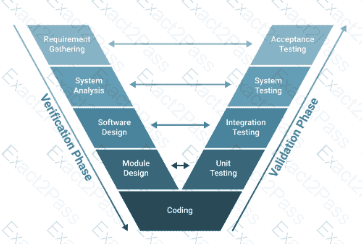
Key Concept: The Project Management Institute (PMI) categorizes these techniques under Data Gathering and Interpersonal and Team Skills. To build a robust Requirements Traceability Matrix, a Business Analyst typically starts with Brainstorming (Choice E) for ideas, conducts Interviews (Choice C) for detail, and uses Facilitated Workshops (Choice B) to align the group and finalize the scope.
What benefit does the Manage Stakeholder Engagement process offer?
Allows the project manager to increase support and minimize resistance from stakeholders
Maintains or increases the efficiency and effectiveness of stakeholder engagement activities as the project evolves and its environment changes
Provides an actionable plan to interact effectively with stakeholders
Enables the project team to identify the appropriate focus for engagement of each stakeholder or group of stakeholders
According to the PMBOK® Guide, the Manage Stakeholder Engagement process is the process of communicating and working with stakeholders to meet their needs and expectations, address issues, and foster appropriate stakeholder engagement in project activities throughout the project life cycle.
The key benefit of this process is that it allows the project manager to increase support and minimize resistance from stakeholders. This is achieved by:
Ensuring stakeholders clearly understand the project goals, objectives, benefits, and risks.
Addressing any risks or potential concerns related to stakeholder management and anticipating future issues.
Negotiating and communicating with stakeholders to manage their expectations.
Analysis of other options based on PMI Standards:
Option B: This describes the key benefit of Monitor Stakeholder Engagement, which is the process of monitoring project stakeholder relationships and tailoring strategies for engaging stakeholders through the modification of engagement strategies and plans.
Option C: This describes the key benefit of Plan Stakeholder Engagement, which is providing an actionable plan to interact with stakeholders effectively.
Option D: This describes the key benefit of Identify Stakeholders, which enables the project team to identify the appropriate focus for engagement for each stakeholder or group of stakeholders.
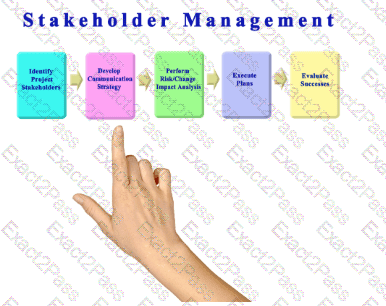
Per the PMI standards, while " Planning " creates the strategy, Manage Stakeholder Engagement is the active execution of that strategy to ensure stakeholders remain aligned with the project ' s success.
Market conditions and published commercial information are examples of which input to the Estimate Costs process?
Scope baseline
Organizational process assets
Enterprise environmental factors
Risk register
According to the PMBOK® Guide and the Standard for Project Management, Market conditions and published commercial information (such as commercial databases or price lists) are classic examples of Enterprise Environmental Factors (EEF).
In the Estimate Costs process, EEFs are internal or external factors that are not under the direct control of the project team but influence, constrain, or direct the project. Specifically:
Market conditions: These describe what products, services, and results are available in the local and global marketplace, which directly affects the cost of resources.
Published commercial information: This includes resource cost rate information that is often available from commercial databases that track skills and human resource costs, and provide standard costs for material and equipment.
The other options are incorrect based on the following PMI definitions:
Scope baseline: This includes the project scope statement, WBS, and WBS dictionary. While it provides the requirements and work packages that need to be estimated, it does not contain external market pricing or commercial data.
Organizational Process Assets (OPA): These are internal to the organization and include things like cost estimating templates, historical information, and lessons learned from previous projects. " Published commercial information " is considered external, thus making it an EEF.
Risk Register: This is an input used to consider the " cost of risk " (contingency reserves). While it influences the total estimate, it is not the source for general market conditions or commercial price lists.
As per the PMI Lexicon of Project Management Terms, Enterprise Environmental Factors provide the context in which the project operates, and in the case of cost estimation, they provide the external economic reality that the project manager must account for.
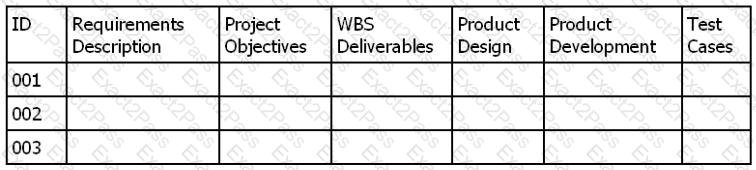
The chart below is an example of a:
Responsibility assignment matrix (RAM)
Work breakdown structure (WBS)
RACI chart
Requirements traceability matrix
According to the PMBOK® Guide (Project Management Body of Knowledge), specifically within the Project Scope Management knowledge area and the Collect Requirements process:
Requirements Traceability Matrix (Option D): The image provided is a textbook example of a Requirements Traceability Matrix (RTM). An RTM is a grid that links product requirements from their origin to the deliverables that satisfy them. As shown in the chart, it tracks the ID and Requirements Description through various stages of the project life cycle, including Project Objectives, WBS Deliverables, Product Design, Product Development, and Test Cases. This ensures that each requirement adds business value and that all requirements are accounted for at the end of the project.
Responsibility Assignment Matrix (RAM) / RACI Chart (Options A and C): These are tools used in Project Resource Management. They map project work packages to the individuals or groups responsible for them (Responsible, Accountable, Consulted, Informed). They do not track technical requirements or product design stages.
Work Breakdown Structure (WBS) (Option B): A WBS is a hierarchical decomposition of the total scope of work to be carried out by the project team. It is typically displayed as a tree diagram or an indented list of work packages, not a horizontal matrix tracking the development lifecycle of specific requirements.
In the PMI framework, the Requirements Traceability Matrix is essential for managing scope creep. It provides a means to track requirements throughout the project life cycle, ensuring that requirements approved in the charter and scope statement are actually delivered and tested.
The following is a network diagram for a project.
How many possible paths are identified for this project?
3
4
6
7
According to the PMBOK® Guide under the Develop Schedule process, a Project Network Diagram is a graphical representation of the logical relationships (dependencies) among the project schedule activities.
Path Identification: A " path " is defined as any continuous sequence of activities from the Start node to the Finish node.
Analysis of the Network Structure: In the standard PMI practice question regarding nodes A through I (as referenced in your previous question, No. 259), the network branches at two specific decision points:
First Branch: From Node A, the path can go to either B or D.
Convergence: Both paths (B-C and D-E) converge at Node F.
Second Branch: From Node F, the path can go to either G or H.
Final Convergence: Both G and H lead to the final Node I.
Calculation of Total Paths: To find the total number of possible paths, we identify all unique routes from start to finish:
Path 1: A - > B - > C - > F - > G - > I
Path 2: A - > B - > C - > F - > H - > I
Path 3: A - > D - > E - > F - > G - > I
Path 4: A - > D - > E - > F - > H - > I
Comparison with other options:
A. 3: This would miss one of the combinations of the two branching points.
C and D. 6 or 7: These numbers would imply additional cross-dependencies or loops that are not present in a standard Precedence Diagramming Method (PDM) used for these specific PMI examination questions.
Which process includes prioritizing risks for subsequent further analysis or action by assessing and combining their probability of occurrence and impact?
Perform Qualitative Risk Analysis
Perform Quantitative Risk Analysis
Plan Risk Management
Plan Risk Responses
According to the PMBOK® Guide, the process of Perform Qualitative Risk Analysis is the process of prioritizing individual project risks for further analysis or action by assessing their probability of occurrence and impact, as well as other characteristics.
Key Function: This process focuses on the subjective evaluation of risks. It allows project managers to reduce the level of uncertainty and focus on high-priority risks.
Methodology: It involves the use of a Probability and Impact Matrix to assign a risk rating (e.g., Low, Medium, High). This prioritization is essential because it identifies which risks require a more detailed Quantitative Risk Analysis (Choice B) or immediate Risk Response Planning (Choice D).
Efficiency: By combining probability and impact, the project team can effectively categorize risks and allocate resources to manage the most critical threats or opportunities first.
Analysis of other choices:
Choice B (Perform Quantitative Risk Analysis): This process numerically analyzes the combined effect of identified individual project risks and other sources of uncertainty on overall project objectives. It usually follows Qualitative analysis.
Choice C (Plan Risk Management): This is the process of defining how to conduct risk management activities for a project; it sets the " rules, " but does not assess the risks themselves.
Choice D (Plan Risk Responses): This is the process of developing options, selecting strategies, and agreeing on actions to address overall project risk exposure, which occurs after the risks have been prioritized.
Match the life cycle type to when its requirements are defined.


 A screenshot of a login box Description automatically generated
According to PMI standards, the choice of life cycle determines how the project scope is managed and when the " What " of the project is finalized.
Predictive (Waterfall): This lifecycle is used when the product is well understood. Requirements are locked in during the planning phase. Any changes later usually require a formal change request. This provides high predictability but low flexibility.
Iterative: The goal here is to arrive at the correct solution through successive prototypes or versions. Requirements are revisited and refined based on feedback from the previous iteration. It focuses on the " correctness " of the solution.
Incremental: This life cycle delivers a finished, usable portion of the product in each interval. Requirements for a specific " slice " of the project are defined and delivered, with subsequent increments adding more features until the total scope is met.
Adaptive (Agile): In highly uncertain environments, requirements are never " finished " until the project is. They are maintained in a Product Backlog and refined/prioritized just before the start of a sprint or iteration. This allows the team to respond to change and deliver value quickly.
Understanding these distinctions is crucial for the Project Integration Management knowledge area. The Project Manager must choose the life cycle that best fits the project ' s level of uncertainty, complexity, and the need for frequent delivery.
What organizational process asset (OPA) might impact a project ' s outcome?
Processes, polices, and procedures
Legal restrictions
Infrastructure, resource availability. and employee capability
Financial considerations
According to the PMBOK® Guide, a project manager must navigate two primary types of internal and external factors: Organizational Process Assets (OPAs) and Enterprise Environmental Factors (EEFs).
Understanding OPAs: Organizational Process Assets are the plans, processes, policies, procedures, and knowledge bases specific to and used by the performing organization. These are internal to the organization and include:
Processes and Procedures: Standardized guidelines, work instructions, proposal evaluation criteria, and performance measurement criteria.
Corporate Knowledge Base: Historical information, lessons learned repositories, and project files from previous initiatives.
Why it impacts outcomes: OPAs provide a " head start " for projects. By following established processes and policies, the project manager ensures consistency, complies with organizational governance, and avoids " reinventing the wheel. " Conversely, if these assets are outdated or poorly followed, they can negatively impact the project ' s efficiency and success.
Analysis of other options:
Legal restrictions (Option B): These are Enterprise Environmental Factors (EEFs). They are typically external constraints (laws, regulations) that the project must follow but does not own or control.
Infrastructure, resource availability, and employee capability (Option C): These are internal EEFs. They represent the " conditions " under which the project operates (e.g., the quality of the building, the skills of the available staff), rather than documentation or knowledge assets.
Financial considerations (Option D): These are also considered EEFs. Market conditions, currency exchange rates, and regional price fluctuations are environmental factors that influence project success from the outside.
Per PMI standards, the key differentiator is that OPAs are typically the " tools and documentation " the organization provides to help you, while EEFs are the " circumstances and constraints " you must work within.
The scope of a project cannot be defined without some basic understanding of how to create the specified:
objectives
schedule
product
approach
According to the PMBOK® Guide, specifically within the Project Scope Management knowledge area, there is a fundamental distinction between Project Scope (the work performed to deliver a product, service, or result) and Product Scope (the features and functions that characterize a product, service, or result).
Interdependence: The scope of a project cannot be effectively defined without a basic understanding of the product to be created. This is because the " Project Scope " is entirely dependent on the requirements of the " Product Scope. "
Product Analysis: In the Define Scope process, Product Analysis is a key tool and technique. For projects that have a product as a deliverable, as opposed to a service or result, product analysis is a critical tool. Each application area has one or more generally accepted methods for translating high-level product descriptions into tangible deliverables.
Techniques involved: Product analysis includes techniques such as:
Product breakdown.
Systems analysis.
Requirements analysis.
Systems engineering.
Value engineering.
Value analysis.
The Logic: If the project team does not understand the technical specifications, functions, or physical characteristics of the product, they cannot accurately estimate the work (Project Scope) required to build it, nor can they create a Work Breakdown Structure (WBS).
Comparison with other options:
A. Objectives: While objectives provide the " why " and the overall goal, they are often high-level. You can define objectives (e.g., " Increase market share " ) without knowing how to build the specific product that achieves it, but you cannot define the scope of the work without that product knowledge.
B. Schedule: The schedule is a result of defining the scope. You cannot create a realistic schedule until after the scope (the work) has been defined. Therefore, the schedule is an output, not a prerequisite for defining scope.
D. Approach: The " approach " (or methodology) describes how you will manage the project (e.g., Agile vs. Waterfall). While important, the specific boundaries of the scope are dictated by the nature of the product itself rather than just the management approach used to get there.
The project leam is brainstorming on approaches to deliver the upcoming product launch for which the project has been chartered. The project manager is laying out hybrid, adaptive, iterative methods. What is the team trying to address?
Co-location
Lite-cycle
Diversity
Management
According to the PMBOK® Guide, the choice between hybrid, adaptive (agile), iterative, and predictive (waterfall) methods refers to the Project Life Cycle. A life cycle is the series of phases that a project passes through from its start to its completion. It provides the basic framework for managing the project.
When a project manager is evaluating these specific methods, they are determining the Development Life Cycle best suited for the product, service, or result:
Predictive (Waterfall): Scope, time, and cost are determined in the early phases of the life cycle.
Iterative: Scope is generally determined early, but time and cost estimates are routinely modified as the team ' s understanding of the product increases.
Adaptive (Agile): Change-driven or agile; the detailed scope is defined and approved before the start of an iteration.
Hybrid: A combination of a predictive and an adaptive life cycle.
Why Option B is correct: The terms " hybrid, " " adaptive, " and " iterative " are the standard classifications used to describe the nature and cadence of the project ' s life cycle. Selecting the correct life cycle ensures the project management approach aligns with the complexity and uncertainty of the project ' s requirements.
Analysis of Distractors:
A (Co-location): This refers to the physical placement of team members (working in the same room or office) to improve communication. It is a resource management technique, not a delivery methodology.
C (Diversity): This usually refers to the composition of the project team or stakeholder group regarding different backgrounds and perspectives. While important for team performance, it does not describe delivery methods.
D (Management): While the project manager " manages " the project, this term is too broad. The specific technical term for the structure of delivery (hybrid/adaptive) is the " Life-cycle. "
What is the probability of occurrence if the risk rating is 0.56 and the impact if the risk does occur is very high (0.80)?
0.45
0.56
0.70
1.36
According to the PMBOK® Guide, specifically within the Perform Qualitative Risk Analysis process, the risk rating (also known as the Risk Score) is determined by the combination of a risk ' s probability of occurrence and its impact on the project objectives if it does occur.
The Risk Formula: The standard formula used to calculate the risk rating is:
$$\text{Risk Rating} = \text{Probability} \times \text{Impact}$$
The Calculation:
Given Risk Rating = $0.56$
Given Impact = $0.80$ (Very High)
To find the Probability ($P$):
$$0.56 = P \times 0.80$$
$$P = \frac{0.56}{0.80}$$
$$P = 0.70$$
Application: This mathematical approach allows project managers to prioritize risks on a numerical scale. In a Probability and Impact Matrix, a risk with a probability of $0.70$ and an impact of $0.80$ would typically fall into the " High Risk " (red) zone, requiring aggressive response strategies and proactive monitoring.
Comparison with other options:
A. 0.45: This value is incorrect. Multiplying $0.45$ by $0.80$ would result in a risk rating of $0.36$.
B. 0.56: This is the risk rating itself, not the probability.
D. 1.36: This value is mathematically incorrect and impossible for a probability. In project management risk scales, probability is always expressed as a value between $0.0$ and $1.0$ (or $0\%$ to $100\%$). A value of $1.36$ would imply a likelihood greater than $100\%$.
Which two processes should be used to influence costs in the early stages of a project?
Estimate Costs and Determine Budget
Plan Cost Management and Estimate Activity Durations
Control Quality and Control Costs
Plan Stakeholder Engagement and Plan Communications Management
According to the PMBOK® Guide, the ability to influence costs is highest during the early stages of a project, specifically during the Planning Process Group. As the project progresses, the cost of changes increases, making early intervention critical.
Estimate Costs: This process involves developing an approximation of the monetary resources needed to complete project work. By accurately estimating costs early, the project manager can identify potential overruns or savings before significant resources are committed.
Determine Budget: This process aggregates the estimated costs of individual activities or work packages to establish an authorized Cost Baseline. Setting this baseline early allows for effective management and influence over the project ' s financial trajectory.
Analysis of other options:
B: While " Plan Cost Management " is an early process, " Estimate Activity Durations " is primarily a Schedule Management process. While duration impacts cost, it is not one of the two primary cost-influencing processes compared to direct estimation and budgeting.
C: Control Quality and Control Costs occur during the Monitoring and Controlling phase. By the time you are " controlling, " the project is already in execution, and the window for maximum influence at a low cost has largely closed.
D: These are Stakeholder and Communications processes. While they support project success, they do not directly manage or influence the financial cost structure of the project deliverables.
Per PMI standards, the most direct impact on the project ' s financial outcome is established when the team defines what things will cost (Estimate Costs) and secures the funding and baseline for them (Determine Budget).
An output of Control Schedule is:
A project schedule network diagram
A schedule management plan
Schedule data
Schedule forecasts
According to the PMBOK® Guide, the Control Schedule process is the process of monitoring the status of the project to update the project schedule and managing changes to the schedule baseline.
Schedule Forecasts: These are estimates or predictions of conditions and events in the project ' s future based on information and knowledge available at the time of the forecast. As the project progresses, the schedule is updated based on work performance data, and the Schedule Forecasts (such as the predicted finish date) are updated and communicated to stakeholders.
Calculation: These forecasts are often derived from Earned Value Management (EVM) metrics. For example, the Schedule Performance Index (SPI) and Schedule Variance (SV) are used to predict if the project will finish on time or if corrective actions are required to meet the baseline.
Context within Outputs: Other key outputs of this process include Work Performance Information (WPI), Change Requests, and updates to the Project Management Plan and Project Documents.
Comparison with other options:
A. A project schedule network diagram: This is a schematic display of the logical relationships (dependencies) among the project schedule activities. It is a primary output of the Sequence Activities process, not Control Schedule.
B. A schedule management plan: This is a component of the project management plan that establishes the criteria and the activities for developing, monitoring, and controlling the schedule. It is the output of the Plan Schedule Management process.
C. Schedule data: This is a collection of information for describing and controlling the schedule, such as schedule milestones, schedule activities, and activity attributes. It is primarily an output of the Develop Schedule process. While it may be updated during Control Schedule, " Schedule Forecasts " is the definitive, specific output related to the controlling and predictive nature of this process.
What is one reason why stakeholders must be identified when performing business analysis?
To identify project timelines through business reviews
To allow the business analyst to determine the project budget
To identify who should define the business requirements for the project
To determine a cost-benefit analysis for the project
According to the PMI Guide to Business Analysis and the PMBOK® Guide, identifying stakeholders is one of the most critical initial steps in any project or business analysis effort.
Defining the " Who " : Requirements do not exist in a vacuum; they belong to people, groups, or organizations. By identifying stakeholders early, the business analyst determines exactly whose needs, expectations, and constraints must be captured to define the project ' s scope.
Requirements Ownership: Different stakeholders provide different types of requirements. For example, a department head might define high-level Business Requirements, while an end-user defines User Requirements. Without identifying these individuals, the business analyst would not know whom to interview, observe, or invite to workshops, leading to critical gaps in the final solution.
Stakeholder Influence: Identifying stakeholders also allows the business analyst to understand their level of influence and impact. This ensures that the requirements defined are not only comprehensive but also prioritized based on the stakeholders ' roles and their ability to affect the project ' s success.
Analysis of other options:
Option A: Identifying project timelines is a function of the Develop Schedule process. While stakeholders provide input on constraints, the primary reason for identifying them in a business analysis context is related to requirements, not schedule creation.
Option B: Determining the project budget is the responsibility of the Project Manager and the Sponsor during the Determine Budget process. A business analyst uses the budget as a constraint but does not identify stakeholders specifically to set the project ' s total funding.
Option D: A Cost-benefit analysis is typically part of the Business Case, which is often created before or alongside stakeholder identification. While stakeholders provide the data for the analysis, the fundamental reason for identifying them is to extract the requirements that the project must fulfill.
Per PMI standards, the core purpose of stakeholder identification in business analysis is to ensure that all relevant voices are heard so that the Business Requirements accurately reflect the problem to be solved or the opportunity to be seized.
When can we say that a project is completed?
When the planned time duration is completed
When the project objectives have been reached
When the project manager has left the team
When the project team decides to stop the work on the project
According to the PMBOK® Guide, a project is defined as a temporary endeavor undertaken to create a unique product, service, or result. The " temporary " nature of a project indicates that it has a definite beginning and end.
The end of a project is reached when one or more of the following conditions are met:
Objectives Met: The primary condition for completion is that the project objectives have been achieved. This means the specific goals, results, or products defined in the project charter and scope statement have been delivered and accepted.
Objectives Cannot Be Met: The project is also considered ended if it is determined that the objectives cannot be met (e.g., due to lack of funding, technical impossibility, or shifting organizational strategy).
Need No Longer Exists: If the original reason for the project is no longer valid (e.g., the market changed, or a competitor released a superior product first), the project is terminated.
Termination for Cause: The project may be ended for legal or convenience reasons before the objectives are reached.
Why other options are incorrect:
Option A: When the planned time duration is completed: Reaching the end date of a schedule does not mean the project is " completed " if the deliverables have not been produced. If time runs out but work remains, the project is considered behind schedule, not finished.
Option C: When the project manager has left the team: The presence or absence of a specific individual does not define the status of the project. A project manager may be replaced, but the project continues until its objectives are met or it is formally closed.
Option D: When the project team decides to stop the work: The project team does not have the unilateral authority to declare a project completed. Completion is a formal status determined by the achievement of objectives and the formal sign-off from the project sponsor or customer.
The following is a network diagram for a project.
The total float for the project is how many days?
3
5
7
9
According to the PMBOK® Guide, Total Float (TF) is the amount of time that a schedule activity can be delayed or extended from its early start date without delaying the project finish date or violating a schedule constraint.
Calculating Total Float: Total Float is calculated using the formula:
$$TF = LS - ES$$
or
$$TF = LF - EF$$
(Where $LS$ = Late Start, $ES$ = Early Start, $LF$ = Late Finish, and $EF$ = Early Finish).
Analysis of the Network Diagram (Standard PMI Question Set 279-280):
Based on the previous analysis of this network, the Critical Path is A-C-F-G with a total duration of 27 days.
To find the total float for the project ' s non-critical paths, we compare them to the critical path duration.
Consider Path A-B-D-G, which has a duration of 22 days.
The float for this path is calculated as the difference between the Critical Path and this specific path: $27 - 22 = 5$ days.
Interpretation: This means the activities on the non-critical path (B and D) can collectively slip by up to 5 days without pushing the final completion date of Activity G beyond day 27.
Comparison with other options:
A. 3: This value often represents a specific activity duration or a " Free Float " value for a single segment of the diagram rather than the total path buffer.
C and D. 7 or 9: These values would correspond to paths with durations of 20 or 18 days. Based on the standard durations provided in this diagram set (A=5, B=5, C=9, D=8, E=4, F=10, G=3), no path results in a gap of 7 or 9 days relative to the 27-day critical path.
What should a project manager do to prepare a risk management plan with a lot of technical uncertainty?
Get expert judgment.
Count on personal experience.
Ask project sponsors.
Delay the project until technical uncertainty is clarified
According to the PMBOK® Guide, specifically the Plan Risk Management process, when a project manager faces high levels of technical uncertainty, they must rely on specialized knowledge to identify, analyze, and plan for potential risks.
Expert Judgment (Choice A): This is a primary Tool and Technique for all risk processes. When the project involves complex technical components, the project manager should consult with subject matter experts (SMEs), specialized consultants, or technical leads. These experts can provide insight based on similar past projects or specialized training to help define the risk management approach, set the appropriate thresholds, and identify specific technical " red flags " that a non-specialist might miss.
Personal Experience (Choice B): While a project manager’s experience is valuable, relying solely on it—especially in a project with high technical uncertainty—is dangerous. It can lead to cognitive biases or blind spots regarding new technologies or specialized environments where the PM may not have direct expertise.
Asking Project Sponsors (Choice C): Sponsors provide high-level strategic direction and funding. While they may define the organization’s overall risk appetite, they are typically not the correct source for resolving specific technical uncertainties.
Delaying the Project (Choice D): This is generally not an option in professional project management. The purpose of Project Risk Management is to manage uncertainty as it exists. Waiting for 100% clarity would result in " analysis paralysis, " as some uncertainties are only resolved through the execution of the project itself.
By utilizing Expert Judgment, the project manager ensures that the Risk Management Plan is robust, realistic, and tailored to the technical complexities of the project, allowing the team to proactively address potential issues rather than merely reacting to them.
In agile projects while performing scope management. What is the definition of requirements
Metrics
Sprint
Charter
Backlog i
In Agile and Adaptive environments, as described in the PMBOK® Guide and the Agile Practice Guide, requirements are not captured in a static scope statement but are managed dynamically through a Backlog.
Backlog (Choice D): In Agile, the Product Backlog is the primary document (an ordered list) representing the project scope. It consists of user stories, features, or requirements that need to be addressed. Requirements are " refined " and prioritized within this backlog throughout the project, rather than being finalized upfront. This aligns with the Agile principle of " responding to change over following a plan. "
Sprint (Choice B): A Sprint is a time-boxed iteration (typically 1–4 weeks) during which a specific set of work is completed. While requirements from the backlog are selected for a Sprint Backlog, the Sprint itself is a container for work, not a definition of the requirements themselves.
Charter (Choice C): The Project Charter (or Agile Charter) is a high-level document that authorizes the project. While it may contain a high-level vision and objectives, it does not define the detailed requirements that evolve during the project.
Metrics (Choice A): These are measurements (such as velocity or cycle time) used to track progress and quality, but they do not define the functional or non-functional requirements of the product.
In scope management for adaptive lifecycles, the Product Backlog serves as the evolving " single source of truth " for what the team needs to build, ensuring that the most valuable requirements are always addressed first.
An input to Develop Project Charter is a/an:
Business case.
Activity list.
Project management plan.
Cost forecast.
According to the PMBOK® Guide and the Standard for Project Management, the Business Case is a critical input to the Develop Project Charter process. It provides the necessary information from a business standpoint to determine whether or not the project is worth the required investment.
As per PMI standards, the Business Case is typically created as a result of one or more of the following:
Market demand (e.g., a car company authorizing a project to build more fuel-efficient cars).
Organizational need (e.g., a training company authorizing a project to create a new curriculum).
Customer request (e.g., an electric utility authorizing a project to build a new substation for a new industrial park).
Legal requirement (e.g., a hospital authorizing a project to comply with new health data privacy laws).
The Business Case, along with the Benefits Management Plan, makes up the Business Documents category of inputs. These documents are usually developed outside the project but are used as a basis for project authorization.
The other options are incorrect based on their placement in the project lifecycle:
Activity list: This is an output of the Define Activities process, which occurs much later during the Planning Phase.
Project management plan: This is the primary output of the Develop Project Management Plan process. It cannot be an input to the Charter because the Charter must exist before the Project Management Plan can be developed.
Cost forecast: This is an output of the Control Costs process. It is a monitoring and controlling tool used to predict future cost performance based on actual work, not an initiating document.
As per the PMI Lexicon of Project Management Terms, the Business Case describes the objectives and reasons for initiating the project and helps the sponsor and the project manager align the project ' s success criteria with the organization ' s strategic goals.
How can a project manager maintain the engagement of stakeholders in a project with a high degree of change?
Monitor project stakeholder relationships using engaging strategies and plans
Send all project documents to stakeholders each time they are modified
Schedule monthly meetings with the stakeholders, including team members
Engage only with the project sponsors
According to the PMBOK® Guide, specifically within the Monitor Stakeholder Engagement process, projects characterized by a high degree of change (such as those using agile or adaptive methodologies) require continuous and proactive management of stakeholder relationships.
Dynamic Engagement: In high-change environments, stakeholder needs, influence, and interest levels can shift rapidly. The project manager must use the Stakeholder Engagement Plan as a living document, constantly monitoring the effectiveness of engagement strategies and adjusting them as the project evolves.
Continuous Feedback Loops: Rather than relying on static communication, the project manager monitors relationships to ensure that stakeholders remain aligned with project goals. This involves using data analysis (such as stakeholder engagement assessment matrices) to identify gaps between desired and actual engagement levels.
Adaptive Strategies: The " Monitor " process ensures that if an engagement strategy is no longer working due to a change in project direction or stakeholder turnover, the project manager can implement a corrective action to bring stakeholders back into the fold.
Analysis of Other Options:
B. Send all project documents to stakeholders each time they are modified: This is an example of information overload. Sending every technical or minor update to all stakeholders can lead to " noise, " causing them to ignore critical communications and decreasing their overall engagement.
C. Schedule monthly meetings with the stakeholders, including team members: In a project with a high degree of change, monthly meetings are likely too infrequent. High-change projects typically require more frequent interaction (such as bi-weekly reviews or daily stand-ups in agile) to ensure stakeholders stay informed.
D. Engage only with the project sponsors: While sponsors are critical, the definition of a stakeholder includes anyone who can affect or be affected by the project. Ignoring other stakeholders (users, customers, functional managers) leads to missed requirements and potential resistance later in the project.
Which tool should a project manager use to calculate cost variance for a project?
Contingency analysis
Review lessons learned from similar projects
Expert judgment
Actual cost
According to the PMBOK® Guide, specifically the Control Costs process, Earned Value Analysis (EVA) is the standard method used to assess project performance and progress.
Why Choice D is correct: To calculate Cost Variance (CV), you must have the Actual Cost (AC).
The Formula: Cost Variance is calculated using the formula:
$$CV = EV - AC$$
Components:
EV (Earned Value): The value of the work actually performed expressed in terms of the approved budget.
AC (Actual Cost): The total cost actually incurred and recorded in accomplishing work performed for an activity or WBS component.
Significance: You cannot determine if you are over or under budget without knowing exactly how much money has been spent (Actual Cost). A positive CV indicates the project is under budget, while a negative CV indicates it is over budget.
Analysis of other options:
A (Contingency analysis): This is used to determine the amount of management or contingency reserves needed for a project based on risk. It is a planning and risk management tool, not a performance measurement tool for calculating current variance.
B (Review lessons learned): Historical data from similar projects is used during the Estimate Costs phase (Analogous Estimating). While it helps in setting the baseline, it cannot be used to calculate the real-time variance of the current project ' s spending.
C (Expert judgment): While expert judgment is a tool and technique for almost every process, it is used to interpret data or make estimates. Calculating variance is a mathematical exercise requiring specific data points (EV and AC) rather than an opinion-based assessment.
Key Concept:
The Project Management Institute (PMI) emphasizes that Actual Cost (AC) (Choice D) is one of the three fundamental data points (along with Planned Value and Earned Value) required for Earned Value Management. Without capturing the actual spend, a project manager lacks the " reality " component needed to measure financial performance against the Cost Baseline.
Which input will be used when tasked with developing the human resource plan?
Project management plan
Activity resource requirements
Resource calendar
Project staff assignments
According to the PMBOK® Guide, specifically within the Plan Human Resource Management process (now known as Plan Resource Management), the project manager must identify the types and quantities of resources needed to complete the project activities.
Activity Resource Requirements: This is a primary input to developing the human resource plan. These requirements are determined during the Estimate Activity Resources process. They identify the specific types of people, skills, and competencies needed for each work package or activity. By reviewing these requirements, the project manager can determine the total human resource needs of the project.
The Planning Logic: You cannot create a plan for how to manage your team until you know what kind of team you need. The " Activity Resource Requirements " provide the data on the " what " (e.g., 2 Java developers, 1 QA tester, 1 UI designer) which then allows you to create the " how " (the Human Resource Plan).
Other Key Inputs:
Enterprise Environmental Factors: The organization ' s culture, existing human resources, and marketplace conditions.
Organizational Process Assets: Templates for HR plans, lessons learned, and organizational charts.
Analysis of Other Options:
A. Project management plan: While the Human Resource Plan eventually becomes part of the Project Management Plan, the overall plan is not typically listed as a specific input to this individual subsidiary process in the same way the detailed resource requirements are.
C. Resource calendar: This is an output of the Acquire Resources process. It shows when specific resources are available. During the initial planning phase, you are defining requirements; you don ' t yet have the specific calendars for people who haven ' t been assigned yet.
D. Project staff assignments: This is an output of the Acquire Project Team process. It refers to the specific individuals assigned to the project. You cannot have assignments as an input to the plan that is designed to figure out how to get those assignments in the first place.
A key project team member complains about being left out of the communication loop. In order to ensure that each key member is involved, who should review the business analysis communications management plan?
Business analyst, project manager, and sponsor
Business analyst, project manager, and stakeholders
Business analyst and project manager
Only the business analyst
According to the PMBOK® Guide and the PMI Guide to Business Analysis, the Communication Management Plan (and its sub-components related to business analysis) is a living document that defines how, when, and by whom information will be distributed. When a team member feels excluded, it indicates a failure in the current communication strategy.
Why Choice B is correct:
Collaboration: Effective communication requires agreement from all parties involved in the exchange of information.
Business Analyst (BA): The BA is responsible for the requirements-related communications and must ensure the right people are involved in elicitation and feedback loops.
Project Manager (PM): The PM oversees the entire project’s communication and ensures the BA ' s plan aligns with the overall Project Communications Management Plan.
Stakeholders: This is the critical addition. By involving the stakeholders (which includes key team members) in the review, the BA and PM can directly address gaps. It allows the team members to specify their information needs, preferred formats, and frequency of updates, ensuring no one is " left out of the loop " again.
Analysis of other options:
A (BA, PM, and Sponsor): While the sponsor provides high-level oversight, they are usually not involved in the day-to-day communication needs of individual team members. This group is too small to solve a broader team exclusion issue.
C (BA and PM only): If only the BA and PM review the plan, they are merely checking their own work. They risk repeating the same mistakes because they aren ' t getting feedback from the people who actually feel excluded.
D (Only the BA): Communication is by definition a multi-party activity. A BA working in isolation cannot ensure that the rest of the team or the PM are aligned with the communication flow.
Key Concept: The Project Management Institute (PMI) emphasizes that " Communication is the lifeblood of a project. " To resolve communication breakdowns, the PM/BA must perform the Monitor Communications process, which involves validating that the communication needs of stakeholders are being met. Involving the stakeholders in the review (Choice B) is a proactive step to ensure the plan is effective and inclusive.
Project deliverables that have been completed and checked for correctness through the Control Quality process are known as:
Verified deliverables.
Validated deliverables.
Acceptance criteria.
Activity resource requirements.
According to the PMBOK® Guide (Project Management Body of Knowledge), specifically within the Quality Management and Integration Management knowledge areas, the flow of deliverables follows a very specific sequence of states:
Verified Deliverables (Option A): These are the completed project deliverables that have been checked for correctness through the Control Quality process. The primary goal of Control Quality is to ensure that the technical requirements and quality standards defined in the project management plan have been met. Once they pass this internal check, they are " Verified. "
Validated Deliverables (Option B): These are deliverables that have been signed off by the customer or sponsor during the Validate Scope process. Verification (Internal/Quality) must happen before Validation (External/Customer Acceptance).
Acceptance Criteria (Option C): These are the standards, rules, or requirements that a deliverable must meet to be accepted by the customer. They are the inputs or benchmarks used during the testing, not the deliverables themselves.
Activity Resource Requirements (Option D): This is a document from the Project Schedule Management area that identifies the types and quantities of resources required for each activity; it is unrelated to the status of completed deliverables.
In the standard PMI process flow, the Control Quality process produces Verified Deliverables as an output, which then becomes an input to the Validate Scope process to eventually become Accepted Deliverables.
Which of the following factors within a company cloud trigger the creation of a project?
Need to lower production costs to remain competitive
Need to submit a warranty claim for a faulty product
Need to submit the monthly production report
Need to define next month ' s production goals
According to the PMBOK® Guide, projects are initiated in response to factors that influence an organization. These factors are often categorized as " Project Initiation Contexts. " A project is a temporary endeavor undertaken to create a unique product, service, or result, and it is usually launched to achieve a specific strategic objective or to solve a problem.
Market Demand / Competition: The need to lower production costs to remain competitive is a classic strategic trigger. This would typically involve a project to improve processes (e.g., Six Sigma), implement new technology, or redesign a manufacturing line. This creates a unique change or improvement, which is the hallmark of a project.
Strategic Opportunity: Organizations often initiate projects to align with their business strategies. Reducing costs to maintain a competitive edge directly supports the organization ' s long-term viability and market position.
Why other options are incorrect:
Option B: Need to submit a warranty claim: This is a routine administrative or customer service task. It does not create a unique product or result; it is part of the ongoing operations of a business.
Option C: Need to submit the monthly production report: This is a repetitive, ongoing activity. Monthly reporting is a functional operational task required to maintain the business, not a project.
Option D: Need to define next month ' s production goals: This is a standard management or operational planning activity. Setting recurring short-term goals for existing lines of work is part of operations management, not a project initiation trigger.
In the project charter process, which three of the following are discussed during meetings held with stakeholders? (Choose three)
High-level deliverables
Phase transitions
Project objectives
Success criteria
Cost
According to the PMBOK® Guide, specifically the Develop Project Charter process, the project charter is the document that formally authorizes the existence of a project and provides the project manager with the authority to apply organizational resources to project activities.
During meetings to develop this document, the focus is on high-level strategic alignment rather than granular tactical details. The three correct elements discussed are:
Project Objectives (C): These are the measurable goals the project is intended to achieve. Meetings with stakeholders are crucial to ensure that the project ' s purpose is clearly defined and aligned with the business case and strategic goals of the organization.
Success Criteria (D): Stakeholders must agree on what constitutes project success. This includes defining the measurable standards (such as KPIs, quality levels, or specific business outcomes) that will be used to determine if the project has met its objectives upon completion.
High-level Deliverables (A): The charter outlines the main products, services, or results that the project will produce. While a detailed Work Breakdown Structure (WBS) comes later during planning, the " big picture " deliverables must be identified in the charter to define the project ' s boundaries.
Analysis of other options:
Phase transitions (Option B): Discussions regarding how to move from one phase to another (Kill Points or Stage Gates) are typically part of the Project Management Plan or the Project Life Cycle definition during the planning phase, not the initial chartering process.
Cost (Option E): While a High-level Budget or " Summary Budget " is included in a charter, " Cost " (the detailed estimation of all resources and activities) is a specific output of the Determine Budget process during planning. The charter deals with the " order of magnitude " funding, while detailed costs are discussed much later.
Per PMI standards, the meetings held during the initiation phase are designed to capture the Sponsor’s vision, define Project Objectives, and establish Success Criteria to ensure all key stakeholders are in agreement before the project moves into detailed planning.
The links between the processes in the Process Groups are often:
Intuitive
Iterative
Measured
Monitored
According to the PMBOK® Guide, the Project Management Process Groups are not one-time, linear events that happen in isolation. Instead, they are highly interrelated and the links between them are iterative.
The Nature of Iteration: Project management is a " progressive elaboration " of the project management plan. This means that as more information or better estimates become available, the project team must often return to previous process groups to refine the project ' s direction.
Process Links: The output of one process generally becomes an input to another process or is a deliverable of the project. For example:
The Planning group provides the Executing group with the project management plan.
As work is executed, Work Performance Data is generated and sent to the Monitoring and Controlling group.
If the controlling processes identify a significant variance, the team may need to trigger the Planning group again to update the schedule or budget.
Cyclical Interaction: This iterative nature ensures that the project remains aligned with business objectives. It allows for continuous improvement and adjustment throughout the project life cycle until the final objectives are met in the Closing process group.
Comparison with other options:
A. Intuitive: While experienced project managers develop intuition, the formal framework of the PMBOK® Guide is based on structured, documented processes rather than " gut feeling. "
C. Measured: While performance within the process groups is measured (specifically in Monitoring and Controlling), " measured " does not describe the link or relationship between the groups themselves.
D. Monitored: Monitoring is a specific process group (Monitoring and Controlling), but it is not the term used to describe the fundamental, repetitive, and refining relationship that exists between all the groups.
The process of confirming human resource availability and obtaining the team necessary to complete project activities is known as:
Plan Human Resource Management.
Acquire Project Team.
Manage Project Team.
Develop Project Team.
According to the PMBOK® Guide and the Standard for Project Management, the process of confirming resource availability and obtaining the team necessary to complete project activities is Acquire Resources (referred to in previous editions as Acquire Project Team).
This process is part of the Executing Process Group. As per PMI standards, the key benefit of this process is outlining and guiding the selection of resources and assigning them to their respective activities. The internal and external resources required to complete the project are identified and secured during this stage.
The other options are incorrect based on the following PMI definitions:
Plan Human Resource Management: (Now Plan Resource Management) This is the process of defining how to estimate, acquire, manage, and use team and physical resources. It is a Planning process that creates the strategy but does not perform the actual acquisition.
Manage Project Team: (Now Manage Team) This is the process of tracking team member performance, providing feedback, resolving issues, and managing team changes to optimize project performance. It occurs after the team has been acquired.
Develop Project Team: (Now Develop Team) This is the process of improving competencies, team member interaction, and the overall team environment to enhance project performance. Like managing, this happens after the team is already in place.
As per the PMI Lexicon of Project Management Terms, the acquisition of resources often involves negotiation with functional managers and external vendors to ensure the project has the specific skill sets required for success.
Which output is the approved version of the time-phased project budget?
Resource calendar
Scope baseline
Trend analysis
Cost baseline
According to the PMBOK® Guide (Project Management Body of Knowledge), specifically within the Project Cost Management knowledge area, the approved version of the budget is defined as follows:
Cost Baseline (Option D): This is the approved version of the time-phased project budget, excluding any management reserves, which can only be changed through formal change control procedures. It is used as a basis for comparison to actual results. It is developed during the Determine Budget process by aggregating the estimated costs of individual activities or work packages.
Resource Calendar (Option A): This identifies the working days and shifts on which each specific resource is available. It is an output of the Acquire Resources process and is used for scheduling, not for establishing the financial budget.
Scope Baseline (Option B): This consists of the approved Project Scope Statement, the WBS (Work Breakdown Structure), and the WBS Dictionary. While the WBS is an input to determining the budget, the scope baseline itself is used to measure scope performance, not financial performance.
Trend Analysis (Option C): This is a Data Analysis technique used in the Control Costs process to examine project performance over time to determine if performance is improving or deteriorating. It is a process tool/technique, not a budget output.
In PMI standards, the Cost Baseline is typically displayed as an S-curve, representing the cumulative values of the time-phased budget. Once management reserves are added to the cost baseline, the result is the total Project Budget.
Project managers plan a key role performing integration on the project what are the three different levels of integration?
Process, cognitive
Complexity, understand and change
Interact, insight and leadership
Communication, knowledge and value
According to the PMBOK® Guide, specifically in the section regarding the Project Manager’s Sphere of Influence and the role of the project manager, integration is a core responsibility. The Project Manager performs integration at three distinct levels to ensure the project stays aligned with its goals:
Process Level (Choice A): This involves integrating the various project management processes (e.g., Scope, Schedule, Cost, Quality) so that they work together as a cohesive system. It ensures that a change in one area (like scope) is reflected in others (like cost or schedule).
Cognitive Level (Choice A): This refers to the Project Manager ' s personal ability to apply their knowledge, experience, and skills to the project. It involves the " thinking " aspect—analyzing situations, applying the right methodology, and using professional judgment to navigate project challenges.
Context Level (Choice A - implied in the full PMI list): While the prompt only lists two in the correct option, the third level recognized by PMI is Context Level. This involves integrating the project within the broader organizational context, such as its strategic goals, business value, and the environment in which it operates.
Why other choices are incorrect:
Choice B, C, and D: These options use general project management terms (like complexity, leadership, or communication), but they do not represent the formal framework of " Levels of Integration " as defined in the PMI standard documents.
Project integration management is not just about documents; it is the " glue " that binds the project together at these three levels, ensuring that the project team is working toward a unified objective within the organization ' s strategic framework.
A project team member is discussing a new project with their manager. The project is very similar to a project that was delivered last year and the scope is very well documented.
Which of the following project delivery approaches should be recommended?
Adaptive
Hybrid
Extreme
Traditional
According to the PMBOK® Guide and the Agile Practice Guide, the choice of a project delivery approach depends on the levels of uncertainty regarding the project ' s requirements and the technical execution.
Predictability and Low Risk: When a project is " very similar " to a previous one and the scope is " very well documented, " the project has low uncertainty. In these cases, a Traditional (also known as Predictive or Waterfall) approach is highly effective. Since the team already knows what to do and how to do it based on last year’s experience, they can plan the entire project from start to finish with high confidence.
Standardized Processes: Traditional delivery excels in environments where the work is repetitive or follows a clear, linear path. The project manager can leverage Organizational Process Assets (OPAs), such as templates and lessons learned from the previous year, to create a robust schedule and budget.
Fixed Scope: Because the scope is well-defined, there is no need for the iterative discovery found in adaptive methodologies. The focus can remain on efficiency, cost control, and meeting the specific, predetermined requirements.
Analysis of other options:
Option A: Adaptive (Agile) approaches are best suited for projects with high uncertainty or where requirements are expected to change frequently. Using Agile for a well-documented, repetitive project often adds unnecessary overhead.
Option B: Hybrid approaches combine predictive and adaptive elements. While flexible, a hybrid model is unnecessary when the entire scope is already well-understood and stable.
Option C: Extreme (or XP) is a specific Agile framework focused on software engineering. It is a subset of adaptive delivery and is not appropriate for a project where the goal is to follow a pre-established, well-documented plan.
Per PMI standards, when the project scope is stable, well-defined, and based on a proven model, the Traditional delivery approach is the most efficient choice to ensure the project is completed on time and within budget.
In which process is a project manager identified and given the authority to apply resources to project activities?
Acquire Project Team
Develop Project Management Plan
Manage Project Execution
Develop Project Charter
According to the PMBOK® Guide, the Develop Project Charter process is the process of developing a document that formally authorizes the existence of a project and provides the project manager with the authority to apply organizational resources to project activities.
Formal Authority: The project charter is the foundational document of a project. It is usually issued by the project initiator or sponsor. Once signed, it creates a formal link between the project and the strategic objectives of the organization.
Project Manager Identification: One of the key components of a project charter is the naming of the project manager. It is highly recommended that the project manager be identified and assigned as early as possible, preferably while the charter is being developed and always prior to the start of planning.
Resource Allocation: Without a project charter, a project manager does not have the legal or organizational standing to request staff, budget, or equipment from functional managers or other departments.
Comparison with Other Options:
Acquire Project Team (A): This is an executing process where the project manager uses the authority granted in the charter to actually " onboard " or confirm the availability of specific human resources.
Develop Project Management Plan (B): This is the primary planning process. While the PM leads this, the authority to even start this plan comes from the already-approved charter.
Manage Project Execution (C): This is the phase where the work is performed. The project manager is already well-established by this stage.
Every project creates a unique product, service, or result that may be:
tangible
targeted
organized
variable
According to the PMBOK® Guide, a project is defined as a temporary endeavor undertaken to create a unique product, service, or result. The nature of this output can be either tangible or intangible.
Unique Product: This can be a component of another item, an enhancement or correction to an item, or a new end item in itself (e.g., a physical building or a software application).
Unique Service or Capability: This refers to the ability to perform a service (e.g., a business function that supports production or distribution).
Unique Result: This can be an outcome or document (e.g., a research project that develops knowledge that can be used to determine whether a trend exists or a new process will benefit society).
The term tangible specifically describes physical products or assets that have a material existence. While projects can also produce intangible results (such as a brand reputation or a patented process), " tangible " is the standard term used in PMI documentation to categorize physical project outputs.
Comparison with other options:
B. Targeted: While projects have specific objectives and " target " certain outcomes, " targeted " is not the formal PMI classification for the nature of a project ' s product, service, or result.
C. Organized: Projects are " organized " efforts, but the result itself is classified by its physical or functional nature, not by the level of organization used to create it.
D. Variable: In project management, we generally strive for consistency with requirements. While the scope might change, the definition of a project output emphasizes its uniqueness rather than its variability.

