Exact2Pass

Last Update 20 hours ago Total Questions : 1337
The Certified Associate in Project Management (CAPM) content is now fully updated, with all current exam questions added 20 hours ago. Deciding to include CAPM practice exam questions in your study plan goes far beyond basic test preparation.
You'll find that our CAPM exam questions frequently feature detailed scenarios and practical problem-solving exercises that directly mirror industry challenges. Engaging with these CAPM sample sets allows you to effectively manage your time and pace yourself, giving you the ability to finish any Certified Associate in Project Management (CAPM) practice test comfortably within the allotted time.
Which group creativity technique asks a selected group of experts to answer questionnaires and provide feedback regarding the responses from each round of requirements gathering?
The Delphi technique
Nominal group technique
Affinity diagram
Brainstorming
According to the PMBOK® Guide, specifically within the Collect Requirements process, the Delphi Technique is a specific group creativity technique (and a form of expert judgment) used to reach a consensus among a group of experts.
Process and Methodology: In the Delphi technique, a facilitator uses a questionnaire to solicit ideas about the project requirements from a selected group of experts. The responses are summarized and then recirculated to the experts for further comment.
Anonymity: A key characteristic of this technique is that the experts participate anonymously. This prevents any single participant from unduly influencing the others (the " bandwagon effect " ) and encourages honest, unbiased feedback.
Iterative Rounds: The process typically involves several rounds of questionnaires and feedback until a consensus is reached. This is highly effective for reducing bias in the data and ensuring that the requirements are not skewed by a dominant personality in a face-to-face setting.
Analysis of other choices:
Choice B (Nominal group technique): This technique enhances brainstorming with a voting process used to rank the most useful ideas for further brainstorming or for prioritization. It usually involves face-to-face interaction or direct collaboration.
Choice C (Affinity diagram): This is a tool used to allow a large number of ideas to be classified into groups for review and analysis. It is a categorization tool, not a feedback/consensus-gathering method.
Choice D (Brainstorming): This is a general technique used to generate and collect multiple ideas related to project and product requirements. It lacks the formal, iterative, and anonymous structure of the Delphi technique.
Company A’s accountant sends notification about a change in the company’s tax classification.
What would a project have to be initiated?
To change business and technological strategies
To improve processes and services
To meet regulatory and legal requirements
To satisfy stakeholder requests
According to the PMBOK® Guide, projects are initiated in response to factors that influence an organization. These factors are generally categorized into four primary areas of project initiation context.
Meet Regulatory, Legal, or Social Requirements (Choice C): A change in a company’s tax classification is a formal legal and financial status update mandated by government or tax authorities. To remain compliant with the law, the company may need to initiate a project to update its financial systems, reporting structures, and accounting processes. This is a classic example of a project triggered by the need to adhere to external regulations.
Change Business or Technological Strategies (Choice A): This usually refers to a project initiated because the company wants to move in a new direction—such as launching a new product line or moving to a cloud-based infrastructure—rather than reacting to a mandatory tax change.
Improve Processes and Services (Choice B): While the tax change might involve changing a process, the reason for the project is the legal requirement itself. " Improvement " implies a choice to make something better or more efficient for the sake of performance, rather than a mandatory compliance task.
Satisfy Stakeholder Requests (Choice D): While an accountant is a stakeholder, their notification is regarding a structural/legal change. Stakeholder requests as a project trigger usually refer to specific desired features or changes requested by customers or internal executives that are not necessarily legally mandated.
By initiating a project to address Regulatory and Legal Requirements, the organization avoids penalties, fines, and legal complications, ensuring that its operations remain sustainable and legitimate under the new tax classification.
Which input to the Manage Stakeholder Engagement process is used to document changes that occur during the project?
Issue log
Change log
Expert judgment
Change requests
According to the PMBOK® Guide, the Manage Stakeholder Engagement process is the process of communicating and working with stakeholders to meet their needs and expectations, address issues, and foster appropriate stakeholder engagement.
Change Log: This is a specific Project Document used as an input to this process. The change log is used to document changes that occur during a project. These changes—and their impact on the project in terms of time, cost, and risk—must be communicated to the appropriate stakeholders to manage their expectations and maintain their support.
Purpose in Stakeholder Engagement: When a change is approved or rejected, it affects various stakeholders. The project manager uses the change log to ensure they are proactively addressing how these changes might shift a stakeholder ' s level of engagement or concerns.
Why the other options are incorrect:
A. Issue log: While also an input to this process, the issue log is used to document and monitor current problems or gaps that need to be addressed. It does not formally document the " changes " to the project scope, schedule, or budget in the way the change log does.
C. Expert judgment: This is a Tool and Technique, not an input. It involves the specialized knowledge of individuals or groups to help manage stakeholder expectations.
D. Change requests: These are typically an output of this process (or other monitoring and controlling processes). Change requests are the formal proposals to modify a document, deliverable, or baseline; the record of what happened to those requests is what resides in the Change Log.
Which tool or technique is effective in a project in which the deliverable is not a service or result?
Inspection
Variance analysis
Decomposition
Product analysis
According to the PMBOK® Guide and the Standard for Project Management, specifically within the Define Scope process, Product Analysis is the primary tool used when the project deliverable is a tangible product (as opposed to a service or a result).
For projects that have a product as a deliverable, product analysis is a critical technique to translate high-level descriptions into meaningful deliverables. It includes activities such as:
Product breakdown
Systems analysis
Requirements analysis
Systems engineering
Value engineering and value analysis
The other options are incorrect based on the following PMI definitions:
Inspection: This is a tool used in Validate Scope and Control Quality to determine if work and deliverables meet requirements and product acceptance criteria.
Variance Analysis: This is a technique used in Monitor and Control Project Work and Control Scope to determine the cause and degree of difference between the baseline and actual performance.
Decomposition: This is a technique used in Create WBS and Define Activities to divide and subdivide the project scope and project deliverables into smaller, more manageable parts.
As per the PMI Lexicon of Project Management Terms, when the focus is on defining the physical characteristics or functions of a tangible item, Product Analysis is the specified technique.
During which process does the project team receive bids and proposals?
Conduct Procurements
Plan Procurements
Estimate Costs
Control Budget
According to the PMBOK® Guide (Project Management Body of Knowledge), the process of obtaining seller responses, selecting a seller, and awarding a contract is known as Conduct Procurements.
Conduct Procurements (Option A): This is the execution phase of procurement management. Key activities during this process include advertising the procurement, holding bidder conferences, and—most importantly—receiving bids and proposals from prospective sellers. The outputs of this process include selected sellers and formal agreements (contracts).
Plan Procurement Management (Option B): This is the planning stage where the team decides what to buy, how to buy it, and identifies potential sellers. It involves creating the Procurement Management Plan and the Procurement Statement of Work (SOW), but it does not involve the actual receipt of bids.
Estimate Costs (Option C): This process belongs to the Project Cost Management knowledge area. It involves developing an approximation of the monetary resources needed to complete project work. While seller bids might be an input to refining these estimates, the act of receiving the bids itself happens in Conduct Procurements.
Control Budget (Note: " Determine Budget " or " Control Costs " ): In PMI terminology, Determine Budget aggregates the estimated costs of individual activities to establish a cost baseline. Control Costs is the monitoring and controlling process. Neither process is responsible for the administrative receipt of procurement bids.
In summary, the transition from planning to execution in procurement is marked by the Conduct Procurements process, where the project team actively engages the market to collect and evaluate seller responses.
A project manager is monitoring and recording results of executing the quality management activities to assess performance and ensure the project outputs are complete, correct, and meet customer expectations. Which output is the project manager using?
Approved change requests
Verified deliverables
Lessons learned
Work performance data
According to the PMBOK® Guide, the process described is Control Quality. This process is focused on the technical correctness of the deliverables and ensuring they meet the requirements specified by the stakeholders.
Verified Deliverables (The Output): When the project manager monitors and records results to ensure outputs are complete and correct, the successful result is a Verified Deliverable. This means the deliverable has been internally inspected and meets the quality standards and technical requirements.
The Workflow: Once a deliverable is " Verified " in the Control Quality process, it then becomes a primary input to the Validate Scope process, where the customer or sponsor provides formal acceptance.
Analysis of other options:
A. Approved change requests: These are an input to the Control Quality process. The project manager uses them to ensure that any changes previously approved have been correctly implemented in the deliverable.
C. Lessons learned: While " Lessons Learned " are documented throughout the project, they are a broader organizational output and not the specific measure of whether a deliverable is " complete and correct. "
D. Work performance data: This is an input to many monitoring and controlling processes. It represents the raw observations and measurements identified during activities being performed (e.g., actual number of defects found), rather than the completed and checked output itself.
Per PMI standards, the goal of the Control Quality process is to produce Verified Deliverables to provide a high level of confidence that the product is ready for the final customer sign-off.
Which tool or technique used in the Control Procurements process can be conducted during the execution of the project to verify compliance with deliverables?
Procurement documents
Inspection and audits
Estimate budget
Risk register
According to the PMBOK® Guide (Project Management Body of Knowledge), specifically within the Project Procurement Management knowledge area and the Control Procurements process:
Inspection and Audits (Option B): This is a key tool and technique used to verify compliance in the seller’s work. While " Inspections " focus on the product or deliverable itself (physically verifying that the work meets requirements), " Audits " focus on the procurement process and the seller ' s adherence to the agreed-upon procedures. Both are conducted during the project ' s execution and monitoring phases to identify any non-compliance before the final handover.
Procurement Documents (Option A): These are considered Inputs to the Control Procurements process (such as the contract, statement of work, and bid documents). They provide the basis for the requirements but are not the " tool " used to perform the verification itself.
Estimate Budget (Option C): This is part of the Project Cost Management knowledge area (specifically the Determine Budget process). While costs are monitored during procurement, " estimating " the budget is a planning activity, not a compliance verification tool.
Risk Register (Option D): This is a project document (Input) that contains information on identified risks. While procurement involves significant risk, the register is used to track and monitor those risks, not to verify the physical compliance of a vendor ' s deliverables.
In the PMI framework, Control Procurements is the process of managing procurement relationships, monitoring contract performance, and making changes and corrections as appropriate. Inspections and audits are the primary mechanisms for the buyer to ensure the seller is fulfilling their contractual obligations regarding quality and process.
Control charts, flowcharting, histograms, Pareto charts, and scatter diagrams are tools and techniques of which process?
Perform Quality Control
Perform Quality Assurance
Plan Quality
Report Performance
According to the PMBOK® Guide, the tools mentioned (Control charts, flowcharting, histograms, Pareto charts, and scatter diagrams) are part of the Seven Basic Quality Tools (also known as 7QC Tools). These are primarily utilized within the Control Quality process (referred to as Perform Quality Control in older PMI editions).
The Control Quality process is the activity of monitoring and recording results of executing the quality activities to assess performance and recommend necessary changes.
Statistical Process Control: Tools like Control Charts and Scatter Diagrams are used to determine if a process is stable or has predictable performance.
Identifying Variance: Pareto Charts (based on the 80/20 rule) help the team identify the vital few sources that are causing the most defects.
Data Visualization: Histograms and Flowcharts allow the project manager to visualize the distribution of data and the logic of the process to find where failures are occurring.
Output: The use of these tools results in Quality Control Measurements, which are then used as an input to Quality Assurance to verify the project ' s standards.
B. Perform Quality Assurance: While QA (Manage Quality) uses some of these tools, its primary focus is on the process rather than the specific product results. QA typically uses tools like Quality Audits, Process Analysis, and Design for X (DfX).
C. Plan Quality: This process identifies which quality standards are relevant to the project and determines how to satisfy them. While you might plan to use these tools here, the actual application of " Control Charts " and " Histograms " to measure results happens during Control Quality.
D. Report Performance: This is a communications management process. While it might include quality data in a status report, it is not the process where these specific statistical tools are used to analyze quality.
The Control Quality process is focused on the correctness of the deliverables. It is often performed throughout the project to formally demonstrate, with reliable data, that the sponsor’s and customer’s acceptance criteria have been met.
What type of change requires the submission of a change request?
Changes in assigned resources
Changes in a technical solution
Changes in status reporting
Changes in the project ' s scope
According to the PMBOK® Guide, specifically within the Perform Integrated Change Control process, any change to a project baseline (Scope, Schedule, or Cost) must be formally documented and processed through a change request.
Formal Change Control: The Scope Baseline consists of the Project Scope Statement, the WBS, and the WBS Dictionary. Because this baseline represents the approved version of the project work, any modification to it—whether it is adding a new feature or removing a requirement—requires a formal Change Request (CR).
The Process:
Impact Analysis: The project manager evaluates how the scope change affects cost, time, quality, and risk.
Submission: A formal change request is submitted to the Change Control Board (CCB) or the Project Sponsor.
Approval/Rejection: The change is either approved, deferred, or rejected.
Update: If approved, the Scope Baseline and Project Management Plan are updated to reflect the new reality.
Preventing Scope Creep: Requiring formal change requests for scope modifications is the primary defense against Scope Creep, which is the uncontrolled expansion of product or project scope without adjustments to time, cost, and resources.
Analysis of Other Options:
A. Changes in assigned resources: Minor shifts in resource assignments are often handled by the project manager within the Manage Team or Acquire Resources processes. Unless the change impacts the budget or schedule baseline, it typically does not require a formal CR.
B. Changes in a technical solution: While a technical solution change might eventually lead to a scope change, the technical " how-to " is often managed by the project team or experts. If the technical change stays within the existing scope and budget, a formal baseline change request may not be necessary.
C. Changes in status reporting: Changing how or when status is reported is a change to the Communications Management Plan. While the plan might be updated, this is generally considered a management adjustment rather than a formal change to a project baseline requiring CCB intervention.
What is the difference between verified and accepted deliverables?
Accepted deliverables have been completed and checked for correctness; verified deliverables have been formally approved by the customer or authorized stakeholder.
Accepted deliverables have been inspected by the quality team; verified deliverables are outputs from the Validate Scope process.
Accepted deliverables have been formally signed off and approved by the authorized stakeholder; verified deliverables have been completed and checked for correctness.
Accepted deliverables have been formally accepted by the project manager; verified deliverables are the outputs from the Control Quality process.
According to the PMBOK® Guide, there is a specific sequence and distinction between " Verified " and " Accepted " deliverables. This distinction is critical to understanding the flow between the Control Quality and Validate Scope processes.
Verified Deliverables: These are the outputs of the Control Quality process. A deliverable is " verified " when the project team or quality department inspects the work to ensure it is correct and meets the technical requirements/quality standards. The focus here is on correctness.
Accepted Deliverables: These are the outputs of the Validate Scope process. Once a deliverable is verified for correctness, it is presented to the customer or sponsor. When they formally sign off and approve the deliverable, it becomes " accepted. " The focus here is on formalized acceptance and meeting the business needs.
The Process Flow according to PMI:
Direct and Manage Project Work: Deliverables are produced.
Control Quality: Deliverables are checked for correctness $\rightarrow$ Verified Deliverables.
Validate Scope: Verified deliverables are reviewed by the customer $\rightarrow$ Accepted Deliverables.
Analysis of other options:
A. Inverted definitions: This option swaps the definitions of accepted and verified.
B. Incorrect process mapping: Accepted deliverables are the output of Validate Scope, but verified deliverables are inspected by the quality team (Control Quality), not the other way around.
D. Incorrect authority: Deliverables are not merely " accepted " by the project manager; they require formal approval from the customer or sponsor to be categorized as Accepted Deliverables in the final stages of a project or phase.
Per PMI standards, Verified Deliverables are about technical perfection, while Accepted Deliverables are about stakeholder satisfaction and formal project progression.
Which of the following is a tool or technique used in the Determine Budget process?
Variance analysis
Three-point estimating
Bottom-up estimating
Historical relationships
According to the PMBOK® Guide, the Determine Budget process is the process of aggregating the estimated costs of individual activities or work packages to establish an authorized cost baseline.
Historical Relationships: This is a specific tool and technique used in this process. It involves using project characteristics (parameters) to develop mathematical models to predict total costs. These models can be simple (e.g., residential home construction costing a certain amount per square foot) or complex (e.g., software development costs based on points of complexity).
Reliability: To be effective, these relationships must be based on accurate historical data and be scalable (the parameters used in the model must be quantifiable).
Other Tools and Techniques for Determine Budget:
Cost Aggregation: Summing lower-level cost estimates up to higher WBS levels.
Funding Limit Reconciliation: Adjusting the project schedule to stay within budget constraints imposed by the organization or customer.
Expert Judgment: Leveraging experience from similar past projects.
Reserve Analysis: Establishing management reserves and contingency reserves.
Analysis of Other Options:
A. Variance analysis: This is a tool and technique used in the Control Costs process to compare actual performance against the baseline. It is a " monitoring and controlling " tool, not a " planning " tool.
B. Three-point estimating: This is a tool and technique primarily used in the Estimate Costs or Estimate Activity Durations processes. While it helps create the estimates that go into the budget, the PMBOK® Guide specifically categorizes it under the " Estimate " processes.
C. Bottom-up estimating: Similar to three-point estimating, this is a method used to create cost estimates during the Estimate Costs process. Once those estimates are created, the Determine Budget process uses Cost Aggregation to roll them up.
Stakeholder communication requirements should be included as a component of:
enterprise environmental factors
organizational process assets
the project management plan
the stakeholder register
According to the PMBOK® Guide, stakeholder communication requirements are a core component of the Communications Management Plan, which is a subsidiary plan of the overall Project Management Plan.
The Communications Management Plan: This document describes how project communications will be planned, structured, implemented, and monitored for effectiveness. It specifically identifies the information needs of stakeholders, including the content, format, frequency, and reason for the distribution of information.
Linkage to Stakeholders: During the Plan Communications Management process, the project manager analyzes the Stakeholder Register to determine the specific requirements of each stakeholder or stakeholder group. These requirements (e.g., who needs what information, when they need it, and how it will be delivered) are then documented in the plan.
Integrated Planning: Because the Project Management Plan is the primary source of information for how the project will be executed, monitored, and controlled, all subsidiary plans—including those detailing communication requirements—are integrated into it to ensure consistency across the project.
Comparison with other options:
A. Enterprise environmental factors (EEFs): These are external or internal factors that influence the project (e.g., organizational culture, infrastructure, or market conditions). While they might limit or shape how you communicate, the specific requirements for a project ' s stakeholders are not an EEF.
B. Organizational process assets (OPAs): These include formal and informal plans, processes, policies, and procedures (e.g., templates or historical data). While an OPA might provide a template for a communication plan, the actual requirements for the current project ' s stakeholders are project-specific.
D. The stakeholder register: This document contains information about identified stakeholders, such as their names, roles, and interests. While it serves as a primary input to identifying communication requirements, the formal strategy and detailed requirements for communication are documented in the Communications Management Plan (within the Project Management Plan), not the register itself.
The key benefit of the Monitoring and Controlling Process Group is the ability to:
establish and manage project communication channels, both external and internal to the project team.
influence the stakeholders that want to circumvent integrated change control so that their changes are implemented.
monitor the ongoing project team against the team performance assessments and the project performance baseline.
observe and measure project performance regularly and consistently to identify variances from the project management plan.
According to the PMBOK® Guide, the Monitoring and Controlling Process Group consists of those processes required to track, review, and orchestrate the progress and performance of the project.
The core philosophy of this process group is " Plan vs. Actual. " It acts as the project ' s feedback loop.
Measurement: It involves collecting Work Performance Data (raw observations) and converting it into Work Performance Information (analyzed data).
Variance Analysis: By comparing the current status against the Project Performance Baselines (Scope, Schedule, and Cost), the project manager can identify where the project is drifting.
Actionable Insight: Once a variance is identified, the project manager can determine if a Change Request (corrective or preventive action) is necessary to bring the project back in line with the plan.
A. establish and manage project communication channels...: This is primarily a function of the Planning (Plan Communications Management) and Executing (Manage Communications) process groups. While Monitoring and Controlling includes Monitor Communications, its " key benefit " is broader than just communication.
B. influence the stakeholders that want to circumvent integrated change control...: This is fundamentally incorrect. The project manager ' s goal is to ensure stakeholders follow the integrated change control process, not to help them circumvent it.
C. monitor the ongoing project team against the team performance assessments...: This is a specific activity within the Manage Team process (Executing) and Monitor Resources (Monitoring and Controlling). While important, it is a subset of project performance, not the overarching key benefit of the entire process group.
Monitoring and Controlling occurs concurrently with Executing. As the team carries out the work, the project manager is constantly observing (Monitoring) and taking action to ensure the project stays within its defined boundaries (Controlling). This ensures that the project does not deviate so far from the plan that it becomes impossible to recover.
Which type of project management office (PMO) supplies templates, best practices, and training to project teams?
Supportive
Directive
Controlling
Instructive
In accordance with the PMBOK® Guide (The Environment in Which Projects Operate), there are three primary types of Project Management Offices (PMOs) within an organization, categorized by the degree of control and influence they exercise over projects.
The Supportive PMO is characterized by the following:
Role: It provides a consultative role to projects by supplying templates, best practices, training, access to information, and lessons learned from other projects.
Degree of Control: The degree of control provided by this PMO is low. It serves as a project repository rather than a governing body.
Function: It acts as a service provider to the project manager and the project team, ensuring they have the necessary tools to succeed without mandating specific compliance or taking over the management of the project.
Analysis of Distractors:
B. Directive: This PMO takes control of the projects by directly managing them. Project managers are assigned by and report to the Directive PMO. The degree of control is high.
C. Controlling: This PMO provides support but also requires compliance through various means. This may include adopting project management frameworks or methodologies, using specific templates and tools, and conformance to governance frameworks. The degree of control is moderate.
D. Instructive: This is not a standard term used in the PMBOK® Guide to describe a type of PMO. While a Supportive PMO may provide " instruction " through training, " Instructive " is not a formal PMI classification.
A given schedule activity is most likely to last four weeks. In a best-case scenario, the schedule activity is estimated to last two weeks. In a worst-case scenario, the schedule activity is estimated to last 12 weeks. Given these three estimates, what is the expected duration of the activity?
Three weeks
Four weeks
Five weeks
Six weeks
According to the PMBOK® Guide, when three estimates are provided (Most Likely, Optimistic, and Pessimistic), the expected duration is calculated using Three-Point Estimating. Unless a " Beta " or " PERT " distribution is explicitly mentioned, the standard practice in many exam contexts for a simple " expected duration " is to use the Beta Distribution (PERT) formula, which provides a weighted average.
The formula for the Beta Distribution (PERT) is:
$$E = \frac{O + 4M + P}{6}$$
Where:
O (Optimistic / Best-case) = 2 weeks
M (Most Likely) = 4 weeks
P (Pessimistic / Worst-case) = 12 weeks
Calculation:
Multiply the Most Likely estimate by 4: $4 \times 4 = 16$
Add the Optimistic and Pessimistic estimates: $16 + 2 + 12 = 30$
Divide the total by 6: $30 / 6 = 5$
Therefore, the expected duration is 5 weeks.
Note on Triangular Distribution:
If the question had required the Triangular Distribution ($E = \frac{O + M + P}{3}$), the result would have been $18 / 3 = 6$ weeks. However, the Beta/PERT distribution is the industry standard for increasing the accuracy of duration estimates by weighting the " Most Likely " scenario more heavily, and " 5 weeks " is the statistically preferred answer in PMI-aligned testing for this specific data set.
Which tools or techniques are used in the Plan Schedule Management process?
Benchmarking, expert judgment, and analytical techniques
Statistical sampling, benchmarking, and meetings
Negotiations, pre-assignment, and multi-criteria decision analysis
Expert judgment, analytical techniques, and meetings
According to the PMBOK® Guide, the Plan Schedule Management process is the first process in the Project Schedule Management knowledge area. It establishes policies, procedures, and documentation for planning, developing, managing, executing, and controlling the project schedule.
Expert Judgment: This involves individuals or groups with specialized knowledge or training in schedule development, management, and control. This expertise is used to decide which scheduling methodology to use (e.g., critical path or agile) and how to combine various tools and techniques.
Analytical Techniques: These are used to provide a strategic basis for the schedule. They may include choosing among various options such as:
Scheduling methodology.
Scheduling tools and techniques.
Estimating approaches (e.g., PERT, analogous).
Formats for the schedule (e.g., Gantt charts, milestone charts).
Meetings: Project teams hold planning meetings to develop the Schedule Management Plan. Attendees may include the project manager, the project sponsor, selected team members, and any stakeholders with responsibility for schedule planning or execution.
Why the other options are incorrect:
A. Benchmarking, expert judgment, and analytical techniques: While expert judgment and analytical techniques are correct, benchmarking is primarily a tool used in Plan Quality Management or Collect Requirements to compare planned or actual practices to those of comparable organizations.
B. Statistical sampling, benchmarking, and meetings: Statistical sampling is a specific tool used in Control Quality to inspect a portion of a population for inspection. It is not used in high-level schedule planning.
C. Negotiations, pre-assignment, and multi-criteria decision analysis: These are tools and techniques used in the Acquire Resources process. They focus on obtaining the human and physical resources needed for the project, rather than defining the schedule management methodology.
The PV is $1000, EV is $2000, and AC is $1500. What is CPI?
1.33
2
0.75
0.5
In Earned Value Management (EVM), as defined in the PMBOK® Guide, the Cost Performance Index (CPI) is a measure of the cost efficiency of budgeted resources, expressed as the ratio of earned value to actual cost.
Formula: $CPI = \frac{EV}{AC}$
Calculation: Given the values:
Earned Value ($EV$) = $\$2,000$
Actual Cost ($AC$) = $\$1,500$
$CPI = \frac{2000}{1500} = 1.333...$
Rounding: Following standard examination conventions, the result is rounded to two decimal places, which is 1.33.
Interpretation of Results:
A CPI of 1.0 indicates that the project is exactly on budget.
A CPI greater than 1.0 (like the 1.33 in this case) indicates that the project is performing better than planned in terms of cost (i.e., for every dollar spent, the project has earned $\$1.33$ in value).
A CPI less than 1.0 indicates that the project is over budget.
Note: The Planned Value ($PV$) of $\$1,000$ is provided in the question but is not used to calculate the Cost Performance Index; it would be used if you were calculating the Schedule Performance Index ($SPI = \frac{EV}{PV}$) or Schedule Variance.
Which is one of the determining factors used to calculate CPI?
EV
SPI
PV
ETC
According to the PMBOK® Guide, specifically within the Control Costs process, the Cost Performance Index (CPI) is a measure of the cost efficiency of budgeted resources. It is one of the most critical metrics in Earned Value Management (EVM).
The Formula: The CPI is calculated by dividing the Earned Value ($EV$) by the Actual Cost ($AC$).
$$CPI = \frac{EV}{AC}$$
Determining Factors: To calculate CPI, you must have:
Earned Value (EV): The measure of work performed expressed in terms of the budget authorized for that work.
Actual Cost (AC): The realized cost incurred for the work performed on an activity during a specific time period.
Significance: The CPI allows the project manager to determine if the project is over budget ($CPI < 1.0$) or under budget ($CPI > 1.0$) at a specific point in time.
Analysis of Other Options:
B. SPI (Schedule Performance Index): This is another performance metric ($EV / PV$). While it is part of the overall EVM suite, it is not used to calculate the CPI; rather, both are calculated using $EV$.
C. PV (Planned Value): PV is used to calculate the Schedule Variance (SV) and Schedule Performance Index (SPI). It represents the authorized budget assigned to scheduled work but does not factor into the cost efficiency (CPI) calculation.
D. ETC (Estimate to Complete): This is a forecasting metric that predicts the expected cost to finish all the remaining project work. While CPI is often used as a factor to calculate the Estimate at Completion (EAC), the ETC itself is not a factor used to determine the current CPI.
When cost variance is negative and schedule variance is positive, the project is:
under budget and behind schedule.
over budget and ahead of schedule.
on schedule.
complete; all planned values have been earned.
According to the PMBOK® Guide, Earned Value Management (EVM) uses specific formulas to determine the health of a project regarding cost and schedule. To answer this question, we must look at the definitions of Cost Variance (CV) and Schedule Variance (SV).
The formula for Cost Variance is:
$$CV = EV - AC$$
(Where EV = Earned Value and AC = Actual Cost)
Positive CV ( > 0): The project is under budget (you spent less than the value of the work performed).
Negative CV ( < 0): The project is over budget (you spent more than the value of the work performed).
Zero CV: The project is exactly on budget.
The formula for Schedule Variance is:
$$SV = EV - PV$$
(Where EV = Earned Value and PV = Planned Value)
Positive SV ( > 0): The project is ahead of schedule (you have completed more work than was planned for this point in time).
Negative SV ( < 0): The project is behind schedule (you have completed less work than planned).
Zero SV: The project is exactly on schedule.
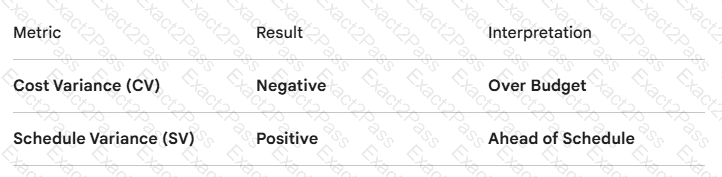
Analysis of Other Options:
A. under budget and behind schedule: This would require a Positive CV and a Negative SV.
C. on schedule: This would require an SV of zero (where $EV = PV$).
D. complete; all planned values have been earned: A project is complete when $EV = BAC$ (Budget at Completion). While a positive SV suggests progress, it does not inherently mean the project is finished; it just means it is moving faster than planned.
After defining activities in project schedule management, which processes should a project manager follow?
Sequence Activities and Estimate Activity Durations
Estimate Activity Durations and Control Schedule
Develop Schedule and Control schedule
Review Activities and Develop Schedule
According to the PMBOK® Guide, Project Schedule Management consists of a specific logical sequence of processes within the Planning Process Group. Once the Define Activities process is complete (resulting in the Activity List, Activity Attributes, and Milestone List), the project manager must determine how those activities relate to one another and how long they will take.
Sequence Activities: This is the process of identifying and documenting relationships among the project activities. It involves using the Precedence Diagramming Method (PDM) to define logical dependencies (Finish-to-Start, Start-to-Start, etc.) so that a project schedule network diagram can be created.
Estimate Activity Durations: This is the process of estimating the number of work periods needed to complete individual activities with estimated resources. This must happen before the final schedule can be developed, as the total duration is a result of the individual activity estimates and their logical sequence.
The standard flow of Schedule Planning is:
Plan Schedule Management
Define Activities
Sequence Activities 4. Estimate Activity Durations 5. Develop Schedule
Why other options are incorrect:
Option B: Control Schedule is a Monitoring and Controlling process. It cannot be performed immediately after Defining Activities because the baseline schedule has not yet been created.
Option C: While Develop Schedule is a subsequent process, you cannot accurately develop a schedule until the activities have been sequenced and their durations have been estimated. Control Schedule is also misplaced in the planning sequence.
Option D: " Review Activities " is not a formal PMI process. Furthermore, you cannot jump directly to Develop Schedule without first establishing the logical relationships (Sequence) and the time required (Estimate) for each activity.
What tool or technique will establish expected behaviors for project team members?
Ground rules
Decision mating
Power/influence grid
Stakeholder engagement assessment matrix
According to the PMBOK® Guide, specifically within the Develop Team and Manage Team processes, Ground Rules are the primary tool used to set clear expectations regarding the code of conduct for project team members.
Defining Expected Behaviors: Ground rules establish acceptable behavior by the project team. They cover topics such as meeting etiquette, communication protocols, conflict resolution strategies, and general professional conduct.
Team Charter Integration: Ground rules are a key component of the Team Charter. By discussing and agreeing upon these rules early in the project, the team reduces misunderstandings and increases productivity. It allows the team to self-regulate; when a rule is broken, the team members themselves can address the behavior based on their prior agreement.
Project Manager ' s Role: While the project manager facilitates the creation of these rules, the most effective ground rules are those developed collaboratively by the team, as this increases commitment and accountability.
Analysis of other options:
Decision making (Option B): (Likely a typo for " Decision making " ). These are techniques (like voting, autocratic, or multicriteria analysis) used to reach a conclusion or select a course of action, not to govern daily behavior.
Power/influence grid (Option C): This is a tool used in Stakeholder Analysis to group stakeholders based on their level of authority (power) and their level of concern (interest) regarding project outcomes.
Stakeholder engagement assessment matrix (Option D): This is a tool used to compare the current engagement levels of stakeholders with the desired engagement levels required for project success.
Per PMI standards, implementing Ground Rules is a proactive leadership technique that helps transition a team through the " Storming " phase of the Tuckman Ladder by providing a structured framework for interaction.
Who selects the appropriate processes for a project?
Project stakeholders
Project sponsor and project stakeholder
Project manager and project team
Project manager and project sponsor
According to the PMBOK® Guide, specifically in the sections regarding Project Management Processes, a project is not a " one size fits all " endeavor. The act of choosing which processes are relevant to a specific project is known as Tailoring.
The Responsibility of Tailoring: The Project Manager and the Project Team are responsible for selecting the appropriate processes, inputs, tools, techniques, outputs, and life cycle phases to manage a project.
The Logic of Selection: Not every process, tool, or technique described in the PMBOK® Guide is required on every project. The PM and team must consider the project ' s size, complexity, risk, and organizational culture to determine what is " fit for purpose. "
Standard of Practice: While the Project Management Institute (PMI) provides the global standard, it explicitly states that the project management team is responsible for determining what is appropriate for the given project.
Collaboration: Although the Project Manager leads this effort, the Team provides the technical expertise and historical knowledge necessary to decide which processes (such as specific quality checks or risk analysis methods) are actually value-added for the project ' s unique constraints.
Comparison with other options:
A. Project stakeholders: While stakeholders have requirements and influences, they do not have the technical project management expertise to select the specific PMBOK® processes required to execute the work.
B. Project sponsor and project stakeholder: The sponsor provides resources and support, but they delegate the " how " of project management (the process selection) to the PM and the team.
D. Project manager and project sponsor: While the sponsor might sign off on the high-level approach (the Project Management Plan), the detailed selection of internal project processes is the functional responsibility of the PM and the team performing the work.
Which of the following is an output of Define Scope?
Project scope statement
Project charter
Project plan
Project schedule
According to the PMBOK® Guide, the Define Scope process is the process of developing a detailed description of the project and product. This process builds upon the high-level deliverables, assumptions, and constraints documented during project initiation.
Project Scope Statement: This is the primary output of the Define Scope process. It provides a documented basis for making future project decisions and for confirming or developing a common understanding of project scope among the stakeholders. It includes:
Product scope description: The characteristics of the product, service, or result.
Acceptance criteria: A set of conditions that must be met before deliverables are accepted.
Deliverables: Any unique and verifiable product, result, or capability to perform a service.
Project exclusion: Explicitly stating what is out of scope to manage stakeholder expectations.
Constraints and Assumptions: Specific factors that limit the team ' s options or factors that are considered to be true for planning purposes.
Relationship to WBS: Once the Project Scope Statement is finalized, it serves as a critical input to the Create WBS process, where the work is subdivided into smaller components.
Analysis of Other Options:
B. Project charter: This is an input to the Define Scope process. The charter is created during the Develop Project Charter process in the Initiating Process Group.
C. Project plan: The " Project Management Plan " is a comprehensive document that integrates all subsidiary plans. While the scope statement is a component that eventually feeds into the plan, the " Project Plan " itself is the output of the Develop Project Management Plan process.
D. Project schedule: This is the output of the Develop Schedule process. While scope defines what will be done, the schedule defines when it will be done.
Which tools or techniques are used during the Close Project or Phase process?
Reserve analysis and expert judgment
Facilitation techniques and meetings
Expert judgment and analytical techniques
Performance reviews and meetings
According to the PMBOK® Guide (Project Management Body of Knowledge), specifically within the Project Integration Management knowledge area, the Close Project or Phase process is the process of finalizing all activities for the project, phase, or contract. The standard tools and techniques for this process are:
Expert Judgment (Option C): This is required to ensure the closure meets organizational and legal standards. Experts provide insight on administrative closure, final lessons learned, and the transfer of the product to operations.
Analytical Techniques (Option C): In the context of closure, analytical techniques are used to perform regression analysis, trend analysis, and variance analysis to verify that the project met its objectives and to document the final project performance.
Meetings (Option B and D): While meetings are used in nearly every process (including closure for lessons learned or wrap-up sessions), they are often paired with other specific tools.
Reserve Analysis (Option A): This is a tool used in Cost Management and Risk Management to determine if the remaining contingency and management reserves are sufficient. It is not a primary tool for the formal administrative closure of a project.
Performance Reviews (Option D): These are typically part of Control Schedule, Control Costs, or Manage Team to compare actual performance against the baseline. While relevant to the final report, the PMBOK® specifically highlights " Analytical Techniques " as the broader category for closure.
In the PMI framework, the combination of Expert Judgment, Analytical Techniques, and Meetings represents the standard toolkit for ensuring a project is legally, financially, and administratively finalized.
Skills necessary for project management such as motivating to provide encouragement; listening actively; persuading a team to perform an action; and summarizing, recapping, and identifying next steps are known as:
organizational skills
technical skills
communication skills
hard skills
According to the PMBOK® Guide (Project Management Body of Knowledge), specifically within the sections on Project Communications Management and Project Resource Management, these abilities are categorized under the umbrella of interpersonal and team skills:
Communication Skills (Option C): These are the specific " soft skills " or interpersonal skills used to lead and manage a project. The PMI Lexicon and the PMBOK® Guide identify active listening, motivating, persuading, and summarizing as core components of effective communication. These skills are essential for managing stakeholder expectations and ensuring the project team remains aligned with the project goals. Specifically, persuading is a form of influence, and summarizing/recapping ensures that the " receiver " has decoded the message correctly, which is a fundamental part of the Communication Model.
Organizational Skills (Option A): These generally refer to the ability to manage time, tasks, and resources efficiently. While a PM needs them, the specific actions of " persuading " and " motivating " are interpersonal in nature, not purely administrative.
Technical Skills (Option B): These are the domain-specific skills related to the product or the project (e.g., coding, engineering, or accounting). They are the " how-to " of the work, not the " how-to " of the people management.
Hard Skills (Option D): These are quantifiable, measurable technical abilities. The skills listed in the question (like listening and motivating) are the opposite; they are traditionally referred to as Soft Skills.
In the PMI framework, a Project Manager spends approximately 90% of their time communicating. Therefore, mastering these specific skills is considered a critical competency for project success.
During project selection, which factor is most important?
Types of constraints
Internal business needs
Budget
Schedule
According to the PMBOK® Guide, specifically in the sections regarding Project Initiation and the Develop Project Charter process, projects are authorized by an organization to respond to specific business drivers.
Internal Business Needs: This is the foundational factor for project selection. A project is a means to achieve a strategic goal or solve a specific problem within the organization. These needs are typically documented in the Business Case, which justifies the investment based on market demand, organizational need, customer request, legal requirement, or ecological impacts.
Strategic Alignment: Projects are selected based on how well they align with the organization ' s strategic objectives. If a project does not meet an internal business need or provide value to the organization, it is unlikely to be selected, regardless of its budget or schedule.
The Selection Process: Organizations often use a variety of selection criteria (such as Net Present Value, Internal Rate of Return, or scoring models) to evaluate which projects best address their internal business needs and offer the highest return on investment.
Analysis of Other Options:
A. Types of constraints: While constraints (such as scope, time, and cost) are critical to manage once a project is selected, they are secondary to the reason for doing the project in the first place.
C. Budget: The availability of a budget is a requirement for a project to proceed, but the decision to allocate that budget is based on the underlying business need. A project is not selected simply because money is available; it is selected because there is a need that justifies the expenditure.
D. Schedule: Similar to budget, the schedule is a constraint. A project must be feasible within a certain timeframe, but the timeframe itself is not the most important driver for selection—the business outcome is.
A complete set of concepts, terms, and activities that make up an area of specialization is known as:
a Knowledge Area
a Process Group
program management
portfolio management
According to the PMBOK® Guide (Project Management Body of Knowledge), the structure of project management is organized into two primary dimensions: Process Groups and Knowledge Areas.
Knowledge Area (Option A): A Knowledge Area represents a complete set of concepts, terms, and activities that make up a professional field, project management field, or area of specialization. These areas are defined by their knowledge requirements and are described in terms of their component processes, practices, inputs, outputs, tools, and techniques. There are currently 10 Knowledge Areas in the traditional PMI framework (e.g., Scope, Schedule, Cost, Quality, etc.).
Process Group (Option B): A Process Group is a logical grouping of project management inputs, tools and techniques, and outputs. The five Process Groups (Initiating, Planning, Executing, Monitoring and Controlling, and Closing) are independent of application areas or industry focus; they represent the phases of managing a project.
Program Management (Option C): This is the application of knowledge, skills, and principles to a program (a group of related projects) to achieve strategic objectives and benefits that could not be realized by managing the projects individually. It is a level of management, not a definition of a specific specialized knowledge set.
Portfolio Management (Option D): This involves the centralized management of one or more portfolios (projects, programs, and operations) to achieve strategic objectives. Like program management, it is a high-level management discipline rather than a discrete " area of specialization " within the PMBOK structure.
In the PMI framework, while Process Groups follow the chronological flow of a project, Knowledge Areas provide the technical depth required to manage specific aspects of the project, such as Risk or Communications, throughout its entire lifecycle.
Which of the in an adaptive project environment, which action helps the project manager?
Project charter and project management plan
Communications management plan and scope management plan
Quality management plan and risk management plan
Project scope statement and communications management plan
According to the PMBOK® Guide and the Agile Practice Guide, even in an Adaptive (Agile) environment, the fundamental governance and direction of a project must be established. While the level of detail in these documents evolves, their presence is essential to help the project manager align the team and stakeholders.
Project Charter and Project Management Plan (Choice A): * Project Charter: This is the document that formally authorizes the existence of a project and provides the project manager with the authority to apply organizational resources to project activities. In adaptive environments, the charter provides the high-level vision and " north star " that keeps the team focused as specific requirements change.
Project Management Plan: While agile teams don ' t create a massive, 200-page static plan, they do have a project management plan that describes how the project will be executed, monitored, and controlled. In an adaptive context, this plan outlines the cadence (sprints/iterations), the definition of done, and the governance framework the team will use to manage changes.
Scope and Communications Management Plans (Choice B): While important, these are subsidiary components of the Project Management Plan. The question asks what " helps the project manager " in a broad sense; the overarching plan and charter provide the foundational authority and strategy required to implement these subsidiary plans.
Quality and Risk Management Plans (Choice C): Like Choice B, these are specific focus areas. In agile, quality is often handled through " Definition of Done " and risks through " Risk-Adjusted Backlogs, " but these are managed under the umbrella of the Project Management Plan.
Project Scope Statement and Communications Plan (Choice D): In an adaptive environment, a detailed Project Scope Statement is often avoided early on because the scope is expected to be refined iteratively. Instead, a Product Vision or Backlog is used.
By having a Project Charter, the project manager ensures there is an agreement on the project’s value proposition. By utilizing a Project Management Plan, the PM establishes the rules of engagement (such as how often the team meets and how they measure progress), which is vital for the self-organizing nature of adaptive teams.
A sponsor asks a project manager to provide a project ' s expected total costs based on its progress. What formula should the project manager use to determine this?
Earned value (EV) / actual cost (AC)
Estimate at completion (EAC) - AC
Budget at completion (BAC) / cost performance index (CPI)
EV - planned value (PV)
The sponsor is asking for the Estimate at Completion (EAC), which represents the " expected total costs based on its progress. " This is a core component of Earned Value Management (EVM) as described in the PMBOK® Guide.
Forecasting with EAC: The Estimate at Completion (EAC) is the forecasted total cost of the project at its conclusion. When the sponsor asks for this " based on progress, " they are assuming that the project ' s past performance (represented by the CPI) will continue into the future.
The Formula ($EAC = BAC / CPI$ ): This is the most common formula used to determine the total expected cost if the current cost performance is expected to persist for the remainder of the project.
BAC (Budget at Completion): The original total budget.
CPI (Cost Performance Index): A measure of cost efficiency ($EV / AC$).
Alternative Assumptions: If the remaining work is expected to be performed at the budgeted rate (regardless of past performance), the formula would be $EAC = AC + (BAC - EV)$. However, the question specifically mentions " based on its progress, " which points toward using the performance index (CPI).
Analysis of Other Options:
A. Earned value (EV) / actual cost (AC): This is the formula for the Cost Performance Index (CPI). While it measures progress/efficiency, it is a ratio, not the " expected total cost. "
B. Estimate at completion (EAC) - AC: This formula results in the Estimate to Complete (ETC), which represents the expected cost of the remaining work, not the total cost.
D. EV - planned value (PV): This is the formula for Schedule Variance (SV), which measures schedule performance in currency units, not expected costs.
When paying a consultation fee to a technical expert, what type of contract is often used ' ?
Time and materials (TandM)
Cost plus incentive fee (CPIF)
Fixed price incentive fee (FPIF)
Cost plus award fee (CPAF)
According to the PMBOK® Guide and the Standard for Procurement Management, the selection of a contract type is determined by the nature of the work, the degree of risk, and how well the scope is defined.
Time and Materials (TandM) contracts are a hybrid type of contractual arrangement that contains aspects of both cost-reimbursable and fixed-price contracts. They are frequently used for technical experts, consultants, or professional services when the specific scope of work cannot be quickly prescribed at the time of the agreement. Since a consultation fee is typically based on the expert ' s time spent and their specific hourly or daily rate, TandM is the most appropriate fit. It allows for flexibility when the precise number of hours required to reach a solution is unknown.
Fixed Price Incentive Fee (FPIF) is used when the scope is very well defined and the buyer wants to provide a financial incentive for meeting specific metrics (like cost or schedule). It is rarely used for simple expert consultations due to the administrative complexity of the incentive calculations.
Cost Plus Incentive Fee (CPIF) and Cost Plus Award Fee (CPAF) are cost-reimbursable contracts used primarily in large-scale, high-risk projects (like RandD or complex construction) where the buyer assumes the cost risk. These require a sophisticated accounting system to track every cost incurred by the seller, which is over-engineered and impractical for paying a simple consultation fee.
As per the PMI standards, when the requirement is for " staff augmentation " or " expert acquisition " where the duration is uncertain, Time and Materials is the industry-standard choice.
Which project documents can determine the budget?
Procurement documents, contracts, requirements documentation, and basis of estimates
Basis of estimates, cost estimates, project schedule, and risk register
Business case, project charter, statement of work, and cost estimates
Scope baseline, resource management plan, activity list, and assumption log
According to the PMBOK® Guide, the Determine Budget process involves aggregating the estimated costs of individual activities or work packages to establish an authorized cost baseline. To do this accurately, the project manager must review specific project documents that provide the necessary data and context for those costs.
Basis of Estimates, Cost Estimates, Project Schedule, and Risk Register (Choice B): These are all primary Inputs to the Determine Budget process:
Cost Estimates: These provide the direct monetary requirements for each activity within a work package.
Basis of Estimates: This document provides the supporting detail behind the cost estimates, explaining how they were derived and what assumptions were made (e.g., current exchange rates, labor categories).
Project Schedule: The budget must be time-phased. The schedule contains the planned start and finish dates for activities, which determines when the funds will be expended.
Risk Register: This is reviewed to determine the necessary Contingency Reserves. Identified risks and their planned responses have associated costs that must be factored into the total budget.
Choice A: While Contracts and Procurement Documents are inputs, " Requirements Documentation " is a more indirect input. Choice B is more comprehensive regarding the core data needed to build the mathematical baseline.
Choice B: The Business Case and Project Charter are higher-level documents usually used during project initiation. While they provide the " ceiling " for the budget, they do not provide the granular data required to determine the detailed budget during the planning phase.
Choice D: The Scope Baseline is a critical input, but the Resource Management Plan and Activity List are typically used to create the cost estimates in the previous process (Estimate Costs). By the time you are determining the budget, you are using the outputs of those earlier steps.
By aggregating these specific documents, the project manager creates the Cost Baseline, which is the approved version of the time-phased project budget, excluding any management reserves.
The basis of identification for current or potential problems to support later claims or new procurements is provided by:
A risk urgency assessment.
The scope baseline.
Work performance information.
Procurement audits.
According to the PMBOK® Guide (Project Procurement Management), specifically within the Control Procurements process, a Procurement Audit is a structured review of the procurement process from the Plan Procurement Management process through Control Procurements.
The objective of a procurement audit is to identify successes and failures that warrant recognition in the preparation or administration of other procurement contracts on the project, or on other projects within the performing organization.
Support for Claims: By identifying where the procurement process may have deviated from the contract or plan, these audits provide the necessary documentation and basis of identification for current or potential problems. This documentation is essential for supporting contested changes and potential constructive changes (claims).
New Procurements: The lessons learned from these audits are used to improve the process for future or new procurements, ensuring that the same mistakes are not repeated.
Relationship to OPA: The results of these audits are archived as part of the Organizational Process Assets (OPAs).
Analysis of Distractors:
A. A risk urgency assessment: This is a tool used in Perform Qualitative Risk Analysis to prioritize risks based on how soon they may occur. It does not provide a basis for procurement claims.
B. The scope baseline: While the scope baseline defines what is to be done, it is a planning document. It does not " identify problems " in the execution or administration of a contract in the way an audit does.
C. Work performance information: This is data collected from various controlling processes, analyzed in context, and integrated based on relationships across areas. While it might indicate a problem, it is the audit that provides the structured " basis of identification " and formal documentation required for claims and procurement improvement.
What process in Project Risk Management prioritizes project risks?
Perform Qualitative Risk Analysis
Perform Quantitative Risk Analysis
Plan Risk Responses
Implement Risk Responses
According to the PMBOK® Guide, the process responsible for prioritizing individual project risks is Perform Qualitative Risk Analysis.
Risk Prioritization: This process assesses the priority of identified risks by evaluating their probability of occurrence and their corresponding impact on project objectives (such as schedule, cost, or quality).
Tools Used: The primary tool used is the Probability and Impact Matrix. By plotting risks on this matrix, the project manager can categorize them as high, medium, or low priority.
Subjective Assessment: Unlike quantitative analysis, qualitative analysis is usually performed quickly and cost-effectively. It relies on the perceptions of the project team and stakeholders to determine which risks require the most immediate attention or further analysis.
Output: The key output is an updated Risk Register, where risks are now ranked or prioritized. This allows the team to focus their limited resources on the most " critical " threats and opportunities.
Why other options are incorrect:
Option B: Perform Quantitative Risk Analysis: This process uses numerical analysis (like Monte Carlo simulations) to quantify the combined effect of risks on project objectives. While it provides deeper data, it is usually performed after qualitative analysis and only on the risks that have already been prioritized.
Option C: Plan Risk Responses: This process focuses on developing options and actions to enhance opportunities and reduce threats. You must know the priority of the risks (from Qualitative Analysis) before you can effectively plan how to respond to them.
Option D: Implement Risk Responses: This is the execution phase where the agreed-upon risk response plans are put into action. It does not involve the initial ranking or prioritization of the risks themselves.
Which of the following terms indicates a deliverable-oriented hierarchical decomposition of the project work?
WBS directory
Activity list
WBS
Project schedule
In accordance with the PMBOK® Guide and the Practice Standard for Work Breakdown Structures, the Work Breakdown Structure (WBS) is the specific term used to describe the hierarchical decomposition of the total scope of work to be carried out by the project team.
Deliverable-Oriented: The WBS is organized around the " deliverables " or " outcomes " of the project rather than the individual actions. Each level of the WBS provides a more detailed definition of the project ' s physical or functional components.
Hierarchical Decomposition: This involves breaking down the project into smaller, more manageable components. The top level represents the entire project, while the lowest level is known as the Work Package, which is the point at which cost and duration can be reliably estimated and managed.
The 100% Rule: A key principle of the WBS is that it includes 100% of the work defined by the project scope and captures all deliverables—internal, external, and interim.
Comparison with Other Options:
WBS Directory (A): This is likely a distractor term. The correct related document is the WBS Dictionary, which provides detailed narrative descriptions of the work for each WBS element.
Activity List (B): This is a list of the specific actions or tasks required to complete the work packages. It is an output of the Define Activities process and is task-oriented, not deliverable-oriented.
Project Schedule (D): This is a model that presents linked activities with planned dates, durations, milestones, and resources. It is derived from the WBS but is not the decomposition itself.
An input of the Create WBS process is:
requirements documentation.
scope baseline.
project charter.
validated deliverables.
According to the PMBOK® Guide, the Create WBS process is the process of subdividing project deliverables and project work into smaller, more manageable components. To perform this decomposition accurately, the project manager needs specific inputs that define what needs to be built.
Requirements Documentation: This is a key input. It provides the detailed description of what the project must deliver to meet stakeholder expectations. Since the WBS is a deliverable-oriented decomposition of the work, the requirements documentation ensures that all necessary features and functions are accounted for in the breakdown.
Other Key Inputs to Create WBS:
Project Scope Statement: This is the primary input, as it describes the work that will be performed and the work that is excluded.
Scope Management Plan: Provides the " how-to " for creating the WBS from the scope statement.
Enterprise Environmental Factors (EEFs): Industry-specific WBS standards relevant to the project ' s domain.
Organizational Process Assets (OPAs): Policies, procedures, and WBS templates from previous projects.
Analysis of Other Options:
B. scope baseline: This is the output of the Create WBS process, not an input. The Scope Baseline consists of the Project Scope Statement, the WBS, and the WBS Dictionary.
C. project charter: While the Charter provides a high-level description of the project, it is an input to the Define Scope process. By the time you reach Create WBS, you use the more detailed Project Scope Statement derived from the Charter.
D. validated deliverables: These are an output of the Control Quality process and an input to Validate Scope. They are not used to create the work breakdown structure, which is a planning activity.
The following chart contains information about the tasks in a project.
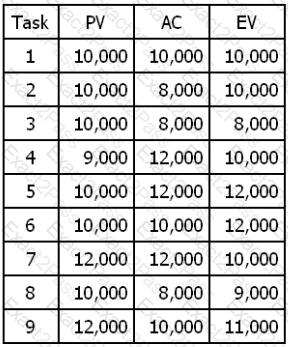
Based on the chart, what is the cost performance index (CPI) for Task 2?
0.8
1
1.25
1.8
According to the PMBOK® Guide (Project Management Body of Knowledge), specifically within the Project Cost Management knowledge area and the Control Costs process, the Cost Performance Index (CPI) is a measure of the cost efficiency of budgeted resources, expressed as the ratio of earned value to actual cost.
To calculate the CPI for Task 2 using the data provided in the table:
Identify the variables for Task 2:
Earned Value (EV) = 10,000
Actual Cost (AC) = 8,000
Apply the CPI Formula:
$$\text{CPI} = \frac{\text{EV}}{\text{AC}}$$
Perform the calculation:
$$\text{CPI} = \frac{10,000}{8,000} = 1.25$$
Option C (1.25): This is the correct calculation. A CPI greater than 1.0 indicates that the project is performing better than planned regarding cost (under budget). In this case, for every dollar spent on Task 2, $1.25$ worth of work was actually accomplished.
Option A (0.8): This would be the result if you incorrectly divided AC by EV ($8,000 / 10,000$). This would represent a project over budget, which is not the case for Task 2.
Option B (1): This would occur if EV and AC were equal (as seen in Task 1 or Task 6), indicating project performance exactly on budget.
Option D (1.8): This is mathematically incorrect based on the provided Task 2 figures.
In the PMI framework, the Cost Performance Index (CPI) is considered the most critical EVM metric. It allows the Project Manager to determine if the project ' s current spending efficiency is sustainable and is used as a primary input for calculating the Estimate at Completion (EAC).
What is the equation to calculate cost variance (CV)?
CV = EV / BAC
CV = EV - AC
CV = EV - BAC
CV = EV / AC
According to the PMBOK® Guide, specifically the Control Costs process, Cost Variance (CV) is the amount of budget deficit or surplus at a given point in time, expressed as the difference between earned value and the actual cost.
The Formula:
$$CV = EV - AC$$
(Where $EV$ is Earned Value and $AC$ is Actual Cost).
The Components:
Earned Value ($EV$): The value of the work actually performed to date.
Actual Cost ($AC$): The total cost actually incurred and recorded in accomplishing the work performed.
Interpreting the Result:
Positive CV ($ > 0$): The project is under budget. You have spent less than the value of the work you have accomplished.
Negative CV ($ < 0$): The project is over budget. You have spent more than the value of the work you have accomplished.
Zero CV ($= 0$): The project is exactly on budget.
Analysis of other options:
Option A: $EV / BAC$ (Budget at Completion) is not a standard performance index, though $EV / BAC$ is sometimes used to calculate the " percent complete " of the total project budget.
Option C: $EV - BAC$ is not a standard formula. Variance at Completion (VAC) is $BAC - EAC$, which measures the projected budget performance at the end of the project.
Option D: $EV / AC$ is the formula for the Cost Performance Index (CPI). While related to CV, it is an index (ratio) used to measure the cost efficiency of resources, not the variance (absolute currency value).
Per PMI standards, the Cost Variance (CV) is a critical metric for tracking the financial health of a project, and it is always calculated by subtracting the Actual Cost from the Earned Value.
What conflict resolution technique involves delaying the issue or letting others resolve it?
Smooth/accommodate
Collaborate/problem solve
Withdraw/avoid
Force/direct
In accordance with the PMBOK® Guide and the Agile Practice Guide, risk management in adaptive environments is not a one-time event or restricted to specific phases. It is an ongoing, continuous process integrated into the heart of the delivery cycle.
Continuous Risk Assessment: In Agile, high-variability environments mean that risks emerge and change rapidly. Therefore, risks are identified, monitored, and prioritized during every iteration (Sprint).
The Risk-Adjusted Backlog: The Product Backlog is frequently reprioritized based on both value and risk. High-risk items are often moved to earlier iterations (a concept known as " failing fast " ) to resolve uncertainty before significant investment is made.
Ceremony Integration:
Iteration Planning: Risks are considered when selecting items for the Sprint.
Daily Stand-ups: Emerging risks or " impediments " are identified daily.
Review and Retrospectives: These sessions are used to identify new risks related to the product or the team ' s processes and to adjust the risk management approach for the next iteration.
Analysis of Other Options:
A. Only during the initiation and Closing phases: This is incorrect for any methodology. Restricting risk management to the start and end of a project leaves the entire execution phase vulnerable to unmanaged threats.
B. During the initiation and Planning phases: This describes a traditional, " up-front " planning mindset. In Agile, planning is continuous (progressive elaboration), so risk management must be as well.
D. Throughout the Planning process group and retrospective meeting: While the retrospective is a key part of the process, risk management isn ' t limited to " Process Groups " (which is more of a predictive terminology) or just the retrospective. It happens throughout the entire duration of every iteration.
How can a project manager represent a contingency reserve in the schedule?
Additional weeks of work to account for unknown-unknowns risks
Task duration estimates of the best case scenarios
Addition Duration estimates in response to identified risks that have been accepted
Milestones representing the completion of deliverables
According to the PMBOK® Guide, specifically within the Develop Schedule and Estimate Activity Durations processes, reserves are essential for maintaining a realistic schedule baseline.
Contingency Reserve (Choice C): This is the amount of time (or cost) allocated for " known-unknowns. " These are identified risks for which a response has been planned or which have been accepted. In a schedule, this is often represented as a " buffer " or a specific duration added to individual activities or as a separate work package at the end of a sequence of activities. It is part of the Schedule Baseline.
Unknown-Unknowns (Choice A): This refers to Management Reserve, not Contingency Reserve. Management reserves are held for unforeseen risks that were not identified during risk management. They are not part of the schedule baseline but are included in the total project duration/budget.
Best Case Scenarios (Choice B): Using only best-case scenarios leads to an unrealistic schedule. Contingency reserves are specifically designed to account for the uncertainty and potential delays (the " worst-case " or " most likely " adjustments) identified during risk analysis.
Milestones (Choice D): While milestones mark significant events or the completion of deliverables, they have zero duration. They cannot " hold " a reserve of time; they simply indicate a point in time.
By explicitly including Contingency Reserves, the project manager ensures the schedule is robust enough to handle the impact of identified risks without needing to constantly request formal changes to the baseline every time a predicted risk occurs.
Resource calendars are included in the:
staffing management plan.
work breakdown structure (WBS).
project communications plan.
project charter.
According to the PMBOK® Guide, specifically within the Plan Resource Management and Develop Schedule processes, resource calendars play a vital role in understanding the availability of human and physical resources.
Staffing Management Plan: In earlier versions of the PMBOK® Guide (which many practice questions still reference), the Staffing Management Plan is a component of the human resource management plan. It describes when and how human resource requirements will be met. Resource calendars—which document the working days and non-working days for specific resources—are logically housed within this plan to show when staff are available to be assigned to project activities.
Modern Context: In more recent editions, this is part of the broader Resource Management Plan. It includes the resource histogram, recognition and rewards, and the timetable for staff acquisition and release.
Function of the Calendar: It identifies the specific time periods (days, weeks, or months) that each resource is available. It accounts for vacations, local holidays, and commitments to other projects.
Analysis of Other Options:
B. Work breakdown structure (WBS): The WBS is a deliverable-oriented hierarchical decomposition of the work to be executed by the project team. It defines the " what " of the project, not " when " specific people are available.
C. Project communications plan: This plan defines the communication requirements for the project and its stakeholders (who needs what information, when, and how). While it might use the resource list for a contact directory, it does not include the calendars of availability.
D. Project charter: The charter is a high-level document that formally authorizes the existence of a project. It contains high-level requirements and milestones but does not contain granular details like individual resource calendars.
Which tool should a project manager consider to deal with multiple sources of risk?
An updated risk register
Risk breakdown structure
Issue log
Stakeholder register
According to the PMBOK® Guide, specifically within the Plan Risk Management process, the Risk Breakdown Structure (RBS) is the primary tool used to categorize and organize multiple sources of risk.
An RBS is a hierarchical representation of potential sources of risk. It helps the project team to look at the project from various perspectives to ensure that no categories are overlooked.
Why the RBS is the correct tool for " Sources " :
Categorization: It groups risks by their source (e.g., Technical, Management, Commercial, External). This allows the project manager to identify where the highest concentration of risk originates.
Systematic Identification: During the Identify Risks process, the RBS provides a framework for brainstorming, ensuring that the team considers " multiple sources " rather than just obvious technical issues.
Structure: Like a Work Breakdown Structure (WBS), it breaks down high-level categories into sub-categories, providing a comprehensive view of the risk landscape.
Analysis of Distractors:
A (Updated Risk Register): The risk register is a document where the results of risk analysis and risk response planning are recorded. It contains individual risks, not the structural framework used to deal with the various " sources " of risk.
C (Issue Log): An issue is a risk that has already occurred (a realized risk). The issue log is used to track these current problems. It is not a tool for managing or categorizing sources of potential future uncertainty (risks).
D (Stakeholder Register): This document identifies the people, groups, or organizations that could impact or be impacted by the project. While stakeholders can be a source of risk, the register itself is not a tool designed to categorize and manage the breadth of all project risk sources.
What type of project structure is a hierarchically organized depiction of the resources by type?
Organizational breakdown structure (OBS)
Resource breakdown structure (RBS)
Work breakdown structure (WBS)
Project breakdown structure (PBS)
According to the PMBOK® Guide, specifically within the Estimate Activity Resources and Plan Resource Management processes, the Resource Breakdown Structure (RBS) is a hierarchical representation of resources by category and type.
Structure and Purpose: The RBS is a type of project structure that organizes the resources needed for the project in a vertical, tree-like format. Each descending level represents an increasingly detailed description of the resource until it is small enough to be used in conjunction with the Work Breakdown Structure (WBS) to plan and monitor the work.
Categorization: Resources are typically categorized by Type (e.g., labor, material, equipment, and supplies) and then further broken down by Category or specialty (e.g., Senior Engineer, Grade A Concrete, or Excavator).
Utility: The RBS is helpful in tracking project costs and can be aligned with the organization ' s accounting system. It also assists the project manager in identifying the total number of resources required and managing resource assignments more effectively.
Analysis of other choices:
Choice A (Organizational breakdown structure - OBS): While also hierarchical, the OBS is organized according to an organization ' s existing departments, units, or teams, with the project activities or work packages listed under each department. It shows which department is responsible for which work.
Choice C (Work breakdown structure - WBS): This is a hierarchical decomposition of the total scope of work to be carried out by the project team. It focuses on deliverables rather than the resources needed to create them.
Choice D (Project breakdown structure - PBS): This is a term sometimes used interchangeably with the WBS in certain industries (like aerospace or defense) to define the physical components of a product, but it is not the standard PMI term for a resource hierarchy.
While preparing the project management plan on a weekly basis, the project manager indicates the intention to provide an issues report to the staff via e-mail. In which part of the plan will this type of information be included?
Communications management plan
Human resource plan
Quality management plan
Procurement management plan
According to the PMBOK® Guide, the Communications Management Plan is a component of the project management plan that describes how, when, and by whom project information will be administered and disseminated.
Information Distribution: The scenario describes the " who " (the staff), the " what " (an issues report), the " how " (via e-mail), and the " frequency " (weekly). All of these are core elements defined during the Plan Communications Management process.
Content of the Plan: A standard Communications Management Plan includes:
Stakeholder communication requirements.
Information to be communicated, including language, format, content, and level of detail.
Reason for the distribution of that information.
Time frame and frequency for the distribution of required information and receipt of acknowledgment or response, if applicable.
Person responsible for communicating the information.
Person responsible for authorizing release of confidential information.
Issues Reporting: Managing and communicating the status of issues is a critical part of keeping stakeholders informed and ensuring project transparency. By documenting this in the Communications Management Plan, the project manager ensures that the staff expects the report and understands the channel through which it will arrive.
Analysis of Other Options:
B. Human resource plan: This plan (now often referred to as the Resource Management Plan) focuses on how project resources (people, equipment, materials) are acquired, managed, and eventually released. It does not dictate the specific logistics of weekly reporting.
C. Quality management plan: This plan describes how the project team will implement the organization ' s quality policy. While it might include reporting on quality metrics, the general distribution of an issues report via email is a communication function.
D. Procurement management plan: This plan contains the activities to be undertaken during the procurement process, such as obtaining seller responses or selecting sellers. It does not cover internal team status reporting.
A project ' s aim, from a business perspective, is moving an organization from one level to another to achieve a specific objective. What is the goal for a project ' s successful completion?
Current state
Future state
Budgeted state
Planned state
In the PMBOK® Guide, a project is defined as a temporary endeavor undertaken to create a unique product, service, or result. From a business value perspective, this is often described as the " Organization State Transition. "
Why Choice B is correct:
Organizational Transition: Business leaders initiate projects to drive change. The starting point is the Current State (where the organization is now), and the goal is the Future State (the desired position after the project ' s objectives are met).
Business Value Realization: Successful completion means the organization has moved into this Future State, where it can now realize the benefits, such as increased revenue, improved efficiency, or a new market presence.
The Gap: The project itself is the " bridge " or the activity that facilitates the transition from A to B.
Analysis of other options:
A (Current state): This is the starting point. If a project leaves you in the current state, it has failed to produce any change or deliver the intended business value.
C (Budgeted state): While completing a project within budget is a key performance indicator (KPI), " budgeted state " is not a recognized standard term for the strategic outcome of a project.
D (Planned state): While a project follows a plan, the " Planned State " is synonymous with the roadmap. The actual goal is the result of that plan—the Future State—where the business operates differently or better than before.
Key Concept: The Project Management Institute (PMI) emphasizes that projects are the primary way companies evolve. Success is not just about finishing the work; it is about achieving the Future State (Choice B) that justifies the investment and creates measurable value for the organization.
What tools or techniques are necessary to create the project management plan?
Meetings and data analysis
Expert judgment and data gathering
Interpersonal skills and change control
Data analysis and expert judgment
According to the PMBOK® Guide, the Develop Project Management Plan process utilizes a specific set of Tools and Techniques to integrate all subsidiary plans and baselines into a comprehensive document.
Expert Judgment: This is the most critical tool for this process. It involves consulting with individuals or groups with specialized knowledge or training in project strategy, tailoring the project management process to meet the project needs, and determining the technical and management details to be included in the plan.
Data Gathering: This involves techniques such as brainstorming, checklists, focus groups, and interviews. These tools are used to collect information from stakeholders and team members regarding how the project should be managed, executed, and controlled.
Integrated Approach: While meetings and interpersonal skills (like facilitation) are also used in this process, the standard PMI documentation emphasizes Expert Judgment and Data Gathering as the foundational methodologies for synthesizing diverse requirements into a single, cohesive management plan.
Why other options are incorrect:
Option A: Meetings and data analysis: While meetings are used, " data analysis " is more commonly associated with the Monitor and Control processes (like analyzing performance data) rather than the initial creation of the management plan itself.
Option C: Interpersonal skills and change control: Interpersonal and team skills (facilitation, conflict management) are indeed used, but Change Control is a separate process (Perform Integrated Change Control) that occurs after the project management plan has been baselined.
Option D: Data analysis and expert judgment: Again, " data analysis " (such as alternatives analysis) can be used, but per the official PMI process mapping for Develop Project Management Plan, Data Gathering is a more primary and frequently cited tool for this specific stage than data analysis.
Which is the main benefit of managing and tailoring strategies in the Stakeholder Engagement process?
Increased support and minimized resistance from stakeholders
Increased performance of the project team
Maintenance of stakeholder satisfaction because costs and scope are under control
Updated project documents, as requested by stakeholders
According to the PMBOK® Guide, the primary purpose of the Monitor Stakeholder Engagement and Manage Stakeholder Engagement processes is to maintain or increase the efficiency and effectiveness of stakeholder engagement activities as the project evolves.
Increased Support and Minimized Resistance: This is the core objective of stakeholder management. By tailoring engagement strategies to the specific needs, interests, and power levels of various stakeholders, a project manager can actively cultivate support from those who are neutral or resistant and ensure that supportive stakeholders remain advocates for the project.
Dynamic Adjustment: Stakeholder interests and influence change throughout the project life cycle. Effective " tailoring " ensures that the project manager isn ' t using a " one-size-fits-all " approach, which is critical for turning potential opposition into productive involvement.
Why other options are incorrect:
Option B: While high stakeholder engagement can indirectly boost team morale, increasing the performance of the project team is the primary goal of the Develop Team and Manage Team processes, not Stakeholder Engagement.
Option C: Maintaining satisfaction via cost and scope control is a result of Monitor and Control Project Work and Control Scope/Cost. While stakeholders care about these, the engagement process itself is about the relationship and involvement rather than the technical metrics of the budget.
Option D: Updating project documents is an Output of the process (e.g., updates to the Stakeholder Register or Issue Log), but it is a mechanical result, not the " main benefit " or strategic goal of the process.
A key benefit of the Manage Communications process is that it enables:
The best use of communication methods.
An efficient and effective communication flow.
Project costs to be reduced.
The best use of communication technology.
According to the PMBOK® Guide and the Standard for Project Management, specifically within the Project Communications Management Knowledge Area, the primary purpose of the Manage Communications process is to ensure that project information is collected, created, distributed, stored, retrieved, managed, controlled, and ultimately disposed of in an appropriate and timely manner.
As per PMI standards, the key benefit of this process is that it enables an efficient and effective communication flow between the project team and the stakeholders.
Efficiency: Refers to providing only the information that is needed (minimizing " noise " or information overload).
Effectiveness: Refers to providing the information in the right format, at the right time, to the right audience, and with the right impact.
The other options are incorrect based on the following PMI distinctions:
The best use of communication methods/technology: These are tools and techniques (e.g., communication technology, communication methods, and communication competence) used within the process to achieve the goal. While they are important, they are not the primary " key benefit " or objective of the process itself. They are the means to the end (the flow).
Project costs to be reduced: While effective communication can prevent misunderstandings that lead to rework (and thus save money), the primary objective of Manage Communications is the distribution of information, not direct cost reduction. Cost management is handled within the Project Cost Management Knowledge Area.
As per the PMI Lexicon of Project Management Terms, the Manage Communications process goes beyond just distributing information; it seeks to ensure that the communication is received and understood, thereby supporting stakeholder engagement and project alignment.

