Exact2Pass

Last Update 20 hours ago Total Questions : 1337
The Certified Associate in Project Management (CAPM) content is now fully updated, with all current exam questions added 20 hours ago. Deciding to include CAPM practice exam questions in your study plan goes far beyond basic test preparation.
You'll find that our CAPM exam questions frequently feature detailed scenarios and practical problem-solving exercises that directly mirror industry challenges. Engaging with these CAPM sample sets allows you to effectively manage your time and pace yourself, giving you the ability to finish any Certified Associate in Project Management (CAPM) practice test comfortably within the allotted time.
What tern describes an intentional activity to modify a nonconforming product or product component?
Preventive action
Corrective action
Defect repair
Updates
According to the PMBOK® Guide, specifically within the Direct and Manage Project Work and Control Quality processes, there are four types of change requests. The term for modifying a nonconforming product is Defect Repair.
Defect Repair: This is an intentional activity to modify a nonconforming product or product component. It is reactive in nature and focuses on fixing a specific deliverable that does not meet the established quality requirements or standards.
Analysis of other options:
A. Preventive action: This is an intentional activity that ensures the future performance of the project work is aligned with the project management plan. It is proactive and aimed at preventing a problem before it occurs.
B. Corrective action: This is an intentional activity that realigns the performance of the project work with the project management plan. While similar to defect repair, corrective action typically refers to the process or the project performance (e.g., getting back on schedule), whereas defect repair refers specifically to the product or deliverable.
D. Updates: These are changes to formally controlled project documents, plans, etc., to reflect modified or additional ideas or content.
Per PMI standards, defect repair is a key output of the quality control process and is performed to bring a specific component back into compliance with requirements.
In Project Cost Management, which input is exclusive to the Determine Budget process?
Scope baseline
Organizational process assets
Project schedule
Resource calendars
According to the PMBOK® Guide, specifically within the Determine Budget process, the inputs are categorized to help aggregate the estimated costs of individual activities or work packages to establish an authorized cost baseline.
While many processes share similar inputs, Resource Calendars hold a unique position in this specific context:
Resource Calendars: These identify the working days and shifts on which each specific resource is available. In the Determine Budget process, they are necessary to know when costs will be incurred. For example, if a specialized piece of equipment is only available for two weeks, the budget must account for that specific expenditure during that window.
The Nuance of " Exclusive " : In the context of the Cost Management knowledge area (Plan Cost Management, Estimate Costs, Determine Budget, and Control Costs), Resource Calendars do not appear as an input to Estimate Costs or Control Costs, but they are critical for Determine Budget to map the cost baseline against the project timeline.
Comparison with Other Options:
Scope baseline (A): This is a common input used in Estimate Costs (to understand the deliverables) and Determine Budget (to ensure all work packages are accounted for). Because it is used in multiple processes within the knowledge area, it is not " exclusive. "
Organizational process assets (B): OPAs are standard inputs to almost every project management process, providing templates, historical information, and lessons learned.
Project schedule (C): The schedule is an input to both Estimate Costs (to determine duration-based costs) and Determine Budget (to aggregate those costs over time).
Which tools and techniques should a project manager use to monitor risks?
Expert judgment, data analysis, and interpersonal and real skills
Data analysis, audits, and decision making
Expert judgement, audits, and decision making
Meetings, data gathering, and expert judgment
A project manager is determining the amount of contingency needed for a project. Which analysis is the project manager using?
What-if scenario analysis
Simulation
Alternatives analysis
Reserve analysis
According to the PMBOK® Guide (6th and 7th Editions), Reserve Analysis is the specific tool and technique used to determine the amount of contingency and management reserves needed for a project. This analysis is utilized across several processes, including Estimate Costs, Determine Budget, and Estimate Activity Durations.
The concept is based on the following components:
Contingency Reserves: These are provisions held for " known-unknowns " —identified risks for which a response has been developed. These reserves are included in the cost baseline and the schedule baseline.
Management Reserves: These are amounts held for " unknown-unknowns " —unforeseen work that is within the scope of the project. These are NOT part of the cost baseline but are part of the total project budget.
The Process: Through Reserve Analysis, the project manager evaluates the risk register and the level of uncertainty to calculate the necessary buffer. As the project progresses and risks are realized or retire, the reserve analysis is updated to see if the remaining reserves are sufficient or if they can be released.
Analysis of Distractors:
A (What-if scenario analysis): This is a technique used to evaluate the impact of various scenarios (e.g., " What if the delivery is delayed by two weeks? " ) on project objectives. It is used for modeling, not specifically for calculating the quantity of reserve funds or time.
B (Simulation): Techniques like Monte Carlo analysis simulate the project many times to provide a distribution of possible outcomes. While simulation can inform the amount of reserve needed, the specific term for the act of setting aside and managing those funds is " Reserve Analysis. "
C (Alternatives analysis): This is used to evaluate different options or approaches to perform the project work (e.g., making vs. buying, or using different tools). It is not the primary tool for determining risk-based contingency.
What are the objectives of Initiation processes?
Initiation processes are performed in order to develop the project charier and Identify stakeholders.
Initiation processes are performed in order to obtain budget approval for a project or phase and approve scope with customers.
Initiation processes are performed to identify business objectives for a project or phase and identify stakeholders ' goals.
Initiation processes are performed to map initial requirements for a project or phase and prioritize them with stakeholders.
According to the PMBOK® Guide, the Initiating Process Group consists of those processes performed to define a new project or a new phase of an existing project by obtaining authorization to start the project or phase.
The primary objectives of this group are encapsulated in its two core processes:
Develop Project Charter: The purpose is to create a document that formally authorizes the existence of a project and provides the project manager with the authority to apply organizational resources to project activities.
Identify Stakeholders: The purpose is to identify the people, groups, or organizations that could impact or be impacted by the project, and to document relevant information regarding their interests, involvement, interdependencies, influence, and potential impact on project success.
Why Option A is correct: Option A directly aligns with the formal names and outputs of the processes within the Initiating Process Group. By developing the charter and identifying stakeholders, the project manager sets the initial boundary for the project, ensures high-level alignment with organizational strategy, and identifies the human landscape of the project.
Analysis of Distractors:
B (Budget and Scope Approval): Detailed budget approval and formal scope approval (the Scope Baseline) are primary outputs of the Planning Process Group. Initiation only involves " pre-approved financial resources " and high-level scope.
C (Business Objectives and Stakeholder Goals): Identifying business objectives is typically part of the Business Case or Needs Assessment conducted before initiation. While stakeholders ' goals are explored, the formal objective of the process group is the identification of the stakeholders themselves and the formal authorization of the project.
D (Map and Prioritize Requirements): Collecting, mapping, and prioritizing requirements are activities that take place during the Collect Requirements process, which is part of the Planning Process Group.
In project management, a temporary project can be:
Completed without planning
A routine business process
Long in duration
Ongoing to produce goods
According to the PMBOK® Guide (Project Management Body of Knowledge), the fundamental definition of a project is a temporary endeavor undertaken to create a unique product, service, or result. PMI clarifies the term " temporary " in the following ways:
Long in Duration (Option C): While a project is " temporary " (meaning it has a defined beginning and end), this does not mean it must be short. A project can last for several years (e.g., building a skyscraper or developing a new aircraft) and still be classified as temporary because it will eventually reach its conclusion.
Routine Business Process (Option B) / Ongoing (Option D): These options describe Operations. Operations are ongoing and repetitive (e.g., a manufacturing line or accounting services), whereas projects are unique and end when their objectives have been met or the project is terminated.
Completed without Planning (Option A): This contradicts all PMI standards. Every project requires a degree of planning (whether predictive/waterfall or adaptive/agile) to ensure that resources are used efficiently and objectives are met.
In the PMI framework, the temporary nature of a project indicates that the project team is disbanded and resources are reassigned once the project’s specific goals are achieved, regardless of how many years the project took to complete.
Which item is an example of personnel assessment?
Resource calendar
Tight matrix
Team-building activity
Focus group
According to the PMBOK® Guide and the Standard for Project Management, specifically within the Develop Team process, Personnel Assessment Tools are used to give the project manager and the project team insight into areas of strength and weakness.
A Focus group can be utilized as a personnel assessment technique by bringing together stakeholders or team members to discuss and evaluate individual or team competencies, behaviors, and expectations. While often used for requirement gathering, in the context of human resources, it serves as a qualitative assessment tool.
The other options are incorrect based on the following PMI definitions:
Resource calendar: This is a document that identifies the working days and shifts on which each specific resource is available. It is an output of the Acquire Resources process and does not assess the quality or skills of the personnel.
Tight matrix: This is a term used for Colocation, where team members are placed in the same physical location to improve communication and working relationships. It is a technique for team development, not an assessment tool.
Team-building activity: These are tasks or exercises designed to help team members work together more effectively. While they may reveal certain traits, their primary purpose is Development, not formal Assessment.
As per the PMI Lexicon of Project Management Terms, personnel assessment tools (which also include attitudinal surveys, indexed tests, and 360-degree reviews) help project managers assess the team’s motivation, how they take in and process information, and how they interact with others.
What three strategies are used to respond to threats?
Escalate, accept, and mitigate
Accept share, and avoid
Escalate, transfer, and exploit
Mitigate, accept, and prioritize
According to the PMBOK® Guide, specifically within the Plan Risk Responses process, risks are categorized as either threats (negative risks) or opportunities (positive risks). There are five specific strategies for responding to threats.
Strategies for Threats:
Escalate: The threat is outside the scope of the project or the project manager’s authority; it is passed to a higher level in the organization.
Avoid: The team acts to eliminate the threat or protect the project from its impact (e.g., changing the project management plan).
Transfer: Shifting the impact and ownership of a threat to a third party (e.g., insurance or warranties).
Mitigate: Taking action to reduce the probability of occurrence or the impact of the threat (e.g., conducting more tests).
Accept: Acknowledging the threat exists but taking no proactive action unless it occurs (passive or active acceptance).
Analysis of other options:
Option B: Includes " Share, " which is a strategy for opportunities (positive risks), not threats.
Option C: Includes " Exploit, " which is a strategy for opportunities. It involves ensuring that the opportunity definitely happens.
Option D: Includes " Prioritize, " which is an activity performed during Qualitative Risk Analysis, not a response strategy itself.
Per PMI standards, selecting the appropriate response depends on the severity of the threat and the project ' s risk threshold. Escalate, accept, and mitigate are three of the valid strategies provided in the list of five for handling negative project risks.
The precedence diagramming method (PDM) is also known as:
Arrow Diagram.
Critical Path Methodology (CPM).
Activity-On-Node (AON).
schedule network diagram.
According to the PMBOK® Guide, specifically within the Sequence Activities process, the Precedence Diagramming Method (PDM) is a technique used for constructing a schedule model in which activities are represented by nodes and are graphically linked by one or more logical relationships to show the sequence in which the activities are to be performed.
Activity-On-Node (AON): This is the alternative name for PDM. In this method, each " node " (typically a box) represents a specific project activity. The dependencies or logical relationships between these activities are represented by arrows connecting the nodes.
Logical Relationships: PDM/AON supports four types of dependencies:
Finish-to-Start (FS): The successor activity cannot start until the predecessor activity has finished.
Finish-to-Finish (FF): The successor activity cannot finish until the predecessor activity has finished.
Start-to-Start (SS): The successor activity cannot start until the predecessor activity has started.
Start-to-Finish (SF): The successor activity cannot finish until the predecessor activity has started.
Dominance in Industry: PDM is the most commonly used method in modern project management software.
Comparison with Other Options:
Arrow Diagram (A): This refers to Activity-on-Arrow (AOA) or the Arrow Diagramming Method (ADM). In this older technique, activities are represented by the arrows themselves, and nodes represent milestones or " events. " It only supports Finish-to-Start relationships.
Critical Path Methodology (CPM) (B): CPM is a schedule network analysis technique used to estimate the minimum project duration and determine the amount of scheduling flexibility. While it uses PDM/AON diagrams to perform its calculations, it is the analytical method, not the name of the diagramming technique itself.
Schedule network diagram (D): This is a general term for any graphical representation of the logical relationships among the project schedule activities. PDM is a type of schedule network diagram, but the question asks for what PDM is specifically " known as " (its synonym).
As the project progresses, which of the following is routinely collected from the project activities?
Communication management activities
Change requests
Configuration verification and audit
Work performance information
According to the PMBOK® Guide, as project activities are executed, various data points are collected to monitor progress. The framework distinguishes between three specific levels of performance reporting:
Work Performance Data: The raw observations and measurements identified during activities being performed to carry out the project work. Examples include actual cost, actual duration, and percent of work physically completed.
Work Performance Information: This is the data collected from various controlling processes, analyzed in context, and integrated based on relationships across areas. For instance, while " Work Performance Data " might say a task took 10 hours, " Work Performance Information " would clarify that those 10 hours represent a 2-hour variance from the original plan.
Routine Collection: This information is routinely collected and processed during the Monitoring and Controlling Process Group. It allows the project manager to communicate the status of the project to stakeholders and provides the foundation for decision-making.
Comparison with Other Options:
Communication management activities (A): This refers to the general tasks involved in the Manage Communications process. While these activities occur, they are not the specific " metric " or " data " routinely collected to measure project performance.
Change requests (B): While change requests are common as a project progresses, they are an output of identifying variances or improvements. They are not the information itself being collected from the activities, but rather a reaction to that information.
Configuration verification and audit (C): This is a specific activity within Configuration Management (part of Integrated Change Control) used to ensure that the project ' s product configuration is correct and that the product meets its functional requirements. It is an occasional audit rather than a routine data collection of activity progress.
The progressive detailing of the project management plan is called:
expert judgment.
rolling wave planning.
work performance information.
specification.
According to the PMBOK® Guide, project management involves iterative planning as more information becomes available. This specific iterative technique is formally known as rolling wave planning.
Rolling wave planning is a form of progressive elaboration where the work to be accomplished in the near term is planned in detail, while the work far in the future is planned at a higher level.
Mechanism: It is a functional application of the " progressive detailing " mentioned in the question. As the project progresses and more risks and requirements are identified, the " wave " moves forward, and the high-level plans are decomposed into detailed work packages.
Context: This is particularly useful in projects where the full scope is not entirely clear at the start (such as RandD or software development) or in high-uncertainty environments.
A. Expert judgment: This is a tool and technique used in almost every project management process. While experts may help with detailing a plan, " expert judgment " refers to the specialized knowledge or training used to make a decision, not the process of progressive detailing itself.
C. Work performance information: This is an output of various controlling processes (like Control Schedule or Control Costs). it is the processed data used to make decisions, but it is not a planning technique.
D. Specification: A specification is a document that describes the requirements, design, or behavior of a product or service. While a specification can be detailed progressively, it is a document/input, not the act of detailing the overall management plan.
Rolling wave planning is the primary technique used to achieve Progressive Elaboration. In the PMI framework, this acknowledges that as a project evolves, the project management team gains a better understanding of the objectives and deliverables, allowing them to manage the project with greater " granularity " over time.
A company must implement sales software because it is opening a new branch in a foreign market. Although this software is used in every domestic branch, multiple changes are expected during the implementation because It is a foreign location.
Which type of life cycle would the project manager use in this case?
Predictive life cycle
Waterfall life cycle
Hybrid life cycle
Product life cycle
According to the PMBOK® Guide (6th and 7th Editions) and the Agile Practice Guide, the choice of a project life cycle depends on the level of certainty regarding requirements and the stability of the environment.
In this scenario, we have a mix of known and unknown variables:
The Known: The software itself is already used in domestic branches, suggesting a degree of " predictability " for the core implementation.
The Unknown: The foreign market introduces significant uncertainty, with " multiple changes expected " due to local regulations, language, or market-specific needs.
A Hybrid life cycle is the most appropriate because it combines elements of both Predictive (Waterfall) and Adaptive (Agile) approaches:
The predictive elements can be used for the standard software deployment steps that the company already understands well.
The adaptive (agile) elements can be used to handle the " multiple changes " and high uncertainty associated with the foreign market through iterative feedback and incremental delivery.
Analysis of Distractors:
A and B (Predictive/Waterfall): These are synonymous in this context. They are used when requirements are well-defined and unlikely to change. Given the statement that " multiple changes are expected, " a rigid predictive approach would likely lead to project failure or significant rework.
D (Product life cycle): This is not a project life cycle. The product life cycle encompasses the entire life of a product from conception through retirement (including multiple projects and operational phases). It is too broad a concept for choosing how to manage a specific implementation project.
What is the common factor among portfolios, programs, and projects, regardless of the hierarchy within an organization?
Resources and stakeholders
Operations and performance
Subsidiary projects
Project manager
According to the PMBOK® Guide and the Standard for Portfolio Management, portfolios, programs, and projects are different ways of grouping and managing work to achieve organizational goals. While they differ in their specific objectives and life cycles, they share fundamental environmental and structural elements.
Resources and Stakeholders: Regardless of whether a manager is overseeing a single project, a group of related projects (program), or a strategic collection of work (portfolio), they must all contend with the management of resources (people, equipment, funding, and materials) and the engagement of stakeholders.
Resources: All levels of the hierarchy compete for or share the same limited organizational resource pool.
Stakeholders: Every level has individuals or groups who can influence or be influenced by the work. Managing expectations and relationships is a constant requirement across all tiers.
Analysis of other options:
Operations and performance (Option B): While performance is measured at all levels, " Operations " are distinct from projects and programs. While portfolios can include operations, projects and programs are by definition temporary, whereas operations are ongoing.
Subsidiary projects (Option C): This is specific to programs and portfolios. A project does not typically contain " subsidiary projects " (it contains tasks, work packages, or activities).
Project manager (Option D): A portfolio is managed by a Portfolio Manager, and a program is managed by a Program Manager. While they are all management roles, the specific title of " Project Manager " does not apply to the oversight of the entire hierarchy.
Per PMI standards, the effective management of Resources and Stakeholders is the universal thread that ensures organizational alignment and successful value delivery across the entire PMO structure.
When establishing a contingency reserve, including time, money and resources, how is the risk being handled?
Accepting
Transferring
Avoiding
Mitigating
According to the PMBOK® Guide, specifically within the Plan Risk Responses process, establishing a contingency reserve is the primary method for Active Acceptance of a risk.
Risk Acceptance: This strategy is adopted when the project team decides not to change the project management plan to deal with a risk, or is unable to identify any other suitable response strategy.
Active vs. Passive Acceptance:
Passive Acceptance requires no action except periodic review of the risk.
Active Acceptance involves establishing a contingency reserve, which includes allocated time (buffer), money (contingency fund), or resources to handle the impact of the risk should it occur.
Contingency Reserves: These are part of the cost baseline and schedule baseline. they are intended to address " known-unknowns " (identified risks for which a proactive response is not feasible or cost-effective).
Why other options are incorrect:
B. Transferring: This involves shifting the impact and ownership of a threat to a third party (e.g., buying insurance or using a performance bond). It usually involves paying a risk premium and does not involve setting aside your own reserves.
C. Avoiding: This involves changing the project management plan to eliminate the threat entirely (e.g., changing the scope to avoid a risky activity). If a risk is avoided, a contingency reserve is not needed because the risk no longer exists.
D. Mitigating: This involves taking proactive steps to reduce the probability and/or the impact of a risk. While mitigation reduces risk, the act of specifically setting aside a reserve to " pay for " or " absorb " the risk as-is is defined by PMI as acceptance.
Which of the following investigates the likelihood that each specific risk will occur?
Risk register
Risk audits
Risk urgency assessment
Risk probability and impact assessment
According to the PMBOK® Guide, specifically within the Perform Qualitative Risk Analysis process, the Risk Probability and Impact Assessment is the primary tool used to evaluate the characteristics of individual project risks.
Risk Probability Assessment: This specific component investigates the likelihood (probability) that each specific risk will occur. It typically uses a scale (e.g., 0.1 to 0.9 or Low to High) to rank the chances of the risk event happening.
Risk Impact Assessment: This investigates the potential effect on a project objective (such as schedule, cost, quality, or performance) if the risk event occurs.
The Probability and Impact Matrix: After assessing both the probability and the impact, the results are often plotted on a matrix to determine the overall risk score (Priority). This allows the project manager to focus on the " High " priority risks that require the most immediate attention and robust response planning.
Data Quality: For this assessment to be effective, the project manager must also perform a Risk Data Quality Assessment to ensure the information being used to judge probability and impact is accurate and reliable.
Comparison with other options:
A. Risk register: This is a document (an output) that contains the results of the risk management processes. While it records the probability and impact, it is the container for the data, not the analytical tool that investigates the likelihood.
B. Risk audits: These are a tool used in the Monitor Risks process. A risk audit is used to consider the effectiveness of the risk management process itself and the effectiveness of the implemented risk responses. It does not primarily investigate the initial likelihood of a risk occurring.
C. Risk urgency assessment: This is a data analysis technique used to identify the timing of a risk. It looks at how soon a risk might happen or how much time is available to implement a response. It does not measure the likelihood of occurrence, but rather the priority based on time.
The most appropriate project life cycle model for an environment with a high level of change and extensive stakeholder involvement in projects is:
adaptive
reflexive
predictive
iterative
According to the PMBOK® Guide and the Agile Practice Guide, project life cycles range from predictive to adaptive. The selection of the life cycle depends on the degree of change and the frequency of delivery required by the project environment.
Adaptive Life Cycles: Also known as agile or change-driven methods, these are specifically designed to handle high levels of change and require ongoing, extensive stakeholder involvement.
Characteristics: In an adaptive environment, the overall scope is decomposed into a set of requirements and work to be performed, often called a product backlog. At the end of each iteration, the product is reviewed by stakeholders to provide immediate feedback, ensuring the project stays aligned with evolving business needs.
Suitability: This model is most appropriate when the project requirements are not well-defined at the start or when the environment is highly volatile (high uncertainty).
Comparison with other options:
B. Reflexive: This is not a recognized project life cycle model within PMI standards or the PMBOK® Guide.
C. Predictive: Also known as waterfall, this life cycle is used when the project scope, time, and cost are determined in the early phases of the life cycle. It is best suited for environments with low levels of change and well-understood requirements.
D. Iterative: While iterative models involve repeating activities to further enhance the product, the Adaptive model is the more comprehensive term used by PMI to describe the specific combination of iterative and incremental approaches optimized for high change and high stakeholder engagement.
Which is the correct hierarchy in a project environment, from most to least Inclusive?
Projects, portfolios, then programs
Portfolios, programs, then projects
Portfolios, projects, then programs
Projects, programs, then portfolios
According to the PMBOK® Guide and the Standard for Portfolio Management, the hierarchy of organizational project management (OPM) is structured based on the scope and strategic alignment of the work. The term " inclusive " refers to which entity contains or encompasses the others.
The correct hierarchy from most to least inclusive is:
Portfolios (Most Inclusive): A portfolio is a collection of projects, programs, subsidiary portfolios, and operations managed as a group to achieve strategic objectives. It is the broadest level and encompasses all work (both related and unrelated) that aligns with the organization ' s high-level strategy.
Programs: A program is a group of related projects, subsidiary programs, and program activities managed in a coordinated manner to obtain benefits not available from managing them individually. Programs are contained within portfolios.
Projects (Least Inclusive): A project is a temporary endeavor undertaken to create a unique product, service, or result. Projects can be standalone or part of a program or portfolio. In this hierarchy, they represent the individual units of work.
Analysis of Distractors:
A, C, and D: These options represent incorrect ordering. In the PMI framework, a project cannot contain a portfolio, and a program is specifically defined as a grouping of related projects. Therefore, any sequence that does not place Portfolios at the top and Projects at the bottom is structurally incorrect according to the Standard for Organizational Project Management (OPM).
Which statement summarizes the role of the change control board?
The change control board is responsible for presenting the change for approval.
The change control board will analyze the change impact in terms of cost and schedule.
The change control board is responsible for managing the change management and configuration management systems.
The change control board is responsible for reviewing and approving changes to the project.
According to the PMBOK® Guide, the Change Control Board (CCB) is a formally chartered group responsible for reviewing, evaluating, approving, deferring, or rejecting changes to the project, and for recording and communicating such decisions.
Primary Function: The CCB acts as the " gatekeeper " for the project baselines (Scope, Schedule, and Cost). Their role is to ensure that no change is made to a baseline without a thorough assessment of its necessity and impact.
Authority: The powers and responsibilities of the CCB are defined within the Change Management Plan and the Configuration Management Plan. On many projects, the CCB includes the project sponsor, customer, and functional managers, though the Project Manager often facilitates the meetings.
The Process: When a change request is submitted, it is the CCB ' s duty to review the analysis provided by the project team and make a final decision. This decision is then documented in the Change Log.
Analysis of other options:
A. Responsible for presenting the change: This is typically the responsibility of the Project Manager or the Change Requestor. The CCB receives the presentation; they do not perform the act of presenting to themselves.
B. Analyze the change impact: While the CCB reviews the impact, the actual technical analysis (calculating exactly how many days or dollars a change will cost) is performed by the Project Manager and the Project Team before the CCB meeting occurs.
C. Managing systems: The " management " of the physical software or procedural systems for change and configuration is an administrative task, usually handled by the project management office (PMO) or the project manager, rather than the board members who focus on decision-making.
Per PMI standards, the Change Control Board is essential for maintaining Integrated Change Control, ensuring that all changes are aligned with the project ' s strategic goals and stakeholder expectations.
At the start of a typical project life cycle, costs are:
low, peak as work is carried out, and drop as the project nears the end.
low, become steady as work is carried out, and increase as the project nears the end.
high, drop as work is carried out, and increase as the project nears the end.
high, become low as work is carried out, and drop as the project nears the end.
According to the PMBOK® Guide (Project Management Body of Knowledge), specifically within the section detailing Project Life Cycle and Organization:
Cost and Staffing Levels (Option A): This is the standard characteristic of a typical project life cycle. At the start of a project (Starting the Project phase), costs and staffing levels are relatively low. As the project moves into the middle phase (Organizing and Preparing / Carrying out the Work), costs and staffing levels peak due to the high volume of resource consumption and execution activities. Finally, as the project nears the end (Closing the Project), these levels drop significantly as deliverables are transitioned and resources are released.
Option B: This incorrectly suggests that costs increase at the end. While " Closing " has associated costs, it is significantly lower than the " Carrying out the work " phase.
Option C and D: These options incorrectly suggest that costs are high at the start. While risk and uncertainty are at their highest at the start, the actual expenditure of capital and human resources is typically minimal compared to the execution phase.
In the PMI framework, understanding the generic life cycle structure allows the Project Manager to plan for resource allocation and cash flow requirements. It highlights that the greatest opportunity for stakeholders to influence the final characteristics of the project ' s product (without significantly impacting cost) is at the start, as the cost of changes increases dramatically as the project nears completion.
What tool or technique is primarily used to plan risk responses ' ?
Risk categorization
Project risk document updates
Strategies for overall project risk
Risk management plan
In the PMBOK® Guide, the process of Plan Risk Responses is defined as the process of developing options, selecting strategies, and agreeing on actions to address overall project risk exposure, as well as to treat individual project risks.
The tools and techniques for this process are categorized based on whether they address individual risks or the project as a whole:
Strategies for Overall Project Risk: This is a primary tool/technique used to address the combined effect of all individual project risks and other sources of uncertainty. Strategies include Avoid, Exploit, Transfer/Share, Mitigate/Enhance, and Accept.
Strategies for Individual Project Risks: Similar to overall strategies, these focus on specific threats (Avoid, Transfer, Mitigate, Accept) or opportunities (Exploit, Share, Enhance, Accept).
Contingent Response Strategies: Responses provided only if certain events occur (also known as " Plan B " ).
Analysis of other options:
Risk categorization (Option A): This is a tool used in the Perform Qualitative Risk Analysis process to group risks by sources or work packages to help focus the team ' s efforts.
Project risk document updates (Option B): This is an Output of the Plan Risk Responses process (specifically updating the Risk Register and Risk Report), not a tool or technique.
Risk management plan (Option D): This is an Input to the Plan Risk Responses process. It provides the framework, roles, and responsibilities, but it is not the technique used to actually design the response.
Per PMI standards, the core " action " of the Plan Risk Responses process is selecting the appropriate strategies to bring the project ' s risk exposure within acceptable thresholds.
Progressively elaborating high-level information into detailed plans is performed by the:
project management office
portfolio manager
program manager
project manager
According to the PMBOK® Guide (Project Management Body of Knowledge), specifically within the chapters on The Role of the Project Manager and Project Management Processes:
Project Manager (Option D): The project manager is the person assigned by the performing organization to lead the team that is responsible for achieving the project objectives. A core part of this responsibility is progressive elaboration, which involves continuously improving and detailing a plan as more detailed and specific information and more accurate estimates become available. The project manager leads the effort to take high-level information (from the Project Charter) and break it down into the detailed Project Management Plan.
Project Management Office (PMO) (Option A): The PMO is a management structure that standardizes the project-related governance processes. While a PMO may provide the templates or oversight for planning, it is not the entity that performs the day-to-day progressive elaboration of a specific project ' s details.
Portfolio Manager (Option B): Portfolio management focuses on ensuring that projects and programs are aligned with strategic business objectives. They deal with high-level selection and prioritization rather than the detailed elaboration of individual project plans.
Program Manager (Option C): A program manager maintains responsibility for a group of related projects. While they ensure alignment between projects, the granular, progressive elaboration of a specific project’s scope, schedule, and resources is the functional duty of that project ' s assigned manager.
In the PMI framework, Progressive Elaboration allows a project management team to manage to a greater level of detail as the project evolves. It is a key characteristic of the project life cycle, distinguishing the broad initial assumptions from the finalized, actionable execution plans developed by the Project Manager.
Which characteristic defines the Delphi technique of group decision-making?
The participants must use their expertise to determine the best option.
The decision is based on eliminating the options that are too expensive.
The decision is based on a predefined algorithm and the highest score.
The participants must create a list of options, rank them, and then vote.
According to the PMBOK® Guide, the Delphi technique is a specialized information-gathering and group decision-making technique used to reach a consensus among a panel of independent experts.
Expert Judgment: The defining characteristic of the Delphi technique is the reliance on individuals with specific expertise. These experts provide their input anonymously to avoid the " bandwagon effect " or " groupthink, " where individuals might be influenced by more dominant personalities in a face-to-face meeting.
Iterative Process: A facilitator uses a questionnaire to solicit ideas or forecasts from the experts. The responses are summarized and then recirculated to the experts for further comment. This process is repeated through several rounds until a consensus—the " best option " —is reached.
Anonymity and Independence: Unlike a standard workshop, the participants often do not know who the other experts are. This ensures that the final decision is based purely on the technical or professional merit of the arguments rather than social pressure.
Analysis of other options:
Option B: This describes a simple screening or elimination process based on cost constraints. While cost is a factor in many decisions, it is not the defining procedural characteristic of the Delphi method.
Option C: This describes a Multicriteria Decision Analysis or a weighted scoring model. The Delphi technique relies on expert consensus and subjective professional judgment rather than a purely automated or predefined algorithm.
Option D: This describes the Nominal Group Technique (NGT). NGT involves brainstorming (listing), followed by ranking and voting. While similar to Delphi in that it seeks consensus, NGT is typically done in person and involves a voting tally rather than anonymous iterative rounds of expert feedback.
Per PMI standards, the Delphi technique is a powerful tool for reducing bias in data collection and ensuring that project estimates or strategic decisions are grounded in the collective expertise of a specialized group.
How many Project Management Process Groups are there?
3
4
5
6
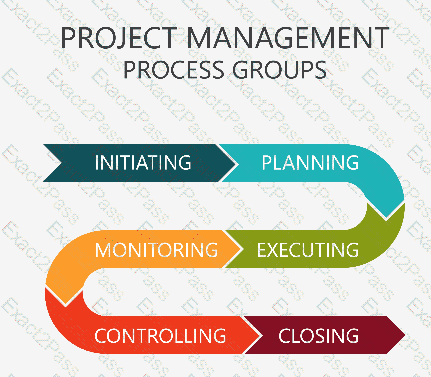
According to the PMBOK® Guide (Project Management Body of Knowledge), project management is performed through the integration of processes. These processes are logically grouped into five categories known as the Project Management Process Groups.
These groups are independent of process phases and are applied to every project or project phase to manage the flow of work:
Initiating Process Group: Those processes performed to define a new project or a new phase of an existing project by obtaining authorization to start.
Planning Process Group: Those processes required to establish the scope of the effort, refine the objectives, and define the course of action required to attain the objectives.
Executing Process Group: Those processes performed to complete the work defined in the project management plan to satisfy the project requirements.
Monitoring and Controlling Process Group: Those processes required to track, review, and regulate the progress and performance of the project; identify any areas in which changes to the plan are required; and initiate the corresponding changes.
Closing Process Group: Those processes performed to formally complete or close the project, phase, or contract.
Process Groups vs. Knowledge Areas: While there are 5 Process Groups, there are 10 Knowledge Areas (such as Scope, Schedule, Cost, etc.).
Process Groups vs. Project Life Cycle: Process Groups are not the same as project phases. Most process groups will typically be repeated within each phase of a project ' s life cycle.
Continuous Nature: The Monitoring and Controlling process group occurs concurrently with all other process groups (except Initiating in some frameworks) to ensure the project stays on track.
An input to Close Project or Phase is:
Accepted deliverables,
Final products or services,
Document updates,
Work performance information.
According to the PMBOK® Guide (Project Integration Management), the Close Project or Phase process is the process of finalizing all activities for the project, phase, or contract. To formally close a project or phase, the project manager must have confirmation that the work was completed according to the requirements.
Accepted Deliverables as an Input: Deliverables that have been signed off through the Validate Scope process are considered " Accepted Deliverables. " These are a primary input to closing because you cannot formally close a project or phase until the customer or sponsor has officially accepted the results of the work.
Transition of Ownership: Once these accepted deliverables enter the closing process, they are transitioned to the next phase or to production/operations.
Other Key Inputs: Other inputs include the Project Charter, the Project Management Plan, and Project Documents (such as the lesson learned register and milestone list).
Analysis of Distractors:
B. Final products or services: This is an output of the Close Project or Phase process. It represents the actual transition of the accepted product to the customer.
C. Document updates: While project documents are updated during this process (e.g., the Lessons Learned Register), " Project Document Updates " is categorized as an output, not a primary input required to start the closing activities.
D. Work performance information: This is an output of various Monitoring and Controlling processes (like Control Schedule or Control Costs). While it is used to manage the project, it is not the specific administrative trigger or requirement for the formal closing process.
Typical outcomes of a project include:
Products, services, and improvements.
Products, programs, and services.
Improvements, portfolios, and services.
Improvements, processes, and products.
According to the PMBOK® Guide (Foundational Concepts), a project is defined as a temporary endeavor undertaken to create a unique product, service, or result. The outcomes (deliverables) of a project can be categorized into several specific types:
A Product: This can be either a component of another item, an enhancement of an item, or an end item in itself (e.g., a new smartphone or a building).
A Service or a capability to perform a service: This includes the development of a new business function or the implementation of a new system (e.g., a new customer support center).
An Improvement: This involves enhancing the effectiveness or efficiency of existing product lines or service functions (e.g., a Six Sigma project to reduce defects in a manufacturing process).
A Result: Such as an outcome or document (e.g., a research project that develops knowledge that can be used to determine whether a trend exists).
Analysis of Distractors:
B and C. Programs and Portfolios: These are not outcomes of a project; rather, they are higher-level management structures. A Program is a group of related projects, and a Portfolio is a collection of projects, programs, and operations managed as a group to achieve strategic objectives. A project is a component of these, not a creator of them.
D. Processes: While a project may result in a new process, the standard definition used by PMI in the PMBOK® Guide specifically groups the outcomes under the umbrella of " products, services, and results/improvements. " " Improvements " and " Products " are correct, but " Services " is a more standard primary category than " Processes " in this specific context.
A construction project is underway with three months left to complete the building. A public authority responsible for approving the final stage is stalling the project. What should the project manager do?
Discuss this with the department head and arrive at an acceptable solution to expedite the approval process.
Report the issue to major stakeholders and explore possible corrective actions along with legal assistance.
Mitigate the risk by requesting an alternative public authority to participate in the approval process.
Visit the public authority headquarters and formally petition them, demanding an explanation about the delay.
According to the PMBOK® Guide, specifically within the Monitor Risks and Manage Stakeholder Engagement processes, external dependencies—such as government or public authority approvals—represent a significant risk to project completion.
Issue Escalation: Since the project is in its final stages (three months left) and the authority is " stalling, " this is no longer just a risk; it is an issue. When a project manager encounters a roadblock that is outside their direct sphere of influence (external bureaucratic stalling), they must inform the major stakeholders and the project sponsor.
Corrective Actions and Legal Support: Construction projects are governed by contracts and local laws. Stalling by a public authority can have massive financial implications. Exploring corrective actions may include re-sequencing work to accommodate the delay, while legal assistance is often required to navigate regulatory hurdles, ensure compliance, or invoke specific clauses that protect the organization ' s interests against arbitrary delays.
Stakeholder Management: Reporting the issue ensures that those with the most influence (executives or sponsors) can use their political or professional capital to assist the project manager in resolving the bottleneck.
Analysis of other options:
Option A: While talking to a department head might seem proactive, a project manager often lacks the organizational standing to " demand " solutions from a public authority head. This approach ignores the formal governance and legal frameworks usually required in construction.
Option B: This is the most professional and standard-aligned response. It recognizes the limits of the PM ' s authority and utilizes the organization ' s broader power (stakeholders and legal) to address a critical external threat.
Option C: In most jurisdictions, public authority jurisdictions are non-negotiable. You cannot simply " request an alternative authority " to provide a legal approval if they do not have the legal mandate to do so.
Option D: Demanding an explanation in person is aggressive and often counterproductive. In project management, " demanding " is rarely an effective strategy for managing external stakeholders who hold the power of approval.
Per PMI standards, when an external dependency threatens the project ' s critical path and is outside the PM ' s control, the PM must report the issue to stakeholders and seek corrective and legal pathways to resolve the impasse.
In which phase of team building activities do team members begin to work together and adjust their work habits and behavior to support the team?
Performing
Storming
Norming
Forming
According to the PMBOK® Guide (Project Management Body of Knowledge), specifically within the Project Resource Management knowledge area, the development of a project team typically follows the Tuckman Ladder model, which consists of five stages:
Norming (Option C): In this stage, team members begin to work together and adjust their work habits and behavior to support the team. Trust begins to develop as they resolve their differences and recognize the virtues of their teammates. They begin to develop a " team identity " and establish unwritten rules or " norms " for how the work will be accomplished.
Forming (Option D): This is the initial phase where the team meets and learns about the project and their formal roles and responsibilities. Team members tend to be independent and not as open in this phase.
Storming (Option B): In this phase, the team begins to address the project work, technical decisions, and the project management approach. If team members are not collaborative or open to different ideas and perspectives, the environment can become counterproductive.
Performing (Option A): Teams that reach this stage function as a well-organized unit. They are interdependent and work through issues smoothly and effectively. The project manager ' s role shifts more toward delegation.
In the PMI framework, understanding these stages is crucial for the Develop Team process. The Project Manager must adapt their leadership style—from directing in the Forming stage to supporting in the Norming stage—to help the team transition toward high performance as quickly as possible.
Which set of activities should a project manager use as part of the Develop Team process?
Training and establishing ground rules
Networking activities and estimating team resources
Conflict management activities and tracking team performance
Recruit new team members and training
According to the PMBOK® Guide, the Develop Team process is focused on improving competencies, team member interaction, and the overall team environment to enhance project performance. It is part of the Resource Management knowledge area and occurs within the Executing Process Group.
Training: This includes all activities designed to enhance the competencies of the project team members. It can be formal (classroom, online) or informal (on-the-job training, mentoring). If team members lack the necessary skills, the project manager must facilitate training to ensure the project ' s success.
Ground Rules: Establishing clear expectations regarding acceptable behavior by project team members. Ground rules decrease misunderstandings and increase productivity. Discussing ground rules in areas such as communication, working hours, or conflict resolution allows the team to discover values that are important to one another.
Other Key Activities: Develop Team also involves team-building activities, recognition and rewards, using colocation, and conducting individual and team assessments.
Analysis of Other Options:
B. Networking activities and estimating team resources: While networking is helpful, " Estimating team resources " is a Planning process (Estimate Activity Resources). Develop Team is about improving the team you already have, not calculating how many people you need.
C. Conflict management activities and tracking team performance: These activities are primary functions of the Manage Team process. Manage Team is about tracking performance, providing feedback, and resolving issues, whereas Develop Team is about building the team ' s capabilities and cohesion.
D. Recruit new team members and training: While training is correct, " Recruiting new team members " (or Acquire Resources) is the process of actually getting the people assigned to the project. You must acquire the team before you can develop them.
A project team for a marketing company is acquiring leaflets and materials from competitors. The team is working on a project to release new products, and they are trying to get ideas on how to most efficiently market these new products.
Which activity is the project team conducting?
Project execution
Benchmarking
Brainstorming
Project initiation
According to the PMBOK® Guide, specifically within the Plan Quality Management and Collect Requirements processes, organizations use various tools to establish a basis for measuring performance and generating ideas.
Why Choice B is correct: Benchmarking involves comparing actual or planned project practices (such as marketing materials and leaflets) to those of comparable organizations—in this case, competitors. The goal is to identify best practices, generate ideas for improvement, and provide a basis for measuring performance. By acquiring and analyzing competitor materials, the team is looking for a " benchmark " of what is currently successful in the market to ensure their own marketing strategy is competitive and efficient.
Analysis of other options:
A (Project execution): While the team is " doing work, " this choice is too broad. The question asks for the specific activity being conducted. Benchmarking is a technique often used during planning or quality management to inform execution.
C (Brainstorming): Brainstorming is an internal technique used to generate a broad set of ideas within a group. While it might follow the analysis of competitor materials, the act of gathering and comparing external data is specifically defined as benchmarking.
D (Project initiation): Initiation involves the formal authorization of a project (e.g., creating the Project Charter). Researching competitors to find marketing efficiencies is a more detailed activity that typically occurs during the planning phase.
In summary, the PMI Standard for Project Management highlights benchmarking as a key tool for continuous improvement and strategic alignment. By looking at competitor leaflets, the team is performing an external comparison to drive their project ' s success.
Following a project planning meeting with the team, a few team members approach the project manager to follow up on actions required. How can the project manager assess the effectiveness of the meeting?
Send the meeting minutes to all team members to verify that the required information is readily available.
Ask the team members to provide feedback for meetings in the phase retrospective.
Review the actions from the meeting with each of the project team members to ensure their understanding.
Consult the communications management plan to determine the success criteria for meetings.
According to the PMBOK® Guide and the Standard for Project Management, effective communication is not just about the distribution of information, but the confirmation of understanding. In the Monitor Communications process, the project manager must ensure that the communication artifacts (like meeting outcomes) have achieved their intended purpose.
Why Choice C is correct:
Closing the Feedback Loop: The true measure of a meeting ' s effectiveness is whether the participants can act on the decisions made. By reviewing the actions with team members, the PM identifies gaps in understanding or misinterpretations that occurred during the meeting.
Interpersonal and Team Skills: This approach utilizes active listening and feedback, which are core power skills. It allows the PM to verify that " noise " did not interfere with the message and that the team is aligned on the path forward.
Immediate Correction: Unlike waiting for a retrospective, this provides immediate insight into whether the planning session was successful or if the team is still confused about their responsibilities.
Analysis of other options:
A (Send the meeting minutes): Sending minutes is a standard administrative task (distribution), but it is passive. Simply having information " readily available " does not mean it was understood or that the meeting was effective in influencing behavior.
B (Wait for the phase retrospective): While retrospectives are excellent for process improvement, waiting until the end of a phase is too late to assess a specific planning meeting ' s effectiveness. The project may have already suffered from misalignment by then.
D (Consult the communications management plan): The plan defines how meetings should be conducted and what the criteria are, but it is a static document. Consulting it doesn ' t tell you how well a specific meeting actually went in practice.
Key Concept: The Project Management Institute (PMI) emphasizes that " Communication = Understanding. " Choice C is the most proactive and direct way to assess if the meeting ' s objectives were met by checking the " output " (team understanding) against the " input " (the meeting content).
How should a stakeholder who is classified as high power and low interest be grouped in a power/interest grid during stakeholder analysis?
Keep satisfied
Keep informed
Manage closely
Monitor
According to the PMBOK® Guide, specifically within the Identify Stakeholders process, the Power/Interest Grid is a categorization tool used to group stakeholders based on their level of authority (power) and their level of concern (interest) regarding project outcomes.
High Power / Low Interest: Stakeholders in this quadrant have significant influence over the project ' s resources or direction but do not have a high level of active interest in the day-to-day details.
Engagement Strategy: The recommended strategy for these individuals is to Keep Satisfied. Because of their high power, they have the ability to derail a project if they become unhappy or if their high-level needs are not met. However, because their interest is low, providing them with too much detailed information could overwhelm or annoy them.
Examples: This often includes senior executives, government regulators, or department heads who provide funding but are not directly involved in the project ' s execution.
Analysis of Other Options:
B. Keep informed: This strategy is used for stakeholders with Low Power but High Interest. These people are interested in the project ' s progress and can often provide helpful details, but they lack the authority to make major changes.
C. Manage closely: This is the strategy for the " Key Players " —those with both High Power and High Interest. They require the highest level of engagement and frequent communication.
D. Monitor: This strategy is reserved for stakeholders with Low Power and Low Interest. They require the least effort; the project team simply monitors them to see if their power or interest levels change over time.
A project manager is launching an information system to provide a lessons learned database. This action is necessary for recipients to access content at their own discretion. Which communication method is described?
Push communication
Pull communication
Interactive communication
Stakeholder communication
According to the PMBOK® Guide and the Standard for Project Management, communication methods are categorized based on how information is shared and accessed.
Pull Communication: This method is used for very large volumes of information or for very large audiences. It requires the recipients to access the content at their own discretion. Examples include intranet sites, e-learning, knowledge repositories (like a lessons learned database), and bulletin boards. The defining characteristic is that the " sender " places the information in a central location, and the " receiver " must take action to " pull " the information.
Push Communication: This involves sending information directly to specific recipients who need to receive it. This ensures that the information is distributed but does not guarantee it reached or was understood by the target audience. Examples include letters, memos, emails, and press releases.
Interactive Communication: This is a multidimensional exchange of information in real-time between two or more parties. Examples include meetings, phone calls, and video conferencing.
Analysis of other options:
D. Stakeholder communication: This is a general term describing the process of sharing information with stakeholders, but it is not a specific communication method defined by PMI ' s technical standards (Interactive, Push, and Pull).
By implementing a lessons learned database, the project manager is contributing to Organizational Process Assets (OPAs). Using a Pull method is the most efficient way to manage such a database, as it allows future project managers and team members to search for and retrieve relevant knowledge only when they need it.
After missing a weekly communication meeting hosted by the project manager, a stakeholder looks at the latest report in the common repository.
What is the communication type used in this scenario?
Pull
Verbal
Written
Push
In the PMBOK® Guide, the Plan Communications Management process identifies three primary methods of communication. Understanding the direction of information flow is key to selecting the correct method.
Why Choice A is correct:
Pull Communication: This method is used for large volumes of information or for large audiences. The information is placed in a central repository (like a SharePoint site, intranet, wiki, or project management software), and the recipients must " pull " the information by accessing it at their own discretion.
Scenario Application: Since the stakeholder " looks at the latest report in the common repository " on their own time after missing a meeting, they are actively retrieving the data. This is the definition of pull communication.
Benefits: It allows stakeholders to access information when they need it without cluttering their inboxes, and it ensures everyone has access to the " single source of truth. "
Analysis of other options:
B (Verbal): This refers to spoken communication, such as the weekly meeting the stakeholder missed. Since the stakeholder is now reading a report, the communication has transitioned from a verbal/interactive format to a document-based one.
C (Written): While a report is technically written, " Written " is a communication format, not a communication method (type) in the PMI framework. The question asks for the " communication type, " which refers to the delivery method (Push, Pull, or Interactive).
D (Push): Push communication involves sending information directly to specific recipients who need to receive it (e.g., emails, memos, letters, or reports sent directly to an inbox). In this scenario, the information was not " pushed " to the stakeholder; the stakeholder went to a " common repository " to find it themselves.
Key Concept: The Project Management Institute (PMI) emphasizes that effective communication requires choosing the right method for the right situation. Pull Communication (Choice A) is an efficient way to manage transparency, as it empowers stakeholders to stay informed at their own pace while reducing the administrative burden on the project manager to manually distribute every report.
Which process determines the risks that may affect the project and documents their characteristics?
Control Risks
Plan Risk Management
Plan Risk Responses
Identify Risks
According to the PMBOK® Guide and the Standard for Project Management, the process of determining which risks may affect the project and documenting their characteristics is Identify Risks.
As per PMI standards, this process is part of the Project Risk Management Knowledge Area and occurs within the Planning Process Group. The key benefit of this process is the documentation of existing risks and the knowledge and ability it provides to the project team to anticipate events. Important aspects of this process include:
Iterative Nature: Identify Risks is an iterative process because new risks may evolve or become known as the project progresses through its life cycle.
Participants: The process should involve the project manager, project team members, risk management team (if assigned), customers, subject matter experts, end users, and other stakeholders.
Risk Register: The primary output of this process is the Risk Register, which initially contains the list of identified risks and a list of potential responses.
The other options are incorrect based on the following PMI definitions:
Control Risks: (Now referred to as Monitor Risks) This is the process of monitoring the implementation of agreed-upon risk response plans, tracking identified risks, and identifying and analyzing new risks. It is a Monitoring and Controlling process, not the initial identification process.
Plan Risk Management: This is the process of defining how to conduct risk management activities for a project. It establishes the " roadmap " or strategy but does not identify the specific risks themselves.
Plan Risk Responses: This is the process of developing options and actions to enhance opportunities and to reduce threats to project objectives. This happens after risks have been identified and analyzed.
As per the PMI Lexicon of Project Management Terms, the Identify Risks process ensures that the team has a comprehensive understanding of the uncertainties that could impact the project ' s scope, schedule, cost, or quality.
The number of potential communication channels for a project with 5 stakeholders is:
10.
12.
20.
24.
According to the PMBOK® Guide (Project Communications Management), specifically within the Plan Communications Management process, the number of potential communication channels is a key indicator of the complexity of a project ' s communications.
The formula used to calculate the number of potential communication channels is:
$$Total\ Channels = \frac{n(n - 1)}{2}$$
Where $n$ represents the number of stakeholders.
Step-by-Step Calculation for 5 Stakeholders:
Identify the number of stakeholders: $n = 5$
Plug the value into the formula: $\frac{5(5 - 1)}{2}$
Subtract 1 from the number of stakeholders: $5 \times 4 = 20$
Divide by 2: $20 / 2 = 10$
Therefore, a project with 5 stakeholders has 10 potential communication channels.
Key Insight: This calculation is vital for project managers because it demonstrates how communication complexity grows exponentially as more stakeholders are added. For example, adding just one more stakeholder (moving from 5 to 6) increases the channels from 10 to 15. Managing these channels effectively is essential to ensure that the right information reaches the right people at the right time.
Analysis of Distractors:
B, C, and D: These values do not align with the mathematical result of the communication channels formula ($n(n-1)/2$). Option C (20) represents the numerator of the formula ($5 \times 4$) before dividing by 2.
During a project ' s execution phase, the project manager reviews the communications management plan for communication technology factors. What can affect the choice of communications?
Legal requirements
Politics and power structures
Internal information needs
Sensitivity and confidentiality of the information
In accordance with the PMBOK® Guide, specifically the Plan Communications Management process, the selection of communication technology is influenced by several specific factors. Communication technology refers to the methods used to transfer information among project stakeholders.
The factors that can affect the choice of communication technology include:
Urgency of the need for information: The frequency and speed of information delivery.
Availability and reliability of technology: Ensuring that the technology required is compatible, available, and accessible for all stakeholders.
Ease of use: Whether the technology is appropriate for the participants and if training is required.
Project environment: Whether the team will meet face-to-face or in a virtual environment.
Sensitivity and confidentiality of the information: Some information is sensitive, and the choice of technology must ensure it is secure. For instance, highly confidential information may require a secure, encrypted platform rather than standard email.
Analysis of other options:
Legal requirements (Option A): While legal requirements (like GDPR) influence what is stored and how it is handled, they are generally considered Enterprise Environmental Factors (EEFs) that govern the project rather than a direct " Communication Technology Factor " used to select a specific tool like a video call vs. a written report.
Politics and power structures (Option B): These are part of Stakeholder Analysis and affect the engagement strategy and messaging, but not necessarily the technical medium (technology) chosen for the transmission of data.
Internal information needs (Option C): These define what needs to be communicated (the content), whereas technology factors focus on how that content is delivered (the medium).
Per PMI standards, the project manager must ensure that the communication technology chosen is appropriate for the information being conveyed, particularly when dealing with the Sensitivity and confidentiality of the information to protect organizational assets.
The project manager is working in the Resource Management process. Which items may the project manager need to include in the team charter?
Cultural norms, roles and responsibilities, and organizational chart
Assumption logs, resource calendars and training schedule
Communication guidelines, conflict resolution process, and team agreements
Company policies, recognition plan, and roles and responsibilities
According to the PMBOK® Guide, the Team Charter is a document that establishes the team values, agreements, and operating guidelines for the team. It is a key output of the Plan Resource Management process. The goal of the charter is to provide a clear set of expectations regarding behavior and interaction, which helps reduce misunderstandings and increase productivity.
Key elements typically included in a team charter are:
Team values: The shared beliefs that guide the team.
Communication guidelines: How and when the team will communicate (e.g., email vs. instant messaging).
Decision-making criteria: How the team will reach a consensus or make final decisions.
Conflict resolution process: A pre-defined approach for handling disagreements within the team.
Meeting guidelines: Rules for frequency, duration, and participation in meetings.
Team agreements: Ground rules regarding how the team will work together.
Why other options are incorrect:
Option A: While cultural norms are relevant, roles and responsibilities and the organizational chart are typically documented in the Resource Management Plan or a RAM/RACI chart, rather than the team charter, which focuses on behavioral ground rules.
Option B: Assumption logs and resource calendars are separate project documents. A training schedule is part of the Resource Management Plan. These are technical management data points, not behavioral guidelines.
Option D: Company policies are Organizational Process Assets (OPAs) that exist outside the project. A recognition plan and roles and responsibilities are components of the broader Resource Management Plan.
Completion of the product scope is measured against the product:
prototypes
requirements
analyses
benchmarks
According to the PMBOK® Guide, a clear distinction is made between Project Scope and Product Scope regarding how completion is measured:
Product Scope: The features and functions that characterize a product, service, or result. Completion of the product scope is measured against the product requirements to ensure that the delivered product has all the specified characteristics and functions.
Project Scope: The work performed to deliver a product, service, or result with the specified features and functions. Completion of the project scope is measured against the project management plan, specifically the scope baseline (which includes the scope statement, WBS, and WBS dictionary).
Validation: During the Validate Scope process, the formalized acceptance of the completed project deliverables is obtained. This involves inspecting the deliverables to ensure they meet the documented requirements and acceptance criteria.
Comparison with other options:
A. Prototypes: These are a tool used in the Collect Requirements process to provide a working model of the expected product. While they help define requirements, they are not the formal metric against which final completion is measured.
C. Analyses: Data analysis is a technique used throughout the project to make decisions or identify trends, but it is not the baseline for scope completion.
D. Benchmarks: Benchmarking involves comparing actual or planned practices to those of comparable organizations to identify best practices or provide a basis for measuring performance. It helps set the standard for requirements but is not the requirements document itself.
An adaptive team schedules 20 story points in the upcoming sprint. Historically, the team completes 25 story points on average per sprint. Each sprint is two weeks, and there is one day of float.
What is the likelihood the team will complete all 20 story points in the upcoming sprint?
50-75%
25-50%
75-100%
0-25%
In Agile and Scrum methodologies, specifically regarding Empirical Process Control, a team ' s historical performance is the most reliable predictor of future performance. This is primarily measured through Velocity.
Why Choice C is correct:
Velocity Comparison: The team ' s average velocity is 25 story points. They have only planned 20 story points for the upcoming sprint. Since 20 is significantly less than their historical average (80% of their typical capacity), the team is working with a " buffer. "
Confidence Levels: In Agile estimation, if a team takes on work that is well below their average velocity, the probability of completion is very high. Statistically, since they usually finish 25, the likelihood of finishing 20—barring a major impediment—is extremely high (near certain).
Capacity and Float: The mention of " one day of float " further supports a high completion rate, as it indicates the team has built-in time to handle unexpected issues or administrative tasks without impacting the delivery of the 20 points.
Analysis of other options:
A and B (25-75%): These ranges would be more applicable if the team had scheduled exactly 25 points (their average) or slightly more. When a team schedules at their exact average, the probability of finishing everything is typically closer to 50% (since an average implies they sometimes do more and sometimes do less).
D (0-25%): This would only be the case if the team scheduled significantly more than their average velocity (e.g., scheduling 40 points when they usually only finish 25).
Key Concept: The Project Management Institute (PMI) and the Agile Practice Guide emphasize that Velocity (Choice C) is a measure of a team’s capacity. By scheduling work below their demonstrated capacity, the team increases the " probability of success " and ensures a sustainable pace, which is one of the core principles of the Agile Manifesto. This approach reduces the risk of carrying over unfinished stories to the next sprint.
In which type of organizational structure are staff members grouped by specialty?
Functional
Projectized
Matrix
Balanced
According to the PMBOK® Guide, organizational structures are categorized based on how they distribute authority and how they group their resources.
Functional Organization: This is the most common classical organizational structure. In a functional organization, the hierarchy is arranged by specialty or department (e.g., Engineering, Marketing, Finance, Manufacturing).
Structure: Each department has its own manager (Functional Manager), and staff members report directly to that manager.
Project Characteristics: In this environment, projects usually occur within a single department. If work is needed from another department, the request is passed from the head of one department to the head of another. The Project Manager has little to no authority, and the functional manager controls the budget and resources.
Analysis of Other Options:
B. Projectized: In this structure, the organization is arranged by project. Staff members are co-located and report directly to a Project Manager who has high to almost total authority.
C. Matrix: This is a blend of functional and projectized characteristics. Staff members report to both a functional manager and a project manager. It can be further categorized into Weak, Balanced, or Strong matrices based on who holds more power.
D. Balanced: This is a specific type of Matrix organization where the power is shared relatively equally between the functional manager and the project manager. While it involves specialties, the defining characteristic of " grouping by specialty " as the primary hierarchy remains the " Functional " definition.
Which of the following Project Communication Management processes uses performance reports as an input?
Manage Stakeholder Expectations
Report Performance
Distribute Information
Plan Communications
According to the PMBOK® Guide (specifically within the Communications Management knowledge area), the process of getting the right information to the right stakeholders at the right time is central to project success. In older versions of the PMBOK® Guide (which these specific numbered questions often reference), Distribute Information is the process that handles the collection and delivery of project data.
The Distribute Information process is focused on making relevant information available to project stakeholders as planned.
Input vs. Output: While " Performance Reports " are the primary output of the Report Performance process, they immediately become a critical input for Distribute Information.
The Flow of Data:
Work performance data is collected.
It is analyzed and turned into a Performance Report (in the Report Performance process).
That report is then fed into Distribute Information to be sent out via email, meetings, or portals to the stakeholders who need to see it.
A. Manage Stakeholder Expectations: This process (now called Manage Stakeholder Engagement) uses the Communications Management Plan and the Stakeholder Management Plan as primary guides. While performance reports might be discussed during engagement, they are not the primary mechanical input for this process.
B. Report Performance: This is the process that creates the performance reports. In the PMI framework, an output of a process is generally not listed as its own input; it is the result of the tools and techniques applied to work performance data.
D. Plan Communications: This is the initial process where you determine who needs what information. Since it happens during the Planning phase, performance reports (which reflect actual work) do not yet exist and cannot be an input.
In the most recent versions of the PMBOK® Guide, these processes have been consolidated and renamed:
Distribute Information and Report Performance are now largely contained within Manage Communications.
Manage Stakeholder Expectations is now Manage Stakeholder Engagement.
Perform Quality Control is accomplished by:
Identifying quality standards that are relevant to the project and determining how to satisfy them.
Monitoring and recording the results of executing the quality activities to assess performance and recommend necessary changes.
Ensuring that the entire project team has been adequately trained in quality assurance processes.
Applying Monte Carlo, sampling, Pareto analysis, and benchmarking techniques to ensure conformance to quality standards.
According to the PMBOK® Guide, the process traditionally known as Perform Quality Control (referred to as Control Quality in more recent editions) is the process of monitoring and recording results of executing the quality management activities to assess performance and ensure the project outputs are complete, correct, and meet customer expectations.
Core Objective: The primary purpose of this process is to verify that project deliverables and work meet the requirements specified by key stakeholders for final acceptance. It focuses on the correctness of the deliverables.
Key Activities:
Identifying the causes of poor process or product quality and recommending/taking action to eliminate them.
Validating that project deliverables and work meet the requirements specified by stakeholders.
Recording the results of quality activities to provide a basis for the Manage Quality (Quality Assurance) process to evaluate the overall quality standards.
Choice A describes Plan Quality Management, which happens during the planning phase to define standards.
Choice C describes a human resource or training activity that may fall under Manage Quality (Quality Assurance), which focuses on the processes, not the specific outputs.
Choice D is incorrect because while it lists some valid tools (Sampling, Pareto), " Benchmarking " is primarily a tool for Plan Quality Management, and " Monte Carlo " is a tool for Quantitative Risk Analysis, not standard quality control.
A project team member is estimating the cost of activity and is checking documentation from previous similar projects. Which estimation method is the project manager using to complete this task?
Bottom-up estimating
Three-point estimating
Analogous estimating
Parametric estimating
According to the PMBOK® Guide, specifically the Estimate Costs and Estimate Activity Durations processes, project managers choose from several estimation techniques depending on the available data and the required level of precision.
Analogous Estimating (Choice C): This technique uses values or attributes—such as scope, cost, budget, or duration—from a previous, similar project as the basis for estimating the same attribute for the current project. It is often used when there is a limited amount of detailed information available about the current project (e.g., in the early phases). It is generally less costly and time-consuming than other techniques but also less accurate. Because the team member is specifically " checking documentation from previous similar projects, " they are performing an analogy.
Bottom-up Estimating (Choice A): This involves estimating the cost of individual work packages or activities with the greatest level of specified detail. These costs are then summarized or " rolled up " to higher levels. This requires a detailed WBS and is much more granular than looking at past projects.
Three-point Estimating (Choice B): This technique improves accuracy by considering estimation uncertainty and risk. It uses three estimates (Most Likely, Optimistic, and Pessimistic) to calculate an expected cost. It does not inherently rely on " previous similar projects " as its primary source, though historical data can inform the three points.
Parametric Estimating (Choice D): This uses a statistical relationship between historical data and other variables (e.g., square footage in construction, lines of code in software development) to calculate an estimate. While it uses historical data, it applies a mathematical algorithm or model rather than a direct comparison to one specific previous project.
By using Analogous Estimating, the project manager can quickly develop a high-level estimate based on the organization ' s Organizational Process Assets (OPAs) and historical knowledge, provided the previous projects are truly similar in nature to the current one.
Which of these is true of project integration management?
Project Integration Management is mandatory and more effective in larger projects.
Project Integration Management and expert judgment are mutually exclusive.
Project Integration Management is the responsibility of the project manager
Project Integration Management excludes the triple constraints if cost performance index (CPI) equals zero.
According to the PMBOK® Guide, Project Integration Management is the core Knowledge Area that includes the processes and activities to identify, define, combine, unify, and coordinate the various processes and project management activities.
The Responsibility of the Project Manager: PMI explicitly states that while other Knowledge Areas (like Scope, Schedule, or Cost) can be managed by specialists (e.g., cost engineers or schedulers), Project Integration Management cannot be delegated. The Project Manager is the sole individual responsible for the " big picture " and ensuring that all pieces of the project work together as a cohesive whole.
Accountability: The Project Manager must oversee the interdependencies among the other Knowledge Areas. This includes balancing competing objectives and managing the trade-offs between constraints.
Analysis of other options:
A. Mandatory and more effective in larger projects: While Integration Management is essential, PMI teaches that it is necessary for all projects, regardless of size. Its importance is not " more " in large projects; it is fundamentally required in every project to ensure success.
B. Mutually exclusive with Expert Judgment: This is incorrect. Expert Judgment is actually one of the most common Tools and Techniques used within the Integration Management processes (such as in Developing the Project Charter or Developing the Project Management Plan).
D. Excludes triple constraints if CPI equals zero: This is a logical fallacy. The " Triple Constraints " (Scope, Schedule, Cost) are always central to integration. Furthermore, a CPI of zero would typically indicate that no work has been performed or no value has been earned, which would require more intense integration and corrective action, not the exclusion of constraints.
In summary, the PMBOK® Guide emphasizes that the Project Manager ' s primary role is that of an integrator. They are the ones who link the project’s objectives with the organization ' s strategic goals and ensure that all deliverables are aligned.
A team has been tasked with designing a product to address a problem they have never faced before. The project team is struggling to get traction as the solutions are not clear. What should the project manager do next?
Add the risk to the project risk register, as the lack of solutions could impact how the product is built.
Add the issue to the project issue log, as it will impact the project performance.
Facilitate a brainstorming session for the team to discuss ideas to solve the problem.
Meet with the project sponsor to understand their vision on how to address the problem.
According to the PMBOK® Guide, specifically the Collect Requirements and Develop Team processes, the project manager acts as a facilitator when the team faces technical ambiguity or " wicked problems " that lack clear solutions.
Facilitation and Brainstorming: When a team is " struggling to get traction " on a new problem, the Project Manager should utilize data-gathering techniques like Brainstorming. This creates a collaborative environment where diverse ideas can be surfaced without immediate judgment. It is the most effective way to jump-start the creative process and move from stagnation to action.
The Power of the Team: In both adaptive and predictive environments, the technical experts (the team) are best positioned to develop solutions. The PM’s role is not to provide the answer, but to provide the structure (the session) that allows the answer to emerge.
Divergent Thinking: Brainstorming encourages divergent thinking, which is essential when facing a problem the team has " never faced before. " Once a wide array of ideas is generated, the team can then use tools like Affinity Diagrams or Multicriteria Decision Analysis to narrow them down.
Analysis of other options:
Option A: While it is technically a risk, simply adding it to a Risk Register does nothing to solve the immediate problem of the team being stuck. Documentation is a secondary action to active problem-solving.
Option B: Adding it to the Issue Log tracks the problem but doesn ' t resolve it. The prompt asks what the PM should do next to get the team moving.
Option D: The Project Sponsor provides the " what " (the vision and funding) but generally should not be responsible for the " how " (the technical solution). Meeting with the sponsor for technical direction undermines the team ' s autonomy and expertise.
Per PMI standards, when a project hits a creative or technical roadblock, the project manager should immediately employ interpersonal and team skills to facilitate a Brainstorming session, empowering the team to innovate and find a path forward.
A project team is reviewing project performance. During the execution phase, the project team discovers that there is an off-the-shelf (OTS) product, which could reduce the timeline for development.
What should the project manager do next?
Update the project management plan.
Add the discovery to the assumptions.
Evaluate the risk with the project team.
Conduct an opportunity analysis with the team.
According to the PMBOK® Guide and the Standard for Project Management, when a potential benefit—such as an off-the-shelf (OTS) product that can reduce the timeline—is identified during the execution phase, it is classified as a positive risk or an opportunity.
Why Choice D is correct: Before any changes are made to the plan or the risk register, the Project Manager must understand the potential value and feasibility of the discovery. Opportunity Analysis (part of the Perform Qualitative and Quantitative Risk Analysis processes) involves evaluating the probability of success and the impact of the opportunity on project objectives (e.g., cost vs. time savings). This aligns with the " Optimize " or " Exploit " strategies for positive risks.
Analysis of other options:
A (Update the project management plan): This is premature. You cannot update the plan (which requires the Perform Integrated Change Control process) until the opportunity has been fully analyzed and a change request has been approved.
B (Add the discovery to the assumptions): An assumption is something considered to be true without proof. A discovered product is a tangible option/opportunity, not a foundational assumption.
C (Evaluate the risk with the project team): While " risk " technically covers both threats and opportunities, in PMI terminology, when a specific beneficial discovery is made, the most proactive and targeted step is Opportunity Analysis to determine if the benefit outweighs the potential drawbacks of switching from custom development to an OTS product (such as integration issues or licensing costs).
By conducting an opportunity analysis, the Project Manager determines if the OTS product should be pursued, which then leads to a formal change request to capture the timeline reduction.
Project management processes ensure the:
alignment with organizational strategy
efficient means to achieve the project objectives
performance of the project team
effective flow of the project throughout its life cycle
According to the PMBOK® Guide (Project Management Body of Knowledge), specifically in the chapters covering Project Management Processes, the core purpose of these processes is to manage the project ' s progression:
Effective Flow (Option D): PMI defines project management as the application of knowledge, skills, tools, and techniques to project activities to meet project requirements. This application is accomplished through the effective integration of the project management processes. The processes are grouped into Process Groups (Initiating, Planning, Executing, Monitoring and Controlling, and Closing) specifically to ensure the effective flow of the project throughout its life cycle. This ensures that the transition between phases is structured and that the project moves logically from a concept to a finalized result.
Efficient Means (Option B): While processes certainly aim for efficiency, the primary definition provided by PMI focuses on the flow and integration of the project rather than just being a " means " to an objective.
Alignment with Strategy (Option A): This is primarily the function of Portfolio Management and the Project Charter. While project management supports this, the processes themselves are the mechanical engine that moves the project forward.
Performance of the Team (Option C): This is managed through the Project Resource Management knowledge area (specifically the " Develop Team " and " Manage Team " processes), but it is only one aspect of the overall project management process framework.
In the PMI framework, the Project Management Processes are iterative and linked by the outputs they produce. The output of one process generally becomes an input to another process or is a deliverable of the project, creating the " flow " necessary for project success.
Which of the following are outputs of Develop Project Team?
Human resources plan changes and project staff assignment updates
Project management plan updates and enterprise environmental factor updates
Resource calendars and project management plan updates
Team performance assessments and enterprise environmental factor updates
According to the PMBOK® Guide, specifically the Develop Team process (part of the Resource Management knowledge area), the primary goal is to improve competencies, team member interaction, and the overall team environment to enhance project performance.
When a project manager successfully develops a team through training, team-building, and establishing ground rules, the following outputs are generated:
Team Performance Assessments: As the project team’s effectiveness increases, the project management team makes formal or informal assessments of the team ' s effectiveness. These measure improvements in skills, competencies, reduced staff turnover, and increased team cohesiveness.
Enterprise Environmental Factors (EEF) Updates: The " culture " or " climate " of the organization is an EEF. By developing the team, you are effectively updating the organization ' s internal factors, such as employee development records and skill updates.
A. Human resources plan changes...: " Human Resource Plan " is a term from older PMBOK versions; the current term is Resource Management Plan. While staff assignment updates are common in other resource processes, they are not the primary output of developing the existing team.
B. Project management plan updates...: While the Project Management Plan can be updated as a result of Develop Team, this option omits the most critical output (Team Performance Assessments).
C. Resource calendars...: Resource calendars are primarily an output of the Acquire Resources process, as they document when specific resources are available for work.
To reach these outputs, the project manager uses:
Colocation (Tight Matrix)
Virtual Teams
Communication Technology
Interpersonal and Team Skills (Conflict management, influencing, motivation)
Recognition and Rewards
Training
A project management office manages a number of aspects including the:
Project scope, schedule, cost, and quality of the products of the work packages.
Central coordination of communication management across projects.
Assignment of project resources to best meet project objectives.
Overall risk, overall opportunity, and interdependencies among projects at the enterprise level.
According to the PMBOK® Guide, a Project Management Office (PMO) is an organizational structure that standardizes the project-related governance processes and facilitates the sharing of resources, methodologies, tools, and techniques.
While the specific responsibilities of a PMO can range from providing project management support functions to actually being responsible for the direct management of one or more projects, a primary function is the central coordination of communication management across projects.
Coordination Role: The PMO acts as a bridge between the strategic level of the organization and the project execution level. It ensures that communication flows consistently across various projects to maintain alignment with organizational goals.
Support and Governance: PMOs often manage shared resources, identify and develop project management methodologies, and provide coaching, mentoring, and oversight.
Types of PMOs:
Supportive: Provides templates and best practices but has low control.
Controlling: Requires compliance with frameworks and tools; has moderate control.
Directive: Actually manages the projects; has high control.
Analysis of other choices:
Choice A (Project scope, schedule, cost, etc.): These are the primary responsibilities of the Project Manager, not necessarily the PMO. While a " Directive PMO " might handle these, it is not the defining characteristic of PMOs in general.
Choice C (Assignment of project resources): While a PMO might facilitate resource sharing, the actual assignment of resources to specific project objectives is typically a negotiation between the Project Manager and Functional Managers.
Choice D (Overall risk and interdependencies at the enterprise level): This more accurately describes Portfolio Management or Enterprise Project Management (EPM). While a PMO may support this, managing enterprise-level interdependencies is a broader strategic function.
Processes in the Initiating Process Group may be completed at the organizational level and be outside of the project ' s:
Level of control.
Communication channels.
Scope.
Strategic alignment.
According to the PMBOK® Guide (Project Management Body of Knowledge), specifically the section regarding the Initiating Process Group, the relationship between the organization and the project boundaries is defined as follows:
Level of Control (Option A): The PMBOK® Guide states that the processes in the Initiating Process Group (such as Developing the Project Charter) often start at the organizational, program, or portfolio level. Because these high-level decisions—such as the initial business case or the decision to fund a project—occur before the project is formally authorized, they are considered to be outside of the project ' s level of control. The project manager is often assigned during or after these processes have been initiated by the organization.
Communication Channels (Option B): While communication channels are vital, they are established within the project and are not the limiting factor for where the Initiating processes reside. The organization and the project share communication channels; they are not " outside " them.
Scope (Option C): While the project scope is defined during planning, the initial project boundaries are set during Initiating. Saying a process is " outside the scope " usually implies it is not part of the work, but Initiating is the work required to define that scope. The key distinction in the PMI standard is the authority and control over those processes.
Strategic Alignment (Option D): This is the opposite of the truth. Projects must be inside or perfectly aligned with the organization ' s strategic alignment. Processes in the Initiating group are specifically designed to ensure the project aligns with the organization ' s strategy.
In the PMI framework, the Project Boundary is defined as the point in time that a project or a project phase is authorized to its completion. Processes occurring before this authorization (pre-project work) are technically outside the project ' s direct control.

