Exact2Pass

Last Update 20 hours ago Total Questions : 1337
The Certified Associate in Project Management (CAPM) content is now fully updated, with all current exam questions added 20 hours ago. Deciding to include CAPM practice exam questions in your study plan goes far beyond basic test preparation.
You'll find that our CAPM exam questions frequently feature detailed scenarios and practical problem-solving exercises that directly mirror industry challenges. Engaging with these CAPM sample sets allows you to effectively manage your time and pace yourself, giving you the ability to finish any Certified Associate in Project Management (CAPM) practice test comfortably within the allotted time.
What is the purpose of an adaptive standup meeting?
To review what work has been completed, remove impediments, and calculate velocity
To ask the team what work has been completed, calculate velocity, and determine what work will be completed
To ask the team what work has been completed, ask what work will be completed, and report impediments
To update the burndown chart, calculate velocity, and report impediments
According to the Agile Practice Guide and the PMBOK® Guide, the daily standup (also known as the Daily Scrum) is a key ceremony in adaptive environments designed for team synchronization and micro-planning.
The Three Questions: The traditional format of a standup involves each team member answering three specific questions to provide visibility into the iteration ' s progress:
What have I completed since the last meeting?
What do I plan to complete between now and the next meeting?
What are my impediments (blocks/risks) that are preventing me or the team from reaching the iteration goal?
Peer-to-Peer Communication: The primary purpose is not to " report status " to a manager, but for the team to communicate with one another. It ensures everyone is aligned on the current state of the sprint and can collaborate to resolve issues immediately.
Timeboxing: These meetings are strictly timeboxed (usually to 15 minutes) to keep the focus on immediate coordination rather than deep problem-solving, which should happen in separate " breakout " sessions.
Analysis of other options:
Option A: While removing impediments is a goal, calculating velocity is an activity typically performed at the end of an iteration (during the Sprint Review or Retrospective), not during the daily standup.
Option B: Similar to Option A, calculating velocity is out of place here. The standup is a planning and synchronization tool, not a metrics-gathering session.
Option D: The burndown chart is often updated by the team as they complete tasks, and it may be viewed during the standup, but " calculating velocity " remains an end-of-iteration metric. The core purpose of the meeting is the exchange of information regarding tasks and blockers.
Per PMI standards, the Adaptive Standup Meeting serves as a daily synchronization point for the team to share progress, commit to upcoming work, and highlight any impediments that require resolution to maintain project momentum.
A project team is meeting to seek solutions on a new problem that occurred recently. The meeting is comprised of two parts: the first is a generation of ideas and the second is an analysis.
Which technique is the team using?
Checklists
Interview
Focus group
Brainstorming
In the PMBOK® Guide, specifically within the Identify Risks and Collect Requirements processes, the project manager uses various data-gathering techniques to solve problems and generate options.
Why Choice D is correct: Brainstorming is a two-phased technique used to identify a list of ideas in a short period.
Generation Phase: The first part focuses on quantity and creative flow. Team members share ideas freely without criticism or judgment. The goal is to " widen the net " as much as possible.
Analysis Phase: In the second part, the group reviews the ideas, categorizes them, and evaluates them for feasibility. This is where the team narrows down the list to find the best solution for the problem at hand.
Application: It is particularly effective for new problems where historical data might not exist, as it leverages the collective intelligence and " Power Skills " of the team.
Analysis of other options:
A (Checklists): Checklists are based on historical information and knowledge that has been accumulated from previous similar projects. They are used to ensure consistency, not to generate creative new solutions for unexpected problems.
B (Interview): This is a formal or informal approach to elicit information from stakeholders by talking to them directly. It is typically a one-on-one discovery tool rather than a collaborative team-based idea generation and analysis session.
C (Focus group): A focus group brings together prequalified stakeholders and subject matter experts to learn about their expectations and attitudes about a specific product or service. It is more about gauging reactions than internal team problem-solving.
Key Concept: The Project Management Institute (PMI) identifies Brainstorming (Choice D) as a foundational tool for innovation and problem-solving. By separating the generation of ideas from the analysis of those ideas, the project manager prevents " groupthink " and ensures that the most creative solutions are not dismissed before they are fully understood.
Which statement describes the Monitor Communications process?
Evaluates the differences between the communications management plan and the reality of communications in a project
Ensures that the information needs of the project and the stakeholders are met
Ensures that project information is created, collected, and distributed in a timely and appropriate manner
Develops an appropriate approach and plan for communication of project activities
According to the PMBOK® Guide, the Monitor Communications process is the final step in the Project Communications Management knowledge area, occurring within the Monitoring and Controlling process group.
Ensuring Needs are Met (Choice B): This is the formal definition of the process. The primary goal of Monitor Communications is to ensure that the communication requirements of the project and its stakeholders are being satisfied as planned. It involves verifying that the right information reached the right people at the right time and had the desired effect. If the information is not reaching stakeholders or if they are not understanding it, the project manager may need to trigger a change request to modify the communications approach.
Evaluation of Differences (Choice A): While monitoring involves identifying variances between the plan and reality, this is a component of the process rather than the definitive description of the process’s purpose. Choice B is the broader, more accurate PMI definition.
Creation and Distribution (Choice C): This describes the Manage Communications process. Manage Communications is the execution phase where information is actually created and sent out. Monitor Communications happens afterward to check if that distribution was successful.
Developing an Approach (Choice D): This describes the Plan Communications Management process. This is the planning stage where the strategies and templates for communication are first established.
By performing Monitor Communications, the project manager can maintain or increase the efficiency and effectiveness of information flow throughout the project life cycle, ensuring that communication remains a bridge and not a barrier to project success.
Which schedule compression technique has phases or activities done in parallel that would normally have been done sequentially?
Crashing
Fast tracking
Leads and lags adjustment
Parallel task development
According to the PMBOK® Guide, specifically within the Develop Schedule process, Fast Tracking is a schedule compression technique used to shorten the project duration without reducing the project scope.
Mechanism: Fast tracking involves taking activities or phases that were originally planned to be performed in sequence (one after the other) and performing them in parallel for at least a portion of their duration.
Example: Starting the construction of a building ' s foundation before the final detailed architectural drawings for the upper floors are 100% complete.
Risk vs. Cost:
Unlike crashing, fast tracking typically does not result in increased costs because it doesn ' t necessarily require more resources.
However, it significantly increases risk and can lead to rework. If the activities being done in parallel are dependent on one another, a change in the first activity may require the second (already started) activity to be redone.
Critical Path: This technique is only effective if it is applied to activities on the critical path. Shortening non-critical activities will not reduce the overall project duration.
Analysis of other choices:
Choice A (Crashing): This is another schedule compression technique, but it works by adding resources to critical path activities to shorten their duration. This almost always results in increased costs (e.g., overtime, additional staff) but does not necessarily involve changing the sequence of work to be parallel.
Choice C (Leads and lags adjustment): While adjusting leads (advancing a successor) or lags (delaying a successor) can influence the schedule, it is a tool used during the Sequence Activities or Develop Schedule process to refine relationships. It is not the formal definition of the compression technique that puts sequential phases into parallel.
Choice D (Parallel task development): This is a descriptive phrase for what is happening, but it is not a formal PMI term or recognized " Schedule Compression Technique " in the PMBOK® Guide.
When alternative dispute resolution (ADR) is necessary, which tool or technique should be utilized?
Interactive communication
Claims administration
Conflict management
Performance reporting
According to the PMBOK® Guide, specifically within the Control Procurements process of the Project Procurement Management knowledge area, Claims Administration is the formal tool and technique used to handle contested changes and potential constructive changes.
Definition of Claims: A claim is a request, demand, or assertion of rights by a seller against a buyer, or vice versa, for consideration, compensation, or payment under the terms of a legally binding contract.
Alternative Dispute Resolution (ADR): When the buyer and seller cannot reach an agreement on a claim (a " disputed change " ), it is handled through the claims administration process. The preferred method of settling all claims is through negotiation. If negotiation fails, the parties may use Alternative Dispute Resolution (ADR), such as mediation or arbitration, as defined in the contract ' s terms and conditions.
Hierarchy of Resolution: The PMBOK® emphasizes a specific order: 1. Negotiation (Preferred), 2. ADR (Mediation/Arbitration), and 3. Litigation (Legal action in court, the least desirable).
Why the other options are incorrect:
A. Interactive communication: This is a Communication Method used in Project Communications Management. While it involves multidirectional exchange of information, it is not the formal legal/contractual framework used for settling procurement disputes.
C. Conflict management: This is a Tool and Technique used in Manage Team and Manage Stakeholder Engagement. While ADR is a form of resolving conflict, " Conflict Management " in PMI terms refers to the general interpersonal skills (e.g., Withdraw/Avoid, Smooth/Accommodate, Collaborate/Problem Solve) used with team members and stakeholders, not the specific contractual administration of claims.
D. Performance reporting: This is a process (or part of Manage Communications) that involves collecting and distributing performance information. It provides the data that might lead to a claim, but it is not the technique used to resolve the dispute.
Recently, the government published a new tax law giving companies one year to implement the changes. A project was initiated to change the accounting system. Which delivery approach is most suitable in this context?
Predictive, because of the high risk that the company can be fined.
Predictive, because the requirements are clearly defined up-front.
Adaptive, because the government will provide constant feedback.
Adaptive, because the changes have never been implemented before.
According to the PMBOK® Guide and the Agile Practice Guide, selecting the correct delivery approach depends on the degree of uncertainty and the clarity of requirements.
Predictive (Waterfall) Approach: This lifecycle is most suitable when the project requirements are well-defined, stable, and unlikely to change significantly. In the case of a new tax law, the requirements are typically prescriptive—the government provides specific rules, percentages, and deadlines that the accounting system must adhere to.
Fixed Deadlines and Scope: The prompt mentions a specific one-year timeline. A predictive approach allows for a structured, sequential flow (Analysis → Design → Build → Test → Deploy) which is ideal for compliance-driven projects where the " definition of done " is non-negotiable and dictated by external regulations.
Low Uncertainty: Because the law is already published, the " what " of the project is known. The project team can plan the entire scope in detail at the beginning of the project, establishing a clear Schedule Baseline to ensure the one-year deadline is met.
Analysis of other options:
Option A: While the risk of fines is real, the risk itself does not dictate the delivery approach; the stability of requirements does. High risk can exist in both adaptive and predictive projects.
Option C: This is incorrect because governments rarely provide " constant feedback " during a system implementation; they provide the law, and the company must comply. Adaptive approaches rely on frequent stakeholder interaction to define the path forward, which is unnecessary when the rules are already set.
Option D: " Never been implemented before " often suggests a need for innovation, but in the context of legal compliance, it doesn ' t automatically require an adaptive approach. If the instructions (the law) are clear, a predictive approach is more efficient for ensuring every legal requirement is checked off.
Per PMI standards, a Predictive approach is the best choice for regulatory and compliance projects where the scope is fixed by law and the primary goal is meeting a specific, predetermined outcome by a hard deadline.
A project is delivering an integrated solution to an external client on a fixed-price contract. The project has a significant technical component and has a dedicated technical project manager working with a business program manager and the client ' s project manager. The technical lead is requesting two new developers.
Which plan should the project manager use to identify who is responsible for finding the budget for additional developers?
Cost management plan
Business management plan
Stakeholder engagement plan
Resource management plan
According to the PMBOK® Guide, specifically within the Project Cost Management knowledge area, the project manager must refer to the established guidelines for managing and controlling costs, especially when a request for additional resources arises that was not originally budgeted.
Why Choice A is correct: The Cost Management Plan is the primary document that defines how the project costs will be planned, structured, and controlled. Crucially, it describes the level of authority for making financial decisions and the procedures for identifying and securing additional funding. In a fixed-price contract scenario, where the budget is rigid, the Cost Management Plan would specify the process for addressing budget overruns or requesting additional funds—including identifying who (e.g., the Program Manager, Sponsor, or Finance Department) is responsible for sourcing that budget.
Analysis of other options:
B (Business management plan): This is not a standard PMI document. While a " Business Case " or " Benefits Management Plan " exists, they focus on project justification and value realization, not the tactical responsibility of budget allocation for specific roles.
C (Stakeholder engagement plan): This plan outlines how to effectively engage stakeholders based on their needs and interests. While it helps identify who the stakeholders are, it does not define the financial procedures or budgetary responsibilities for resource acquisition.
D (Resource management plan): This plan identifies how to acquire, manage, and use physical and team resources. While it would help the technical lead define the roles of the two new developers, it typically defers to the Cost Management Plan to determine the financial " who " and " how " regarding the funding source for those resources.
In a complex structure involving a Technical PM, a Business Program Manager, and an External Client, the Cost Management Plan serves as the " source of truth " for financial governance and authority levels.
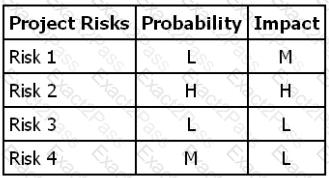
Which project risk listed in the table below is most likely to occur?
1
2
3
4
According to the PMBOK® Guide (Project Management Body of Knowledge), specifically within the Project Risk Management knowledge area and the Perform Qualitative Risk Analysis process, risks are assessed based on their probability of occurrence and their impact on project objectives.
Risk 2 (Option B): This risk has a High (H) probability of occurrence. Probability refers specifically to the likelihood that the risk will happen. Since Risk 2 is the only risk in the provided table with a " High " probability, it is the one most likely to occur compared to the others (which are Low or Medium).
Risk 1: Has a Low (L) probability.
Risk 3: Has a Low (L) probability.
Risk 4: Has a Medium (M) probability.
While the " Impact " column is used to determine the overall Risk Rating or priority (where Risk 2 would also be the highest priority because it is High/High), the specific question asks which is " most likely to occur, " which is a direct reference to the Probability metric alone.
In the PMI framework, the Perform Qualitative Risk Analysis process uses these qualitative descriptors (Low, Medium, High) to help the project manager and team prioritize which risks require the most immediate attention in the Plan Risk Responses process.
A project manager is working on the communications management plan. Which of these documents are inputs to consider?
Stakeholder engagement plan and organizational process assets
Project schedule and stakeholder register
Quality management plan and risk register
Basis of estimates and scope baseline
According to the PMBOK® Guide, the Plan Communications Management process is the process of developing an appropriate approach and plan for project communication activities based on the information needs of each stakeholder or group.
To create an effective Communications Management Plan, the project manager must consider several key inputs:
Stakeholder Engagement Plan: This is a critical input because it identifies the management strategies required to effectively engage stakeholders. Since engagement is primarily achieved through communication, the communications plan must be aligned with these strategies to ensure stakeholder needs are met.
Organizational Process Assets (OPAs): These include the organization’s established policies, procedures, and historical information. Specifically for communication, OPAs provide templates, guidelines for software/tools, and lessons learned from previous projects regarding what communication methods worked best.
Why other options are incorrect:
Option B: While the Stakeholder Register is an input to Plan Communications Management, the Project Schedule is generally considered a project document that may be referenced, but it is not a primary " input " to the creation of the communication strategy in the same way the Stakeholder Engagement Plan is.
Option C: The Quality Management Plan and Risk Register are project management plan components and project documents, respectively. While they contain information that will be communicated, they do not provide the framework for how to communicate as directly as the Stakeholder Engagement Plan does.
Option D: The Basis of Estimates and Scope Baseline are focused on cost/duration and work content. They provide the " what " of the project, but they do not inform the communication requirements or methods needed to keep stakeholders informed.
Which input to Collect Requirements is used to identify stakeholders who can provide information on requirements?
Stakeholder register
Scope management plan
Stakeholder management plan
Project charter
According to the PMBOK® Guide and the Standard for Project Management, the Stakeholder Register is the specific input to the Collect Requirements process used to identify which stakeholders are capable of providing detailed information regarding project and product requirements.
As per PMI standards, the Collect Requirements process is the process of determining, documenting, and managing stakeholder needs and requirements to meet project objectives. The Stakeholder Register is essential here because:
Identification: It contains the list of all identified stakeholders who may have an interest in or impact on the project.
Requirement Sources: It helps the project team identify " key " stakeholders who can provide information about specific requirements, including their expectations and their level of influence.
Categorization: It allows the project manager to target specific groups (e.g., end-users, sponsors, or regulators) for requirement-gathering sessions like interviews or focus groups.
The other options are incorrect based on the following PMI document definitions:
Scope management plan: This is a Planning document that describes how the scope will be defined, developed, monitored, controlled, and verified. It provides the process for collecting requirements but does not list the people (stakeholders) themselves.
Stakeholder management plan: (Now often called the Stakeholder Engagement Plan) This document identifies the management strategies and actions required to effectively engage stakeholders. While it uses the register as an input, its focus is on engagement strategy rather than being the primary list used to pull requirement sources.
Project charter: The charter is an input to Collect Requirements because it provides the high-level project description and high-level requirements. However, it does not provide the granular list of stakeholders needed to extract detailed functional or technical requirements.
As per the PMI Lexicon of Project Management Terms, the Stakeholder Register is a living document that ensures the project team remains aligned with the individuals whose needs define the project ' s success.
A project manager called for a team meeting...................method did the team use
A project manager called for a team meeting to estimate the project effort. During the session, the team went on to identify all the deliverables and analyzed the related work. Each of the analyzed deliverables were estimated. Which estimation method did the team use?
Rolling wave planning
Expert Judgement
Decomposition
Data analysis
According to the PMBOK® Guide, the technique described is a core component of both Create WBS and Estimate Activity Durations. The process of breaking down a project deliverable or a high-level project component into smaller, more manageable parts is formally known as Decomposition.
How it Works: The team starts with the final deliverables (as defined in the Scope Statement) and divides them into smaller components until the work is defined at the " work package " level.
Estimation Link: Once the work is decomposed into these smaller, specific tasks, it becomes significantly easier and more accurate for the team to provide a " bottom-up " estimate of the effort, time, and resources required for each piece.
Team Involvement: As seen in the scenario, involving the team in decomposition ensures that those who will perform the work are the ones analyzing it, leading to higher buy-in and accuracy.
Analysis of other options:
A. Rolling wave planning: This is an iterative planning technique where work to be accomplished in the near term is planned in detail, while work further in the future is planned at a higher level. While it involves decomposition, it is a strategy for when to plan, not the specific act of breaking down work to estimate effort.
B. Expert Judgement: This involves using individuals or groups with specialized knowledge. While the team members are " experts, " the method they are using to analyze the deliverables is decomposition.
D. Data analysis: This is a broad category of techniques (like Alternative Analysis or Reserve Analysis). While the team is " analyzing " work, the specific systematic breakdown of deliverables described is the definition of decomposition.
Per PMI standards, Decomposition is the essential tool used to transform high-level scope into a detailed list of activities that can be measured, scheduled, and estimated.
Which of the following is a category of organizational process assets?
Government standards
Organizational culture
Employee capabilities
Organizational knowledge bases
According to the PMBOK® Guide, Organizational Process Assets (OPAs) are the plans, processes, policies, procedures, and knowledge bases specific to and used by the performing organization. These assets influence the management of the project and are grouped into two primary categories:
Processes, Policies, and Procedures: These are usually established by the Project Management Office (PMO) or another function outside of the project. They include things like standard templates, quality policies, and change control procedures.
Organizational Knowledge Bases: These are the repositories used for storing and retrieving information. They include:
Lessons learned repositories and historical information.
Project files from previous projects (baselines, calendars, etc.).
Financial data repositories (labor hours, costs, budgets).
Configuration management knowledge bases (versions of software/hardware standards).
Issue and defect management databases.
OPAs are internal to the organization and represent a " storehouse " of experience that project managers can leverage to avoid " reinventing the wheel. "
Analysis of Other Options:
A. Government standards: These are Enterprise Environmental Factors (EEFs). They are external to the project and often the organization, representing " rules " that the project must follow rather than assets it can use.
B. Organizational culture: This is an internal Enterprise Environmental Factors (EEF). While it exists within the organization, it is considered a " condition " or " constraint " the project manager must navigate, rather than a documented process or knowledge base asset.
C. Employee capabilities: This is also an internal EEF. It refers to the existing human resources ' skills, knowledge, and specialized expertise available to the project. It is a " factor " the PM must work within.
Recognition and rewards are tools and techniques of which process?
Develop Team
Manage Team
Control Resources
Plan Resource Management
According to the PMBOK® Guide, Recognition and Rewards are specific tools and techniques used in the Develop Team process. The purpose of this process is to improve the competencies of team members, enhance their interaction, and foster a positive team environment.
Motivation and Engagement: Recognition and rewards are used to reinforce positive behaviors and performance. They are only effective if they satisfy a need which is valued by that individual.
The Reward Strategy: A good project manager plans for rewards throughout the project life cycle. Recognition can be formal or informal (e.g., a simple thank-you note versus an official award) and should be based on the achievement of specific, measurable project objectives.
Cultural Sensitivity: When applying this technique, the project manager must consider cultural differences. For example, some individuals prefer public recognition, while others may find it embarrassing and prefer a private acknowledgment.
Analysis of other options:
B. Manage Team: This process is focused on tracking team member performance, providing feedback, and resolving issues. While managing a team involves oversight, the specific mechanism for motivating through rewards is categorized under the " Development " of that team.
C. Control Resources: This process is concerned with physical resources (materials, equipment, facilities) rather than the human element of the project team.
D. Plan Resource Management: This is the planning stage where the project manager determines how to categorize and manage resources. While the reward plan might be documented here, the actual execution and use of recognition as a technique happen during the team development phase.
Per PMI standards, using Recognition and Rewards is a proactive leadership strategy within the Develop Team process to increase team member commitment and project success.
What is project management?
A logical grouping of project management inputs, outputs, tools, and techniques
Applying knowledge, skills, tools, and techniques to project activities to meet the project requirements
Launching a process that can result in the authorization of a new project
A formal, approved document that defines how the project is executed, monitored, and controlled
According to the PMBOK® Guide, Project Management is defined as the application of knowledge, skills, tools, and techniques to project activities to meet the project requirements.
Core Purpose: Project management is accomplished through the appropriate application and integration of the project management processes identified for the project. It allows organizations to execute projects effectively and efficiently.
Effective Project Management: Managing a project typically includes, but is not limited to:
Identifying requirements.
Addressing the various needs, concerns, and expectations of the stakeholders in planning and executing the project.
Setting up, maintaining, and carrying out communications among stakeholders that are active, effective, and collaborative in nature.
Managing stakeholders towards meeting project requirements and creating project deliverables.
Balancing the competing project constraints, which include, but are not limited to: Scope, Quality, Schedule, Budget, Resources, and Risk.
Analysis of Other Options:
A. A logical grouping of project management inputs...: This describes a Project Management Process. Processes are the " building blocks " that make up the practice of project management, but a single grouping does not define the entire discipline.
C. Launching a process that can result in the authorization...: This describes the Initiating Process Group or specifically the Develop Project Charter process. While a critical part of project management, it is only the starting phase.
D. A formal, approved document...: This is the definition of the Project Management Plan. This document is a primary output of the planning process and a tool for management, but it is not the definition of the practice itself.
The project manager is distributing project communications, collecting and storing project information, and retrieving documents when required. In which process is the project manager involved?
Monitor Communications
Plan Communications Management
Manage Communications
Manage Stakeholder Engagement
According to the PMBOK® Guide, the Manage Communications process is the stage where the project manager ensures that project information is collected, created, distributed, stored, retrieved, managed, controlled, and ultimately disposed of in an appropriate and timely manner.
This process is part of the Executing Process Group and focuses on the active movement of information. Key activities include:
Distribution: Getting the right information to the right stakeholders using the methods defined in the Communications Management Plan (e.g., emails, portals, or presentations).
Information Management: Ensuring that project artifacts are not just sent, but also organized and stored so they can be easily retrieved for audits, future phases, or lessons learned.
Effective Communication: Tailoring the message to the audience, including the choice of media, tone, and technical level.
Analysis of Other Options:
A. Monitor Communications: This is a Monitoring and Controlling process. Its purpose is to ensure the communication needs of the project and its stakeholders are met. It involves checking if the plan is working, rather than the act of distributing and storing the information itself.
B. Plan Communications Management: This is a Planning process. It involves developing the strategy and " rulebook " for how communications will be handled. The actual execution of that plan happens in Manage Communications.
D. Manage Stakeholder Engagement: While communication is a tool used here, this process specifically focuses on communicating and working with stakeholders to meet their needs/expectations and fostering appropriate stakeholder involvement. It is more about relationship management than the mechanical storage and retrieval of project documents.
Which of the following is an input to the Perform Qualitative Risk Analysis process?
Risk register
Risk data quality assessment
Risk categorization
Risk urgency
According to the PMBOK® Guide, the Perform Qualitative Risk Analysis process is the process of prioritizing risks for further analysis or action by assessing and combining their probability of occurrence and impact.
To conduct this analysis, the project team requires specific inputs to provide the necessary data and framework:
Risk Register: This is the primary input. The risk register is created during the Identify Risks process and contains the list of identified risks that now need to be qualified (scored) based on their probability and impact.
Risk Management Plan: Provides the roles, responsibilities, budgets, and schedule activities for risk management, as well as the definitions of probability and impact levels.
Scope Baseline: Used to evaluate the potential impact of risks on the project ' s scope and deliverables.
Organizational Process Assets: Includes data from previous, similar projects and the organization ' s risk categories.
Analysis of Other Options:
B. Risk data quality assessment: This is a tool and technique used during the process to evaluate the degree to which the data about risks is useful for risk management.
C. Risk categorization: This is a tool and technique used to group risks by their sources (e.g., using a Risk Breakdown Structure) to identify the areas of the project most exposed to uncertainty.
D. Risk urgency: This is an assessment/output criteria used during the process to identify risks that require near-term responses.
What is a deliverable-oriented, hierarchical decomposition of the work to be executed to accomplish the project objectives and create the required deliverables?
Organizational breakdown structure (OBS)
Work performance information
Work package
Work breakdown structure (WBS)
In accordance with the PMBOK® Guide and the Practice Standard for Work Breakdown Structures, the Work Breakdown Structure (WBS) is a fundamental tool used in the Create WBS process within the Scope Management knowledge area.
Definition: The WBS is a deliverable-oriented hierarchical decomposition of the total scope of work to be carried out by the project team. It organizes and defines the total scope of the project.
Hierarchical Structure: Each descending level of the WBS represents an increasingly detailed definition of the project work. The total of the work at the lowest levels must roll up to the higher levels so that nothing is left out and no extra work is performed (the 100% Rule).
Purpose: It provides a structured vision of what has to be delivered. It serves as the framework for subsequent project management processes, including cost estimating, scheduling, and risk planning.
Comparison with Other Options:
Organizational Breakdown Structure (OBS) (A): This is arranged according to an organization ' s existing departments, units, or teams, with the project activities or work packages listed under each department. It shows which department is responsible for which work.
Work Performance Information (B): This is the performance data collected from various controlling processes, analyzed in context and integrated based on relationships across areas.
Work Package (C): This is the lowest level of the WBS. While it is part of the decomposition, it is the component of the WBS, not the hierarchical structure itself.
A project manager has recently been assigned a new agile project and needs to determine an appropriate leadership style. The project manager aims to empower the team members so they feel committed and motivated to deliver value.
Which leadership style should be used for this project?
A servant leadership style
A laissez-faire leadership style
A collaborative leadership style
A directive leadership style
In Agile project management, the role of the leader shifts from " command and control " to support and facilitation. This philosophy is encapsulated in the concept of Servant Leadership.
Why Choice A is correct:
Empowerment: Servant leadership focuses on the growth and well-being of the team. By putting the team ' s needs first, the project manager empowers them to make decisions, which fosters the commitment and motivation mentioned in the prompt.
Removing Impediments: A servant leader’s primary job is to clear the path for the team—removing " roadblocks " or " impediments " —so the team can focus on delivering high-value work.
Agile Alignment: The Agile Practice Guide (developed by PMI and Agile Alliance) explicitly recommends servant leadership because it promotes self-organization and accountability, which are the engines of Agile delivery.
Characteristics: Key traits include listening, empathy, stewardship, and a commitment to the professional development of team members.
Analysis of other options:
B (Laissez-faire): This style is " hands-off, " where the leader allows the team to make all decisions without much interference or support. While it offers freedom, it lacks the proactive support and guidance a servant leader provides to help a team succeed.
C (Collaborative): While Agile leaders are collaborative, " Collaborative Leadership " is a general management term. " Servant Leadership " is the specific, recognized framework within the PMI-ACP and PMP domains for Agile projects.
D (Directive): Also known as " Autocratic, " this style involves the leader telling the team exactly what to do. This is the opposite of empowering the team and is generally ineffective in Agile environments where self-organization is required.
Key Concept: The Project Management Institute (PMI) emphasizes that in Agile, the project manager (or Scrum Master) does not manage the people, they manage the environment. By adopting a Servant Leadership style (Choice A), the leader creates a safe space for the team to experiment, learn from failure, and ultimately take ownership of the project ' s value delivery.
Which Define Activities output extends the description of the activity by identifying the multiple components associated with each activity?
Project document updates
Activity list
Activity attributes
Project calendars
In accordance with the PMBOK® Guide (Project Schedule Management), specifically within the Define Activities process, Activity Attributes serve as an extension of the activity list. While the activity list provides the names of the tasks, the activity attributes provide the detailed information required for scheduling and resource management.
Function and Components: Activity attributes identify the multiple components associated with each activity. This includes, but is not limited to:
Activity Identifiers (IDs) and codes.
Predecessor and Successor activities, including leads and lags.
Resource requirements and constraints.
Logical relationships (Finish-to-Start, Start-to-Start, etc.).
Imposed dates and assumptions.
Evolution of Detail: During the initial stages of the project, these attributes are limited. As the project progresses through Progressive Elaboration, the attributes become more detailed, providing the necessary data for the Sequence Activities and Develop Schedule processes.
Relationship to Activity List: The activity list is a documented tabulation of schedule activities, whereas the attributes provide the " meta-data " or descriptive depth for each item on that list.
Analysis of Distractors:
A. Project document updates: While the Define Activities process can result in updates to various project documents (such as the risk register), this is a general category of output and does not specifically describe the detailed components of an activity.
B. Activity list: This is a primary output of Define Activities, but it is merely a list of the schedule activities. It does not " extend the description " with multiple components in the way that the Activity Attributes do.
D. Project calendars: These are typically an output of the Develop Schedule process. They identify working days and shifts available for scheduled activities and are not a description of the activities themselves.
The individual or group that provides resources and support for a project and is accountable for success is the:
sponsor
customer
business partners
functional managers
According to the PMBOK® Guide, specifically the section on Project Stakeholders and Governance, the Sponsor plays a critical role in the project ' s lifecycle from initiation to closure.
Definition and Role: The sponsor is the person or group that provides resources and support for the project and is accountable for enabling success. They lead the project through the initiating process until it is formally authorized and serve as a primary advocate for the project within the organization.
Key Responsibilities:
Authorization: They sign the Project Charter, formally authorizing the project ' s existence.
Funding: They are responsible for ensuring the project has the necessary financial resources.
Conflict Resolution: They assist in resolving issues and or conflicts that are beyond the project manager ' s level of authority.
Strategic Alignment: They ensure the project remains aligned with the organization ' s business objectives.
Accountability: While the project manager is responsible for the day-to-day management of the project, the sponsor is ultimately accountable for the project achieving its intended business value and benefits.
Comparison with other options:
B. Customer: The customer (or user) is the individual or organization that will approve and manage the project ' s product, service, or result. While they provide requirements and feedback, they are not typically accountable for the internal project success or resource provision in the same way the sponsor is.
C. Business partners: These are external organizations that have a special relationship with the enterprise, such as providers of expertise or specific services. They support the project but do not hold the accountability for the project ' s overall success.
D. Functional managers: These individuals have management authority over an organizational unit (e.g., Department Heads). While they provide resources (staff) to the project, their primary accountability is to their own department ' s functional goals, not the specific success of an individual project.
A project veers off track due to scope creep. The project management team requests an immediate response from the major stakeholders.
What should the project manager do next to avoid project failure?
Adopt a change management approach and delay the project to decide on the direction.
Develop a focus group to face the issue and decide on the appropriate direction.
Request a meeting with top management to state concerns about their ability to handle the situation.
Delay the project by adopting a fast-fail approach, mitigating the risk of having a bigger impact on the company.
According to the PMBOK® Guide and the PMI Standard for Project Management, when a project experiences scope creep (uncontrolled expansion to product or project scope without adjustments to time, cost, and resources), the Project Manager must prioritize Stakeholder Engagement and Integration Management.
Why Choice B is correct: A focus group is a recognized data-gathering technique used to bring together stakeholders and subject matter experts to learn about their expectations and attitudes regarding a specific issue. In this scenario, since the team has already requested an immediate response from major stakeholders, organizing a focus group allows the Project Manager to facilitate a collaborative environment. This " faces the issue " directly, ensuring that the next steps are based on a consensus-driven direction, which is critical for realigning the project ' s objectives.
Analysis of other options:
A: Delaying the project to " decide on the direction " is reactive and can exacerbate costs. While change management is necessary, a blanket delay without a structured collaborative session (like a focus group) is less effective.
C: Escalating to top management by stating concerns about the team ' s " ability to handle the situation " is a defensive move that undermines the PM’s leadership and fails to address the root cause of the scope creep with the relevant stakeholders.
D: A fast-fail approach is typically used in Agile or RandD environments to see if a concept is viable. In a project already veering off track due to scope creep, intentionally delaying it further under this guise is inappropriate for recovery; the goal should be to stabilize the scope, not necessarily to fail the project.
By utilizing Tools and Techniques from the Manage Stakeholder Engagement and Scope Management processes, the Project Manager ensures that the project ' s direction is realigned with organizational goals while maintaining stakeholder buy-in.
An input to Conduct Procurements is:
Independent estimates.
Selected sellers.
Seller proposals.
Resource calendars.
According to the PMBOK® Guide (Project Procurement Management), the Conduct Procurements process is the process of obtaining seller responses, selecting a seller, and awarding a contract.
Seller Proposals are a critical input to this process. These are prepared by sellers in response to a procurement document package (like an RFP or RFQ) and form the basic information that will be used by an evaluation body to select one or more successful bidders (sellers). The proposal constitutes a formal response to the buyer ' s requirements.
Other key inputs to this process include:
Project Management Plan (specifically the Procurement Management Plan).
Procurement Documentation (Bid documents, Statement of Work).
Source Selection Criteria.
Make-or-Buy Decisions.
Analysis of Distractors:
A. Independent estimates: This is a tool and technique (specifically under Data Analysis) used during the Conduct Procurements process. The organization may prepare its own " benchmarks " to check the reasonableness of the seller proposals.
B. Selected sellers: This is a primary output of the Conduct Procurements process. Once the proposals are evaluated, the sellers are selected and contracts are awarded.
D. Resource calendars: This is an output of the Conduct Procurements process. Once a seller is contracted, the schedule and availability of their resources are documented in resource calendars to be used in the Develop Schedule process.
One of the outputs of the project schedule is a detailed plan. What is the main purpose of that detailed plan?
It represents how and when the project will deliver the products, services, and results defined in the project scope
It creates a formal record of the project and shows the organizational commitment to the project
It describes how the scope will be defined, developed, monitored, controlled and validated
It provides the needs of a stakeholder or stakeholder group
Based on the PMBOK® Guide, specifically the Develop Schedule process, the resulting schedule (the detailed plan) serves as a communication tool and a model for executing the project.
Primary Purpose (Choice A): The Project Schedule is an output of the schedule model that presents linked activities with planned dates, durations, milestones, and resources. Its core function is to provide a timeline that demonstrates how and when the project will deliver the objectives and scope defined in the project scope statement. It acts as a roadmap for the project team and a baseline for tracking progress.
Project Charter (Choice B): This description refers to the Project Charter. The charter is the document that formally authorizes the existence of a project and provides the project manager with the authority to apply organizational resources to project activities.
Scope Management Plan (Choice C): This describes the Scope Management Plan. This plan is a component of the project management plan that establishes how the scope will be defined, developed, monitored, controlled, and validated.
Requirements Documentation (Choice D): This describes Requirements Documentation, which captures the business, stakeholder, and solution requirements necessary to meet the project objectives.
The Project Schedule is distinct from the Schedule Management Plan. While the plan dictates how the schedule will be managed, the schedule itself (the output of Develop Schedule) provides the specific dates and sequences required for delivery.
A project manager is assigned to a project during the execution phase and consults the documents created by the previous project manager.
Which document should the project manager study to identify the ownership of the project outcome?
The lessons learned repository
The project charter
The business case
The organizational plan
In the PMBOK® Guide, the Project Charter is the foundational document that formally authorizes the existence of a project and provides the project manager with the authority to apply organizational resources to project activities.
Why Choice B is correct:
Authorization and Accountability: The charter explicitly identifies the Project Sponsor (the person or group providing the resources and " owning " the outcome from a high-level perspective) and the Project Manager.
Project Objectives: It defines the " success criteria " and the measurable objectives. To understand who is ultimately responsible for accepting the project outcome, one must look at who signed the charter and who is listed as the primary authority.
Scope and Authority: It establishes the boundaries of the project and names the key stakeholders who have the power to approve or reject the final deliverables.
Continuity: When a new project manager takes over during the execution phase, the Charter serves as the " Source of Truth " to understand the project ' s original intent and governance structure.
Analysis of other options:
A (The lessons learned repository): This is a database used to store historical information from previous projects or earlier phases of the current project. While it helps avoid past mistakes, it does not define the legal or organizational " ownership " of the current project’s results.
C (The business case): This document provides the financial justification and the " Why " behind the project. While it mentions the benefits to the organization, it is a pre-project document that describes the value proposition rather than the specific ownership/governance structure of the project team and outcomes.
D (The organizational plan): This is a generic term that could refer to a company ' s strategic plan or a resource management plan. It does not specifically name the owners of a specific project ' s deliverables.
Key Concept: The Project Management Institute (PMI) emphasizes that the Project Charter (Choice B) is the " contract " between the performing organization and the project team. It bridges the gap between the high-level business goals (Business Case) and the detailed planning documents, making it the primary reference for identifying the hierarchy of ownership and authority.
In an agile and adaptive project, which scope management entity invokes stakeholder engagement?
Collect Requirements
Create work breakdown structure (WBS)
Plan Scope Management
Scope Baseline
According to the PMBOK® Guide and the Agile Practice Guide, the Collect Requirements process is the primary bridge between the project team and the stakeholders regarding the project ' s scope.
Active Engagement: This process is inherently collaborative. It requires the project manager and team to use interpersonal and team skills (such as facilitation, observation, and conflict management) and data gathering techniques (interviews, focus groups, and workshops) to draw out stakeholder needs.
Agile Context: In an agile/adaptive environment, this engagement is continuous. Rather than a single event at the beginning of the project, requirements are collected and refined throughout the project via backlogs and frequent reviews. The Stakeholder Engagement is invoked because the team cannot define the " Definition of Ready " or " Definition of Done " without direct, ongoing input from the stakeholders.
Requirements Traceability: By engaging stakeholders here, the project manager ensures that the requirements reflect actual business needs, which are then documented in the Requirements Traceability Matrix (RTM) or the Product Backlog.
Analysis of Other Options:
B. Create work breakdown structure (WBS): While stakeholders might review a WBS, the actual creation is a technical decomposition process performed by the project team. The initial " invocation " of engagement happens during the identification of the requirements that populate the WBS.
C. Plan Scope Management: This is a planning process that creates the manual for how scope will be handled. It defines the processes, but the active, hands-on engagement with the broader stakeholder group occurs during the collection of the requirements themselves.
D. Scope Baseline: This is an output (comprising the Scope Statement, WBS, and WBS Dictionary). It is a static document/approval point, not a process that " invokes " engagement.
Reserve analysis is a tool and technique used in which process?
Plan Risk Management
Plan Risk Responses
Identify Risks
Control Risks
According to the PMBOK® Guide (Project Risk Management), Reserve Analysis is a specific Data Analysis tool and technique used during the process of monitoring and controlling risks.
The purpose of Reserve Analysis in this context is to compare the amount of contingency reserves remaining to the amount of risk remaining at any given time in the project. This ensures that the reserve is adequate to cover the outstanding risks.
Contingency Reserves: These are funds or time set aside to address " known-unknowns " (identified risks).
Management Reserves: These are for " unknown-unknowns " and are generally not part of the cost baseline but are part of the total project budget.
Throughout the project, as risks occur, some contingency reserves are used. Conversely, if risks do not occur or are closed out, the associated reserves may be released. Reserve Analysis helps the project manager determine if the remaining budget is sufficient for the remaining risk profile.
Analysis of Distractors:
A. Plan Risk Management: This process focuses on defining the methodology for risk activities. It does not involve calculating or analyzing specific reserves.
B. Plan Risk Responses: While this process involves determining the amount of contingency reserve needed for specific response strategies, the " Analysis " of those reserves against actual project performance occurs during the monitoring/control phase.
C. Identify Risks: This process is dedicated to discovering which risks might affect the project and documenting their characteristics. It precedes the allocation and analysis of reserves.
Which subsidiary management plan.... during the project ilfe cycle?
Which Subsidiary management plan would a project manager create to manage Information dissemination during the project life cycle?
Stakeholder Engagement Plan
Quality Management Plan
Communications Management Plan
Scope Management Plan
According to the PMBOK® Guide, specifically the Plan Communications Management process, the project manager must develop an appropriate approach and plan for project communication activities based on stakeholders’ information needs and requirements.
Communications Management Plan (Choice C): This is the specific subsidiary management plan that describes how, when, and by whom information about the project will be administered and disseminated. It covers the " who, what, when, where, why, and how " of information flow. Key elements of this plan include information distribution frequencies, methods (email, meetings, portals), and the person responsible for communicating specific information.
Stakeholder Engagement Plan (Choice A): While closely related, this plan focuses on the strategies to involve stakeholders and manage their expectations. It identifies the " why " and " how " of engagement, whereas the Communications Management Plan focuses on the actual dissemination of the project information itself.
Quality Management Plan (Choice B): This plan describes how the project management team will implement the organization ' s quality policy. It focuses on standards, metrics, and quality control/assurance, not information dissemination.
Scope Management Plan (Choice D): This plan describes how the scope will be defined, developed, monitored, controlled, and validated. It does not deal with the communication of project status or general info dissemination.
The Communications Management Plan is vital for ensuring that the right message reaches the right audience at the right time through the most effective channel, thereby minimizing misunderstandings and ensuring transparency throughout the project life cycle.
What is the key benefit of the Monitor Stakeholder Engagement process?
Ensures that the informational needs of the project and its stakeholders are met through implementation and the development of artifacts
Ensures that the project includes all the work required and only the work required—to complete the project successfully
Increases the probability and/or impact of positive risks, and decreases the probability and/or Impact of negative risks or issues
Maintains or increases the efficiency and effectiveness of stakeholder engagement activities as the project evolves
According to the PMBOK® Guide, Monitor Stakeholder Engagement is the process of monitoring project stakeholder relationships and tailoring strategies for engaging stakeholders through the modification of engagement strategies and plans.
The Key Benefit: The primary value of this process is that it allows the project manager to maintain or increase the efficiency and effectiveness of stakeholder engagement activities. As a project progresses through its lifecycle, the stakeholder community changes, and their interest or influence may shift. This process ensures that the engagement strategies remain relevant and effective in the face of these changes.
Process Nature: This is a Monitoring and Controlling process. It involves comparing actual stakeholder engagement against the planned engagement (as documented in the Stakeholder Engagement Plan) and taking corrective action if there is a variance.
Analysis of other options:
Option A: This describes the key benefit of the Manage Communications or Monitor Communications process, which focuses specifically on the flow of information and meeting informational needs.
Option B: This is the definition of the key benefit of Project Scope Management. It focuses on work containment, not stakeholder relationships.
Option C: This describes the key benefit of Project Risk Management, specifically the Plan Risk Responses and Implement Risk Responses processes.
Per PMI standards, while " Managing " engagement is about doing the activities, " Monitoring " engagement is about evaluating the results of those activities and adjusting the approach to ensure stakeholders remain supportive and project-aligned.
The activity tailoring is necessary because:
the members of the project team need to select the appropriate order of every tool, technique, input, and output listed in the PMBOK Guide, this is required for all projects
each project is unique, and the members of the project team should select the appropriate tools, techniques, inputs, and outputs from the PMBOK Guide
the members of the project team need to understand the PMBOK Guide processes, which are applied to all projects
each project is unique, and the project team must plain how to apply all the tools, techniques, inputs, and outputs in the PMBOK Guide
According to the PMBOK® Guide, Tailoring is the deliberate adaptation of the selected project management processes, inputs, tools, techniques, outputs, and life cycle phases to make them fit the specific environment and the work of the project.
Uniqueness of Projects: Every project is unique due to its specific objectives, stakeholders, complexity, risks, and organizational context. Because of this, it is neither practical nor efficient to use every single process or tool described in the PMBOK Guide for every project.
Team Responsibility: It is the responsibility of the project manager and the project management team to select only what is necessary to manage the project effectively. This prevents " over-management " and ensures that project resources are focused on activities that add value.
Framework vs. Methodology: The PMBOK Guide is a global standard and framework, not a rigid methodology. It provides a " menu " of best practices from which the team must choose based on the project’s needs.
Why other options are incorrect:
Option A: Tailoring is not about selecting a specific " order " for every single item in the guide for every project; it is about deciding what to include and what to exclude.
Option C: While the team needs to understand the processes, simply " understanding " them does not explain why tailoring is necessary. Furthermore, the processes are not applied to all projects in the same way.
Option D: This is incorrect because the team should not apply all tools, techniques, inputs, and outputs. Applying everything would result in unnecessary bureaucracy and wasted effort. Tailoring is the act of omitting unnecessary elements just as much as it is about selecting necessary ones.
An output of the Manage Stakeholder Engagement process is:
change requests
enterprise environmental factors
the stakeholder management plan
the change log
According to the PMBOK® Guide (Project Stakeholder Management), the Manage Stakeholder Engagement process is the process of communicating and working with stakeholders to meet their needs/expectations, address issues as they occur, and foster appropriate stakeholder engagement in project activities throughout the project life cycle.
A primary output of this process is Change Requests. As the project manager interacts with stakeholders, their needs or expectations may evolve, or issues may be identified that require modifications to the project ' s scope, schedule, or budget. These requests are processed through the Perform Integrated Change Control process for approval or rejection.
Other key outputs include:
Project Management Plan Updates (specifically the Communications Management Plan and Stakeholder Engagement Plan).
Project Document Updates (such as the Change Log, Issue Log, Lessons Learned Register, and Stakeholder Register).
Analysis of Distractors:
B. enterprise environmental factors: These are typically inputs to the process (e.g., organizational culture, personnel administration) rather than outputs produced by managing engagement.
C. the stakeholder management plan: This is the primary output of the Plan Stakeholder Engagement process. While it may be updated during Manage Stakeholder Engagement, the document itself is created during the planning phase.
D. the change log: The Change Log is an input to this process. It is used to communicate to stakeholders which changes have been approved, deferred, or rejected. While it might be updated as an output, " Change Requests " is the more definitive output when new requirements or adjustments arise from stakeholder interaction.
Which conflict resolution technique searches for solutions that bring some degree of satisfaction to all parties in order to temporarily or partially resolve the conflict?
Force/direct
Withdraw/avoid
Compromise/reconcile
Collaborate/problem solve
In accordance with the PMBOK® Guide (Project Resource Management), specifically within the Develop Team and Manage Team processes, conflict management is a key tool and technique. There are five general techniques used to resolve conflict, each with a different impact on the relationship and the result.
Compromise/Reconcile is defined by the following characteristics:
Nature of the Solution: It involves searching for solutions that bring some degree of satisfaction to all parties.
Outcome: Because each party is required to give up something, it often results in a " lose-lose " or " partially win-partially win " scenario.
Resolution Duration: This technique is often used to temporarily or partially resolve the conflict. It is a middle-ground approach that may not address the underlying root cause but allows the project to move forward in the short term.
Context: It is typically used when the parties have equal power, when a temporary settlement is needed for a complex issue, or when a quick solution is required under time pressure.
Analysis of Distractors:
A. Force/direct: This is a " win-lose " approach where one ' s viewpoint is pushed at the expense of others. It offers a hard-fast solution but often results in resentment and is not aimed at the satisfaction of all parties.
B. Withdraw/avoid: This involves retreating from an actual or potential conflict situation or postponing the issue to be better prepared or to be resolved by others. It does not provide satisfaction to the parties involved.
D. Collaborate/problem solve: This is the preferred technique in most project situations. It incorporates multiple viewpoints and insights from differing perspectives and requires a cooperative attitude and open dialogue that typically leads to consensus and long-term commitment. Unlike compromise, it aims for a " win-win " solution.
What is the primary purpose of Project Scope Management?
Determining and managing stakeholder needs
Contorting the status of the product scope and managing changes to its be seine
Defining and controlling what is and is not included in the project
Differentiating between the product scope and project scope
According to the PMBOK® Guide, the primary purpose of Project Scope Management is to ensure that the project includes all the work required, and only the work required, to complete the project successfully.
Defining Boundaries: This knowledge area is primarily concerned with defining and controlling what is and is not included in the project. By establishing clear boundaries, the project manager prevents " Scope Creep, " which is the unauthorized expansion of the project scope without adjustments to time, cost, and resources.
Work Containment: It focuses on managing the project ' s perimeter. This involves the creation of a Project Scope Statement, the Work Breakdown Structure (WBS), and the WBS Dictionary, which collectively form the Scope Baseline.
Analysis of other options:
Option A: Determining and managing stakeholder needs is a part of the Collect Requirements process. While it is a process within Scope Management, it is not the overarching purpose of the entire knowledge area.
Option B: This likely contains a typo (intended to be " Controlling " ). While controlling the status and managing changes is part of the Control Scope process, it is a subset of the primary goal of defining the scope in the first place.
Option D: While the knowledge area does differentiate between product scope (features/functions) and project scope (work to be done), this differentiation is a requirement for successful management, not the primary purpose of the management itself.
Per PMI standards, effective Scope Management provides the foundation for schedule and cost estimates. If the project manager does not clearly define what is out of scope, the project risks failure due to uncontrolled growth and resource exhaustion.
A project team is brainstorming about the best methods and practices to adopt for an upcoming project. What is the project team trying to follow?
Portfolios
Standards
Concepts
Programs
According to the PMBOK® Guide, the selection of specific methods, practices, and guidelines is a foundational step in project governance. When a team discusses " best methods and practices, " they are aligning their work with established benchmarks.
Why Choice B is correct:
Standards: In a professional project management context, a standard is a document established by authority, custom, or general consent as a model or example. Examples include the PMI Global Standards or ISO standards.
Consistency: By adopting specific standards, the team ensures that their project management processes are consistent, repeatable, and high-quality. This includes choosing between predictive (Waterfall), adaptive (Agile), or hybrid frameworks based on industry " best practices. "
Benchmarking: Standards provide the metrics against which the project ' s performance and the team ' s professional conduct will be measured.
Analysis of other options:
A (Portfolios): A portfolio is a collection of projects, programs, and operations managed as a group to achieve strategic objectives. While the team works within a portfolio, they don ' t " follow " a portfolio to determine their internal team practices.
C (Concepts): Concepts are abstract ideas or general notions. While brainstorming involves conceptual thinking, a project team seeks to implement concrete standards and methodologies to ensure project delivery, not just stay at the conceptual level.
D (Programs): A program is a group of related projects managed in a coordinated way to obtain benefits not available from managing them individually. Like portfolios, a program is a structural container for the project, not a set of " best methods and practices " that the team adopts for their specific workflow.
Key Concept: The Project Management Institute (PMI) emphasizes Tailoring as a key competency. A project team reviews organizational and industry Standards (Choice B) and then " tailors " them to fit the specific needs, constraints, and environment of the project. This ensures that the team isn ' t " reinventing the wheel " but is instead standing on the shoulders of proven professional methodologies.
Who defines the scope of the product
The client
The project manager
The team
The program manager
In accordance with the PMBOK® Guide, particularly within the Collect Requirements and Define Scope processes, the definition of the product scope is fundamentally driven by the customer ' s needs and expectations.
The Client/Customer (Choice A): The client is the primary stakeholder who defines the requirements and the ultimate scope of the product. They provide the business need and the functional/non-functional requirements that the project is intended to fulfill. While the project team facilitates the discovery and documentation of these requirements, the " what " of the product—its features and functions—is defined by the client.
The Project Manager (Choice B): The PM is responsible for managing the project scope (the work required to deliver the product). While the PM facilitates the Define Scope process and ensures the scope statement is documented, they do not " define " the product features; they translate the client ' s needs into a manageable plan.
The Team (Choice C): The project team (or technical experts) provides input on the technical feasibility and the " how " of the product. In Agile environments, the team may help refine the backlog, but the direction of the product scope remains with the customer or their representative (the Product Owner).
The Program Manager (Choice D): A program manager provides high-level oversight and ensures strategic alignment across multiple related projects. They are too far removed from individual project deliverables to define the specific product scope.
The Product Scope refers to the features and functions that characterize a product, service, or result. Its successful completion is measured against the product requirements, which are owned and defined by the Client.
Who, along with the project manager, is supposed to direct the performance of the planned project activities and manage the various technical and organizational interfaces that exist within the project?
The customer and functional managers
The risk owners and stakeholders
The sponsors and stakeholders
The project management team
According to the PMBOK® Guide, specifically within the Direct and Manage Project Work process, the execution of the project is a collaborative effort led by the Project Manager but supported by a specific core group.
The Project Management Team: This is a subset of the overall project team. It includes the Project Manager and any individuals who assist the PM in management activities, such as scheduling, budgeting, and technical leadership.
Directing Performance: While the Project Manager is ultimately accountable, the Project Management Team shares the responsibility for directing the performance of planned activities. They ensure that the technical work meets the project requirements and that the organizational interfaces (the " touchpoints " between different departments or groups) are managed smoothly.
Management of Interfaces:
Technical Interfaces: Coordination between different technical disciplines (e.g., ensuring the software team and hardware team are aligned).
Organizational Interfaces: Coordination between different units within the performing organization (e.g., Finance, HR, and Legal).
Process Context: This activity occurs during the Executing Process Group. The inputs are the Project Management Plan and approved change requests, and the primary focus is on performing the work defined in the plan to achieve the project ' s objectives.
Comparison with other options:
A. The customer and functional managers: While functional managers provide resources and customers provide requirements, they do not " direct the performance of planned project activities " on a day-to-day basis. That is an internal management function.
B. The risk owners and stakeholders: Risk owners are responsible for specific risk responses, and stakeholders are anyone affected by the project. They do not collectively manage the technical and organizational interfaces of the project execution.
C. The sponsors and stakeholders: The sponsor provides financial resources and support (and may help resolve high-level " political " interfaces), but they are not involved in the direct management of technical project activities.
What type of stakeholder is part of a project manager ' s sphere of influence on a project?
Customers
Sponsors
Directors
Resource managers
According to the PMBOK® Guide, a project manager ' s Sphere of Influence is described as a set of relationships that the project manager develops and maintains to help satisfy the project ' s requirements.
While the project manager interacts with many stakeholders (including customers and sponsors), the specific category of stakeholders within the internal organization that a project manager must influence to obtain and manage personnel and physical resources is the Resource managers.
The Project Manager ' s Sphere of Influence: This model categorizes stakeholders into distinct circles.
The innermost circle is the Project Team.
The next circle includes Project Managers, Resource Managers, and Functional Managers. These are individuals the project manager must influence directly to ensure the team has the necessary skills and tools.
The outer circles include the Sponsor, Governing Bodies, Customers, and Users.
Analysis of other options:
Customers (Option A): These are typically external stakeholders (or internal to the business but external to the project team) who provide requirements and accept deliverables. While the PM interacts with them, they are generally in the outer rim of the influence model.
Sponsors (Option B): The sponsor is at a higher level of authority. The project manager works with the sponsor, but the sponsor typically influences the project manager and the organization ' s executives more than the PM influences them directly in a daily operational sense.
Directors (Option C): Directors are part of senior management or governing bodies. Similar to the sponsor, they provide oversight and strategic direction rather than being part of the PM ' s immediate, day-to-day functional influence network.
Per PMI standards, mastering the ability to influence Resource managers is essential for a project manager, especially in matrix organizations where the PM does not have direct authority over the staff.
The process of prioritizing risks for further analysis or action is known as:
Plan Risk Management.
Plan Risk Responses.
Perform Qualitative Risk Analysis.
Perform Quantitative Risk Analysis.
In accordance with the PMBOK® Guide (Project Risk Management), Perform Qualitative Risk Analysis is the process of prioritizing individual project risks for further analysis or action by assessing their probability of occurrence and impact as well as other characteristics.
Objective: The key benefit of this process is that it focuses efforts on high-priority risks. It is a subjective evaluation that allows project managers to reduce the level of uncertainty and focus on the risks that matter most.
Tools and Techniques: This process typically uses a Probability and Impact Matrix to rank risks into categories such as low, medium, or high. It may also consider other factors like urgency, proximity, and dormancy.
Frequency: Since it is a relatively quick and cost-effective way to prioritize risks, it is performed regularly throughout the project life cycle as new risks emerge or existing risks change.
Outcome: The primary output is an update to the Risk Register, specifically identifying the priority or " ranking " of each risk, which then dictates whether a risk requires a full quantitative analysis or moves straight to response planning.
Analysis of Distractors:
A. Plan Risk Management: This is the process of defining how to conduct risk management activities. it establishes the " rules of engagement " but does not actually analyze or prioritize specific risks.
B. Plan Risk Responses: This process occurs after prioritization. It involves developing options and actions to enhance opportunities and reduce threats. You cannot effectively plan responses until you know which risks are the highest priority.
D. Perform Quantitative Risk Analysis: This is the process of numerically analyzing the combined effect of identified individual project risks and other sources of uncertainty on overall project objectives. While it provides more detail, the initial prioritization of risks is the specific function of the Qualitative process.
It you established a contingency reserve including time, money, and resources, how are you handling risk?
Accepting
Transferring
Avoiding
Mitigating
According to the PMBOK® Guide, the strategy of establishing a contingency reserve is the hallmark of Active Risk Acceptance. Risk strategies are categorized based on how the project team chooses to address a specific threat.
Risk Acceptance: This strategy is used when the project team decides not to change the project management plan to deal with a risk, or is unable to identify any other suitable response strategy.
Passive Acceptance: Requires no action except periodic review of the threat.
Active Acceptance: The most common approach, which involves establishing a contingency reserve, including amounts of time, money, or resources, to handle the threat if it occurs.
Contingency Reserves: These are specifically allocated for " known-unknowns " —risks that have been identified and analyzed, and for which a response has been developed. These reserves are part of the cost baseline and the schedule baseline.
The Logic: By setting aside a reserve, you aren ' t trying to stop the risk (Avoid), reduce its impact before it happens (Mitigate), or give the risk to someone else (Transfer). You are simply saying, " If this happens, we have the budget/time set aside to deal with it. "
Analysis of Other Options:
B. Transferring: This involves shifting the impact and ownership of a threat to a third party (e.g., insurance, performance bonds, or warranties). It almost always involves paying a risk premium to the party taking on the risk.
C. Avoiding: This involves changing the project management plan to eliminate the threat entirely. Examples include extending the schedule, changing the strategy, or reducing scope to remove the risk element.
D. Mitigating: This involves taking action to reduce the probability of occurrence or the impact of a threat. While mitigation often costs money (like adding redundant components), it is a proactive step to make the risk less likely or less severe, rather than just setting aside money to pay for it if it happens.
Conflict should be best addressed in which manner?
Early, in private, using a direct, collaborative approach
Early, in public, using an indirect, collaborative approach
Early, in private, using an indirect, cooperative approach
As late as possible, in public, using a direct, confrontational approach
According to the PMBOK® Guide, specifically within the Manage Project Team process, conflict management is a key tool and technique. Conflict is inevitable in a project environment, but how it is handled determines whether it becomes a functional or dysfunctional force.
Timing (Early): Conflicts should be addressed early. Proactive management prevents minor disagreements from escalating into major issues that could impact team morale, productivity, and the project schedule.
Setting (In Private): As a general rule, conflict should be addressed in private. Handling disagreements away from the larger group or stakeholders protects the professional reputation of the individuals involved and fosters a safer environment for honest communication.
Approach (Direct/Collaborative): The most effective method for long-term resolution is a direct, collaborative approach (also known as the Problem Solving or Confronting technique). This involves treating the conflict as a problem to be solved, examining alternatives, and requiring a " give-and-take " attitude from all parties to reach a consensus.
Analysis of other choices:
Choice B (Early, in public, using an indirect, collaborative approach): While " early " and " collaborative " are positive, " in public " is generally discouraged as it can lead to defensiveness, embarrassment, and a breakdown in team trust.
Choice C (Early, in private, using an indirect, cooperative approach): " Indirect " or " cooperative " (often associated with Smoothing or Accommodating) may provide temporary relief but often fails to address the root cause of the conflict, leading to the issue resurfacing later.
Choice D (As late as possible, in public, using a direct, confrontational approach): This is the least desirable method. Waiting " as late as possible " allows the conflict to fester, while " public " and " confrontational " (associated with Forcing) usually results in a win-lose situation that damages long-term team dynamics.
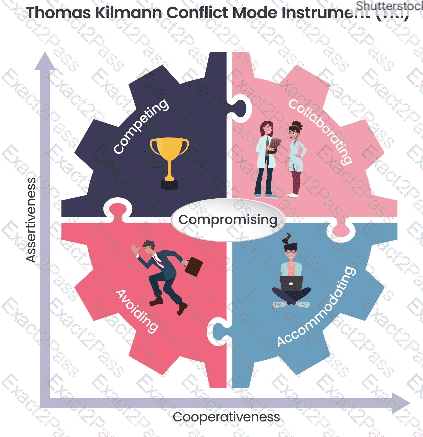
Which risk response strategy is common for both positive and negative risks?
Share
Accept
Mitigate
Transfer
According to the PMBOK® Guide, specifically the Plan Risk Responses process, risks are categorized into threats (negative risks) and opportunities (positive risks). While most strategies are unique to the type of risk, Acceptance is the only strategy used for both.
Acceptance (General): This strategy is adopted when the project team decides not to change the project management plan to deal with a risk, or is unable to identify any other suitable response strategy.
Passive Acceptance: Requires no action other than documenting the strategy and periodically reviewing the risk to ensure it has not changed significantly.
Active Acceptance: The most common approach, which involves establishing a contingency reserve, including amounts of time, money, or resources to handle the risk if it occurs.
In Threats: You accept the risk because the cost of other responses (like Transfer or Mitigate) outweighs the potential impact, or the risk is very low priority.
In Opportunities: You accept the opportunity without actively pursuing it, but you are prepared to take advantage of it if it happens to occur.
Analysis of Other Options:
A. Share: This is a strategy used exclusively for opportunities (positive risks). It involves allocating some or all of the ownership of the opportunity to a third party who is best able to capture the benefit.
C. Mitigate: This is a strategy used exclusively for threats (negative risks). It aims to reduce the probability of occurrence or the impact of a risk. The equivalent for opportunities is Enhance.
D. Transfer: This is a strategy used exclusively for threats (negative risks). It involves shifting the impact and ownership of a threat to a third party (e.g., insurance). The equivalent for opportunities is Share.
A project is in the planning phase and ready for plan review and approval when a sponsor switch happens. What should the next course of action be?
Plan Communications Management
Plan Stakeholder Engagement
Perform Integrated Change Control
Perform Qualitative Risk Analysis
According to the PMBOK® Guide, specifically within the Project Stakeholder Management and Planning Process Group, the arrival of a new project sponsor represents a significant change in the project ' s stakeholder landscape.
Why Choice B is correct: The Project Sponsor is a key stakeholder who provides resources, support, and is responsible for the project ' s success. When a sponsor switch occurs during the planning phase, the Project Manager must immediately update the Stakeholder Register and then Plan Stakeholder Engagement. This process involves developing approaches to involve the new sponsor based on their specific needs, interests, and potential impact on project success. Since the project is ready for plan review and approval, the Project Manager must ensure the new sponsor ' s expectations are aligned with the existing plans before proceeding.
Analysis of other options:
A (Plan Communications Management): While communication is vital, it is a subset of engagement. You must first understand the new sponsor ' s engagement needs (Choice B) to determine what, when, and how to communicate.
C (Perform Integrated Change Control): This process is used to review all change requests and approve changes to deliverables or project documents. While the sponsor has changed, " Perform Integrated Change Control " is usually triggered by a formal request to change a baseline. The immediate human/relational requirement is to plan for the new stakeholder ' s engagement.
D (Perform Qualitative Risk Analysis): A new sponsor is a risk/opportunity, but the primary action in the planning phase when a key stakeholder enters is to address their engagement strategy to ensure the project plan gains their approval.
The Project Manager should treat the new sponsor as a critical addition to the project and use the Stakeholder Engagement Assessment Matrix to bridge any gaps between the new sponsor’s current level of engagement and the level required for successful plan approval.
Which cost is associated with nonconformance?
Liabilities
Inspections
Training
Equipment
In accordance with the PMBOK® Guide (Project Quality Management), the Cost of Quality (COQ) is divided into two main categories: Cost of Conformance and Cost of Nonconformance.
Cost of Nonconformance (also known as failure costs) refers to the money spent during and after the project because of failures. This is further subdivided into:
Internal Failure Costs: Failures found by the project team before the product is released to the customer (e.g., scrap, rework).
External Failure Costs: Failures found by the customer after the product is released. Liabilities, warranty claims, lost business, and repairs fall under this category. These are particularly damaging as they can lead to legal costs and a damaged organizational reputation.
Analysis of Distractors:
B. Inspections: This is a Cost of Conformance, specifically an Appraisal Cost. It is the money spent to assess quality and uncover errors before they reach the customer.
C. Training: This is a Cost of Conformance, specifically a Prevention Cost. It is an investment made to ensure the team has the skills to do the work right the first time, thereby preventing defects.
D. Equipment: Costs associated with the equipment needed to perform the work correctly or to test the product (e.g., specialized testing hardware) are generally considered Prevention or Appraisal costs, which fall under the category of Conformance.
Which of the following includes how requirements activities will be planned, tracked, and reported?
Configuration management plan
Scope baseline
Requirements management plan
Schedule baseline
According to the PMBOK® Guide, the Requirements Management Plan is a subsidiary component of the Project Management Plan that describes how requirements will be analyzed, documented, and managed throughout the project lifecycle.
Core Functions: This plan specifically establishes the processes for:
Planning: How requirements activities will be initiated and structured.
Tracking: How requirements will be monitored and their status recorded.
Reporting: How the progress of requirement collection and validation will be communicated to stakeholders.
Key Components: It often includes:
Configuration management activities (how changes will be initiated and impacts analyzed).
Requirements prioritization process.
The Requirements Traceability Matrix (RTM) structure.
Metrics to be used and the rationale for using them.
Analysis of Other Options:
A. Configuration management plan: This plan focuses on how information about the items of the project (and the items themselves) is recorded and updated so that the product, service, or result remains consistent. While related to requirements, it is not the primary document for planning requirements activities.
B. Scope baseline: This is the approved version of the scope statement, WBS, and WBS dictionary. It is used to compare actual results against the planned scope, but it does not define the process of how requirements are tracked or reported.
D. Schedule baseline: This is the approved version of the project schedule. It is used for measuring schedule performance and has no direct role in defining the methodology for managing requirements.
Which technique helps to determine the risks that have the most potential impact on a project?
Cost risk simulation analysis
Expected monetary value analysis
Modeling and simulation
Sensitivity analysis
In accordance with the PMBOK® Guide, specifically within the Perform Quantitative Risk Analysis process, Sensitivity Analysis is the primary technique used to determine which risks have the most potential impact on the project.
Mechanism: Sensitivity analysis helps to determine which risks have the most potential impact on the project by examining the extent to which the uncertainty of each project element affects the objective being studied when all other uncertain elements are held at their baseline values.
The Tornado Diagram: The typical display for this analysis is a Tornado Diagram. This bar chart is used to compare the relative importance and variables that have a high degree of uncertainty to those that are more stable. The variables are ranked by the width of the spread, with the " widest " bars (most sensitive) at the top and the " narrowest " at the bottom, giving it a funnel or tornado shape.
Application: It is particularly useful for prioritizing risks where a small change in a single variable (like the cost of a specific raw material) could result in a massive deviation in the overall project budget or schedule.
Comparison with Other Options:
Cost risk simulation analysis (A): This is a broader application of modeling (like Monte Carlo) to see the total potential cost of the project, but it doesn ' t isolate the individual risk with the most impact as clearly as sensitivity analysis.
Expected monetary value analysis (B): EMV ($EMV = P \times I$) is a statistical concept that calculates the average outcome when the future includes scenarios that may or may not happen. It is often used in Decision Tree Analysis.
Modeling and simulation (C): This is the overarching category (including Monte Carlo) that uses a model to translate specified uncertainties of the project into their potential impact on project objectives. Sensitivity analysis is a specific type of modeling used for prioritization.
Which procurement management process includes obtaining seller response, seller selection, and contract awarding?
Plan Procurement
Manage Procurement
Conduct Procurements
Perform Procurement
According to the PMBOK® Guide, the process of obtaining seller responses, selecting a seller, and awarding a contract is defined as Conduct Procurements.
Obtaining Seller Responses: This involves activities such as holding bidder conferences and receiving bids or proposals from prospective providers.
Seller Selection: During this stage, the project team applies evaluation criteria to the proposals received to select one or more sellers who are qualified to perform the work and provide the best value.
Contract Awarding: This is the final step of the process where negotiations are completed, and a formal written contract is signed by both the buyer and the seller.
Why other options are incorrect:
Option A: Plan Procurement: This is the initial planning process where the team decides what to buy, how to buy it, and identifies potential sellers. It documents the procurement approach but does not involve active selection or awarding.
Option B: Manage Procurement: While " Control Procurements " is a formal process for managing the relationship and contract performance, " Manage Procurement " is not the standard PMI term for the execution phase where sellers are selected.
Option D: Perform Procurement: This is not a formal process name within the PMI Project Procurement Management knowledge area. The execution-phase process is strictly titled Conduct Procurements.
Development of the benefits management plan occurs in which stage of the project life cycle?
Starting the project
Organizing the project
Completing pre-project work
Executing the product
According to the PMBOK® Guide, the Project Benefits Management Plan is a key business document that is developed before the project is officially initiated. It describes how and when the benefits of the project will be delivered and establishes the mechanisms to measure those benefits.
Pre-Project Work: The Benefits Management Plan, along with the Project Business Case, are considered " Business Documents. " These are generally created during the pre-project phase (often by a business analyst and project sponsor) to justify the investment and provide a basis for the Project Charter.
Purpose: It outlines the target benefits (e.g., increased market share, improved efficiency), the alignment with strategic goals, the timeframe for realizing benefits (short-term vs. long-term), and the " benefit owner " who will be responsible for monitoring them after the project is closed.
Ownership: While the project manager may provide input or help maintain the document, the ultimate responsibility for the benefits management plan often lies with the organization or the sponsor, as many benefits are realized long after the project ' s physical deliverables are completed.
Why other options are incorrect:
Option A: Starting the project: This stage involves the creation of the Project Charter. By the time you are starting the project, the Benefits Management Plan should already exist as an input to help define the project ' s success criteria.
Option B: Organizing the project: This refers to the Planning phase. During this stage, the project manager develops the Project Management Plan. The Benefits Management Plan is an input to this process, not an output developed during it.
Option C: Executing the product: Execution focuses on creating the project ' s deliverables. While the project manager monitors the project to ensure it remains aligned with the intended benefits, the development of the plan occurred much earlier.
What causes replanning of the project scope?
Project document updates
Project scope statement changes
Variance analysis
Change requests
In accordance with the PMBOK® Guide, specifically within the Monitor and Control Project Work and Perform Integrated Change Control processes, Change requests are the primary drivers for replanning.
Mechanism of Action: When a change request is submitted and subsequently approved by the Change Control Board (CCB) or the Project Manager, it often necessitates modifications to the project management plan. This includes updating the scope baseline, schedule baseline, and cost baseline.
The Workflow:
A deviation is identified or a new requirement is requested.
A Change Request (Output of many monitoring/controlling processes) is generated.
Once approved, the change request becomes an Input to the Direct and Manage Project Work and Plan processes, triggering the " replanning " cycle to incorporate the new scope.
Comparison with Other Options:
Project document updates (A): These are the result of the change process, not the initial cause of the replanning.
Project scope statement changes (B): Similar to option A, the scope statement is a document. You don ' t change the document to cause replanning; you process a change request which then updates the document.
Variance analysis (C): This is a tool and technique used to identify that a change or replanning might be necessary, but the analysis itself does not authorize or cause the replanning; the subsequent change request does.
Work performance information and cost forecasts are outputs of which Project Cost Management process?
Estimate Costs
Plan Cost Management
Determine Budget
Control Costs
According to the PMBOK® Guide, the Control Costs process is the process of monitoring the status of the project to update the project costs and managing changes to the cost baseline.
Work Performance Information (WPI): In the Control Costs process, work performance data (raw observations) is collected and compared against the cost baseline. The resulting Work Performance Information includes a calculated assessment of how the project is performing financially, typically expressed through CV (Cost Variance) and CPI (Cost Performance Index).
Cost Forecasts: As part of controlling costs, the project manager must determine if the project can still be completed within the approved budget. This involves calculating the Estimate at Completion (EAC) and Estimate to Complete (ETC). These values, which predict future cost performance based on current trends, are formally documented as Cost Forecasts.
Integration: These outputs are critical because they are subsequently used as inputs to the Monitor and Control Project Work process to provide a holistic view of project health.
Comparison with other options:
A. Estimate Costs: The primary output of this process is Activity Cost Estimates and Basis of Estimates. It focuses on predicting how much individual activities will cost before the work begins.
B. Plan Cost Management: The primary output is the Cost Management Plan, which is a formal document describing how the project costs will be planned, structured, and controlled.
C. Determine Budget: The primary outputs are the Cost Baseline and Project Funding Requirements. This process aggregates the estimated costs of individual activities or work packages to establish an authorized cost baseline.
An organization is faced with increasing demand from the board of directors. They say budgets are flexible as long as the work gets completed.
What project management approach should the organization use?
Predictive
Hybrid
Iterative
Adaptive
In the PMBOK® Guide and the Agile Practice Guide, the choice of project management methodology depends heavily on the constraints and variables of the project environment (the " Triple Constraint " ).
Why Choice D is correct:
Fixed vs. Variable Constraints: In an Adaptive (Agile) environment, the requirements (scope) are variable, while time and cost are often fixed. However, in this specific scenario, the organization is facing " increasing demand " (changing/evolving requirements) and " flexible budgets. "
Responding to Change: Adaptive methods are designed to thrive in environments with high rates of change and uncertainty. Since the Board is prioritizing " getting the work completed " over strict budget adherence, an adaptive approach allows the team to continuously incorporate the Board ' s increasing demands into the backlog and deliver value incrementally.
High Frequency of Delivery: Adaptive approaches allow for rapid feedback loops. As the Board adds demands, the team can pivot quickly, which is much harder to do in a rigid, predictive framework.
Analysis of other options:
A (Predictive): This approach (Waterfall) works best when requirements are well-defined at the start and the budget/schedule are fixed. It is poorly suited for " increasing demand " because any change in scope requires a formal, often slow, change control process.
B (Hybrid): While a Hybrid approach combines elements of both, the prompt describes a situation defined by high volatility and a lack of cost constraint, which points most strongly toward a purely Adaptive mindset to maximize responsiveness.
C (Iterative): Iterative lifecycles focus on improving the quality of a product through successive cycles, but they don ' t necessarily prioritize the rapid incorporation of " increasing demands " from stakeholders as effectively as a full Adaptive (Agile) framework does.
Key Concept: The Project Management Institute (PMI) emphasizes that when Scope is the primary driver and it is expected to change or grow (increasing demand), and Cost is not a primary constraint (flexible budget), the Adaptive (Choice D) approach is the most effective. It ensures that the project remains aligned with the stakeholders ' evolving vision rather than being locked into a plan that was created before the " increasing demands " were known.
A project team is working on relocating offices to another building and providing new furniture. The new furniture was purchased from an international vendor. The price was negotiated in a foreign currency, and due to changes in the exchange rate, the cost has increased by 10%. There is no contingency in the project budget. What should the project manager do?
Escalate this issue to the project management office (PMO).
Escalate this issue to the chief financial officer (CFO).
Escalate this issue to the procurement team.
Escalate this issue to the project sponsor.
According to the PMBOK® Guide, specifically regarding the Monitor and Control Project Work and Determine Budget processes, a project manager ' s authority is limited by the approved cost baseline and management reserves.
Exceeding the Budget: When a project experiences a cost increase (such as a 10% currency exchange fluctuation) and there is no contingency reserve left to cover it, the project manager has exceeded their spending authority.
Role of the Project Sponsor: The sponsor is the individual or group that provides the financial resources for the project. They are ultimately responsible for the project ' s business case and success. Because this issue impacts the project ' s financial viability and requires additional funding beyond the baseline, the project manager must escalate the situation to the Project Sponsor.
Risk vs. Issue: While exchange rate fluctuation is a known risk in international procurement, once it has occurred and there is no budget to address it, it becomes an Issue. The sponsor must decide whether to provide additional funds (from management reserves), reduce the project scope, or accept a lower quality of furniture to stay within the original budget.
Management Reserves: These are amounts of the project budget withheld for management control purposes (the " unknown-unknowns " ). Accessing these funds typically requires formal approval from the sponsor or a steering committee.
Analysis of other options:
Option A: The PMO provides support, governance, and templates. While they may offer advice on how to handle the documentation, they generally do not provide the additional funding needed to solve a project ' s budget deficit.
Option B: Escalating directly to the CFO skips the project ' s established governance structure. The project manager should follow the chain of command, which starts with the project sponsor.
Option C: The procurement team handles the contract and vendor relationship. While they can confirm the price increase and the exchange rate logic, they do not have the authority to grant additional budget to the project.
Per PMI standards, any significant variance that threatens the project ' s baseline and cannot be resolved using the project manager ' s allotted contingency must be escalated to the Project Sponsor for a strategic decision on how to proceed.

