Exact2Pass

We have coached hundreds of senior management accountants, corporate treasury analysts, and strategic finance directors through this final, high-stakes financial tier of the professional qualification. Let's look closely at the modern corporate governance training landscape. The candidates who stumble on this advanced-level evaluation are almost always those who relied on low-tier test pools—those flat, context-stripped answer repositories floating around unverified accounting forums. Those static, unverified materials simply cannot prepare you for the complex real-world investment appraisals or the multi-layered risk management trade-offs tested on the real exam. At Exact2Pass, our approach targets the underlying structural logic, capital frameworks, and risk-mitigation lifecycles of the active CIMA body of knowledge instead. Our F3 exam questions prep delivers comprehensive methodological breakdowns for every capital structure calculation and corporate restructuring scenario. You will master actual core treasury allocations instead of leaning on short-sighted memorization shortcuts. We map out Modigliani-Miller dividend irrelevance proofs, expected value decision trees, business valuation modeling methodologies, and currency swap mechanics step by step. Our learning material is built from the ground up by active Chief Financial Officers and chartered management architects who orchestrate multi-million dollar corporate strategies daily. Because of that, we completely avoid mindless, repetitive question-and-answer lists. Instead, our workspace functions as an active training simulation that forces you to evaluate corporate performance, optimal capital blend limits, and risk thresholds like a principal financial controller. You will learn the exact reason why a specific capital allocation choice or derivative hedging policy succeeds or violates corporate compliance rules. That is how you build real confidence before logging into your official Pearson VUE dashboard to clear this objective test. Our adaptive training software develops deep, practical fiscal skills that transfer perfectly to live boardrooms, helping you pass on your very first try.
Company T is a listed company in the retail sector.
Its current profit before interest and taxation is $5 million.
This level of profit is forecast to be maintainable in future.
Company T has a 10% corporate bond in issue with a nominal value of $10 million.
This currently trades at 90% of its nominal value.
Corporate tax is paid at 20%.
The following information is available:
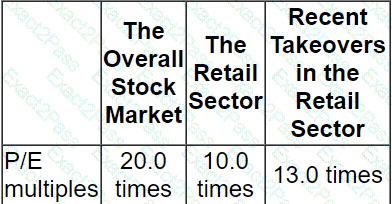
Which of the following is a reasonable expectation of the equity value in the event of an attempted takeover?
A company wishes to raise new finance using a rights issue to invest in a new project offering an IRR of 10%
The following data applies:
• There are currently 1 million shares in issue at a current market value of $4 each.
• The terms of the rights issue will be $3.50 for 1 new share for 5 existing shares.
• The company ' s WACC is currently 8%.
What is the yield-adjusted theoretical ex-rights price (TERP)?
Give your answer to 2 decimal places.
$ ?
Company H is considering the valuation of an unlisted company which it hopes to acquire.
It has obtained the target company ' s financial statements.
Company H has been advised that the book value of net assets as shown in the financial statements of the target company does not provide a reliable indicator of their true value.
Advise the Board of Directors which of the following THREE statements are disadvantages of the net asset basis of valuation?
A company plans to cut its dividend but is concerned that the share price will fall. This demonstrates the _____________ effect
Which THREE of the following are likely to be strategic reasons for a horizontal acquisition?
G purchased a put option that grants the right to cap the interest on a loan at 10.0%. Simultaneously, G sold a call option that grants the holder the benefits of any decrease if interest rates fall below 8.5%.
Which THREE possible explanations would be consistent with G ' s behavior?
A company is considering a divestment via either a management buyout (MBO) or sale to a private equity purchaser. Which of the following is an argument in favour of the MBO from the viewpoint of the original company?
A company is currently all-equity financed with a cost of equity of 9%.
It plans to raise debt with a pre-tax cost of 3% in order to buy back equity shares.
After the buy-back, the debt-to-equity ratio at market values will be 1 to 2.
The corporate income tax rate is 25%.
Which of the following represents the company ' s cost of equity after the buy-back according to Modigliani and Miller ' s Theory of Capital Structure with taxes?
H Company has a fixed rate load at 10.0%, but wishes to swap to variable. It can borrow at LIBOR 8%.
The bank is currently quoting swap rates of 3.1% (bid) and 3.5% (ask).
What net rate will HHH Company pay if it enters into the swap?
A company is currently all-equity financed with a cost of equity of 8%.
It plans to raise debt with a pre-tax cost of 4% in order to buy back equity shares.
After the buy-back, the debt-to-equity ratio at market values will be 1 to 2.
The corporate income tax rate is 30%.
Which of the following represents the company ' s cost of equity after the buy-back according to Modigliani and Miller ' s Theory of Capital Structure with taxes?

