Exact2Pass

We have coached hundreds of senior management accountants, corporate treasury analysts, and strategic finance directors through this final, high-stakes financial tier of the professional qualification. Let's look closely at the modern corporate governance training landscape. The candidates who stumble on this advanced-level evaluation are almost always those who relied on low-tier test pools—those flat, context-stripped answer repositories floating around unverified accounting forums. Those static, unverified materials simply cannot prepare you for the complex real-world investment appraisals or the multi-layered risk management trade-offs tested on the real exam. At Exact2Pass, our approach targets the underlying structural logic, capital frameworks, and risk-mitigation lifecycles of the active CIMA body of knowledge instead. Our F3 exam questions prep delivers comprehensive methodological breakdowns for every capital structure calculation and corporate restructuring scenario. You will master actual core treasury allocations instead of leaning on short-sighted memorization shortcuts. We map out Modigliani-Miller dividend irrelevance proofs, expected value decision trees, business valuation modeling methodologies, and currency swap mechanics step by step. Our learning material is built from the ground up by active Chief Financial Officers and chartered management architects who orchestrate multi-million dollar corporate strategies daily. Because of that, we completely avoid mindless, repetitive question-and-answer lists. Instead, our workspace functions as an active training simulation that forces you to evaluate corporate performance, optimal capital blend limits, and risk thresholds like a principal financial controller. You will learn the exact reason why a specific capital allocation choice or derivative hedging policy succeeds or violates corporate compliance rules. That is how you build real confidence before logging into your official Pearson VUE dashboard to clear this objective test. Our adaptive training software develops deep, practical fiscal skills that transfer perfectly to live boardrooms, helping you pass on your very first try.
A government is currently considering the privatisation of the national airline. The shares are to be offered to the public via a fixed price Initial Public Offering (IPO).
Which THREE of the following statements are correct?
The financial assistant of a geared company has prepared the following calculation of the company ' s equity value:


Useful information;
• Tax rate - 20%
• Cost of equity = 12%
• Weighted average cost of capital (WACC)« 10%
" Debt finance of the company comprises a $6 million 7% undated bond trading at par Valuation workings.
Which of the following errors has been made by the financial assistant?
If a company ' s bonds are currently yielding 8% in the marketplace, why would the entity ' s cost of debt be lower than this?
WX, an advertising agency, has just completed the all-cash acquisition of a competitor, YZ. This was seen by the market as a positive strategic move byWX.
Which THREE of the following will WX ' s shareholders expect the company ' s directors to prioritise following the acquisition?
A financial services company reported the following results in its most recent accounting period:
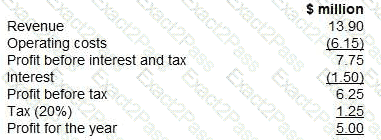
The company has an objective to achieve 5% earnings growth each year. The directors are discussing how this objective might be achieved next year.
Revenues have been flat over the last couple of years as the company has faced difficult trading conditions. Revenue is expected to stay constant in the coming year and so the directors are focussing efforts on reducing costs in an attempt to achieve earnings growth next year.
Interest costs will not change because the company ' s borrowings are subject to a fixed rate of interest.
What operating profit margin will the company have to achieve next year in order to just achieve its 5% earnings growth objective ' ?
Which THREE of the following statements are disadvantages of the net asset basis of valuation?
A manufacturing company based in Country R. where the currency is the R$, has an objective of maintaining an operating profit margin of at least 10% each year
Relevant data:
• The company makes sales to Country S whose currency is the SS It also makes sales to Country T whose currency is the T$ " All purchases are from Country U whose currency is the US.
• The settlement of an transactions is in the currency of the customer or supplier
Which of the following changes would be most likely to help the company achieve its objective?
Listed company R is in the process of making a cash offer for the equity of unlisted company S.
Company R has a market capitalisation of $200 million and a price/earnings ratio of 10.
Company S has a market capitalisation of $50 million and earnings of $7 million.
Company R intends to offer $60 million and expects to be able to realise synergistic benefits of $20 million by combining the two businesses. This estimate excludes the estimated $8 million cost of integrating the two businesses.
Which of the following figures need to be used when calculating the value of the combined entity in $ millions?
A company has stable earnings of S2 million and its shares are currently trading on a price earnings multiple {PIE) of 10 times. It has10 million shares in issue.
The company is raising S4 million debt finance to fund an expansion of its existing business which is forecast to increase annual earnings straight away by 25% and then remain at that level for the foreseeable future. The corporation tax rate is 20%. It is expected that the P/E will reduce to 8 times over the next year.
What is the most likely change in shareholder wealth resulting from this plan?
ADC is planning to acquire DEF in order to benefit from the expertise of DEF ' s owner ‘managers Both are Listed companies. ADC is trying to decide whether to offer cash or shares in consideration for DEF ' s shares.
Which THREE of the following are advantages to ABC of offering shares to acquire CEF?

